

TLF Apparel is a legitimate athletic and lifestyle apparel brand, not a scam brand. For a 2026 purchase, the separate questions are whether you are buying from the correct website, whether the item suits your training, and whether you accept the current checkout and return terms.
- Is TLF Apparel legit or a scam? It is a legitimate activewear brand; verify the website before paying.
- Brand legitimacy does not guarantee your preferred fit, delivery timing, or return eligibility.
- Check product-specific sizing, current policies, and detailed customer feedback before your first order.
- An unfamiliar advertisement deserves a website check, not an automatic verdict about the brand.
Is TLF Apparel legit or a scam?
TLF Apparel is a Miami, Florida-based athletic and lifestyle apparel brand offering men's and women's training clothing, everyday essentials, and streetwear. Its stated focus is Gym-To-Street(R) apparel: clothing intended to connect your training wardrobe with everyday wear.
The brand's website is TLF Apparel. Start there rather than trusting the destination behind an unfamiliar advertisement, message, or search result.
TLF Apparel is best for shoppers seeking activewear and lifestyle clothing in the same wardrobe. That describes its category and intended buyer, not a promise that every garment fits every body or training session.
For a 2026 buying decision, separate evidence about the business from evidence about your potential order:
| Question | Relevant evidence | What it does not establish |
|---|---|---|
| Is this an identifiable brand? | Named business, stated location, and an apparel catalog | The outcome of an individual order |
| Does it offer training clothing? | Leggings, sports bras, shorts, tanks, and performance tops | Suitability for every exercise |
| Does it offer everyday clothing? | Joggers, sweatpants, hoodies, and graphic tees | Your preferred fit or fabric feel |
| Is this particular listing suitable? | Item description, measurements, construction details, and care instructions | A universal sizing rule across the catalog |
| Should you complete this purchase? | Current terms, delivery information, and your own requirements | A guarantee against dissatisfaction |
The business description and catalog support the legitimacy verdict. They are not independent evidence of delivery performance, customer-service outcomes, or how a garment behaves after repeated wear.
Why this matters
A legitimacy question often bundles together concerns that need different answers. You might be asking whether the company exists, whether a social advertisement is authentic, or whether the leggings you want will fit.
Those are different decisions. A real brand can sell a garment that does not suit you, while an unfamiliar link can misuse a real brand's identity.
For your 2026 order, judge the seller, the item, and the transaction separately. This prevents a convincing product photograph from doing the work of a website check, and it prevents a sizing complaint from becoming an unsupported accusation of fraud.
Buy because the item and terms meet your needs—not simply because the business is real.
How do you check the website before ordering?
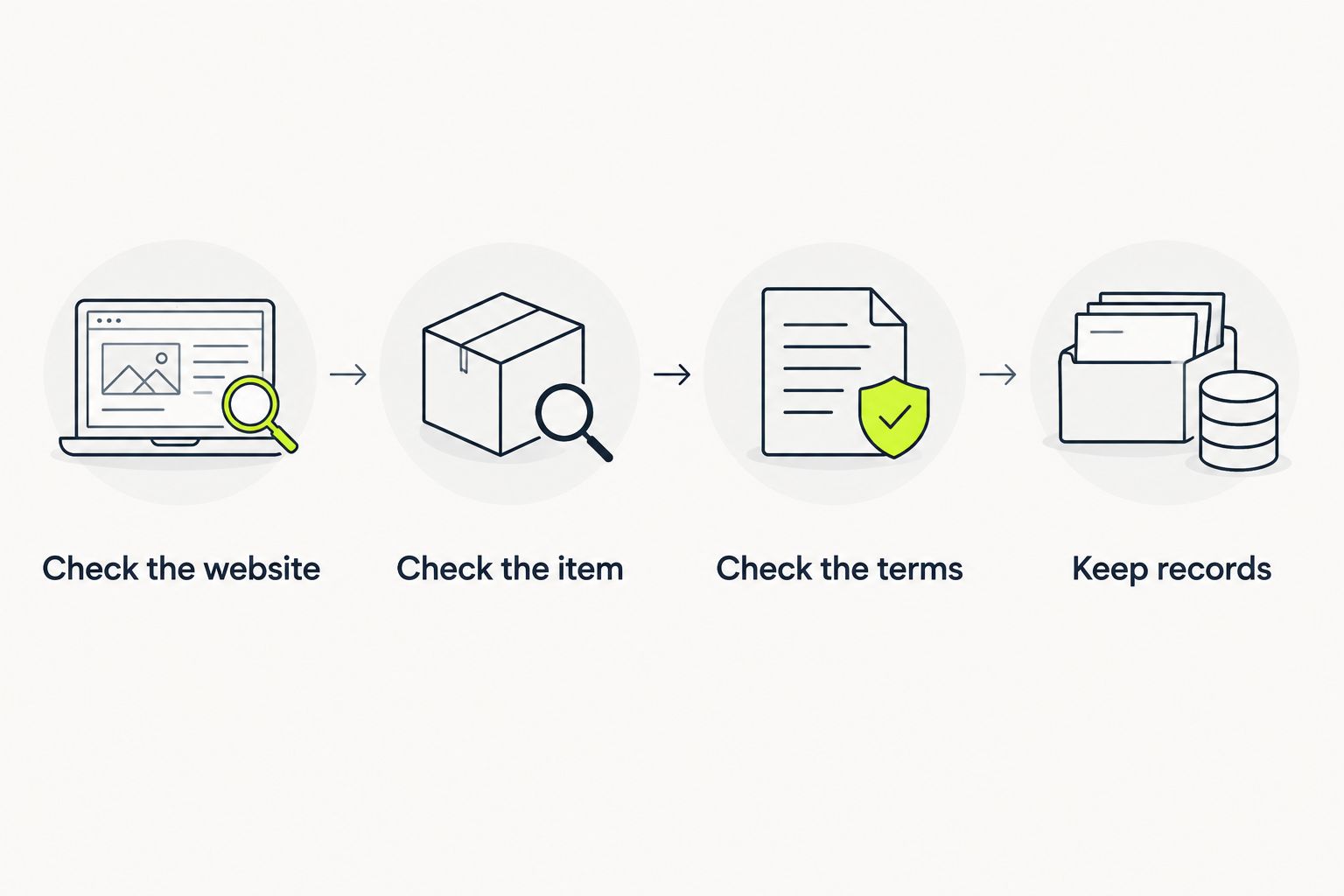
Use a short sequence before entering payment information. Each step answers a different question, so do not substitute a familiar logo for checking the actual destination.
- Check the website. Compare the address with the brand's website linked above. Read the address itself rather than relying on the page title or artwork.
- Check the item. Open the exact garment and read its description, sizing information, and care instructions. Confirm that the selected variation matches what you intend to order.
- Check the terms. Read the current delivery and return information that applies to your order. Resolve any uncertainty before paying.
- Keep records. Save the confirmation and relevant item details. Use those records if you need to ask about the purchase later.
A secure connection is necessary, but it does not answer every trust question. Treat it as a connection check, not proof that the seller will meet your expectations.
If a message asks you to pay somewhere unfamiliar, stop and return to the brand's website independently. Do not use the message itself as your only route back to the seller.
What product details actually help you judge the clothing?
Specific garment information is more useful than broad claims about quality. Look for details you can compare with your measurements, your existing clothes, and the way you train.
For example, the TLF Swole Tee in black has supplied product information identifying Cotton Luxe DNA(TM) fabric. Its model reference lists Seth at 5 feet 11 inches tall and 183 pounds, wearing a size large.
Those details give you a starting point. They do not establish your size, the garment's finished measurements, or how closely your proportions match the model's.
Use the information in this order:
- Your measurements: Compare your body measurements with the item-specific sizing guidance.
- Your preferred silhouette: Decide whether you want a close fit, extra room, or space for layering.
- Your intended activity: Consider the movement and coverage you need during your actual workout.
- Construction details: Read about seams, closures, pockets, and other features relevant to your choice.
- Care instructions: Check whether the garment's care requirements suit your routine.
A model's height and weight help you interpret a photograph. A size label alone cannot tell you how the shoulders, waist, rise, or length will sit on your body.
The same rule applies throughout the catalog: use the exact item's information rather than transferring assumptions from another garment.
What are the strengths and limits of the brand's offering?
The clear strength is its stated combination of performance apparel and everyday clothing. You can consider training pieces alongside lifestyle categories without treating every purchase as strictly gym-only.
Its catalog includes both men's and women's apparel, with categories spanning fitted training clothing and roomier everyday styles. That breadth is relevant if your wardrobe needs to cover workouts and time outside the gym.
The limitation is that category breadth does not answer item-level questions. A sports bra's suitability depends on its construction and your support requirements; a hoodie's appearance does not establish how comfortable you will find it during training.
For a 2026 purchase, weigh these advantages and boundaries together:
| Buying consideration | Useful strength | Limit to keep in mind |
|---|---|---|
| Training-to-everyday wardrobe | The brand explicitly serves both uses | Each item still needs an activity-specific check |
| Choice of silhouettes | The catalog spans fitted and relaxed categories | Different cuts require separate fit decisions |
| Fabric information | Product descriptions identify proprietary fabrics | A fabric name alone does not prove a performance result |
| Model references | Height, weight, and worn size provide context | Your proportions and fit preferences remain different |
The practical advantage is choice across training and lifestyle clothing; the practical responsibility is checking each garment. Neither point requires assuming that every product performs identically.
Why shopping experiences vary
Different shoppers can reach different conclusions without either account establishing fraud. Their orders, expectations, and fit requirements are not necessarily alike.
When reading feedback in 2026, distinguish these factors:
- Garment category: Feedback about an everyday top does not establish sports-bra support or leggings coverage.
- Cut and silhouette: A relaxed style and a fitted style answer different wardrobe needs.
- Body proportions: Height and weight do not fully describe torso length, inseam, shoulder width, or waist-to-hip proportions.
- Intended use: Lounging, lifting, and running create different requirements for movement and coverage.
- Order-specific terms: Your decision depends on the conditions presented for your purchase, not another shopper's assumptions.
- Care routine: Evaluate a durability complaint alongside the garment's stated care instructions and the reviewer's description of use.
These are reasons to read feedback carefully, not excuses to dismiss complaints. A detailed account of a problem deserves attention, particularly when it explains the item, circumstances, and response received.
How should you read customer reviews?
Read for information you can use. A review that explains sizing, activity, and garment behavior helps more than an enthusiastic verdict with no detail.
For fit feedback, look for the purchased size, the reviewer's measurements where provided, and the fit they wanted. Someone seeking a loose silhouette can dislike the same cut that another shopper chooses deliberately.
For service feedback, distinguish the original issue from the eventual outcome. A complaint about a delayed parcel, a wrong item, and a disputed return involves different evidence and different next steps.
Check the date, too. For a 2026 purchase, current item information and recent, specific feedback are more useful than an undated comment about an unidentified garment.
Do not assume a review badge answers every question. Read any explanation of how reviews are collected and labeled, then assess the content of the review itself.
Look for a specific, relevant pattern—not a single dramatic comment or a wall of generic praise. Do not turn either into a claim about every order.
Does a sizing problem mean you were scammed?
A sizing problem alone does not establish a scam. It establishes that the garment did not fit as expected; the next questions concern the listing information and the applicable resolution process.
Compare what you received with the ordered variation and the description you relied on. Keep photographs and order records if something differs, and explain the discrepancy precisely when requesting help.
Avoid wearing or washing an item before checking the conditions that apply to a potential return. Do not assume that trying something on, removing tags, or using it leaves every resolution option unchanged.
Does a late parcel mean the seller is fraudulent?
A late parcel alone does not establish fraud. Compare the order information with any tracking updates, then ask the seller about the specific discrepancy.
Keep the confirmation, dates, and correspondence together. If the issue remains unresolved, consult your payment provider's applicable dispute process rather than assuming a particular remedy or deadline.
An unexplained transaction deserves a different response from a documented order that is taking longer than expected. Describe what happened accurately so the party helping you can address the right problem.
Should you place a first order?
Place an order only when you understand the item and accept the current terms. Brand recognition is not a reason to overlook a sizing question or a delivery requirement you have not resolved.
Choose a garment for a clear use in your existing wardrobe. Check it against something you already wear comfortably, especially when you are trying an unfamiliar cut.
If you cannot determine whether an item suits you, ask a specific question before purchasing. Request the information you need rather than asking for a general promise that you will like it.
That approach gives your first purchase a useful purpose: evaluating a particular garment against your own requirements. It avoids treating an entire brand as either perfect or fraudulent based on a single fit decision.
FAQ
Is TLF Apparel legit or a scam in 2026?
TLF Apparel is a legitimate athletic and lifestyle apparel brand. Verify that you are using the correct website, then check the exact item's sizing and the current transaction terms before ordering.
Does being a legitimate brand guarantee that the clothes will fit?
No, brand legitimacy does not guarantee fit. Compare your measurements with the specific item's sizing guidance and account for the silhouette you want.
Can I trust an advertisement just because it uses the brand's logo?
No, a logo alone does not authenticate an advertisement or its destination. Check the website address independently before entering personal or payment information.
What should I check before buying gym clothes online?
Check the seller, item description, sizing guidance, care instructions, and current delivery and return terms. Keep the order confirmation and relevant purchase details afterward.
Does a model wearing a large mean I should order a large?
No, a model's worn size is a reference rather than a personal sizing recommendation. Your proportions and preferred fit still determine which size suits you.
Does a negative review prove that a clothing brand is a scam?
No, a negative review alone does not prove fraud. Read the specific issue, supporting details, and resolution before drawing a broader conclusion.
What should I do if my clothing order has a problem?
Keep your order records and contact the seller with a precise description of the problem. If it remains unresolved, check the applicable process with your payment provider.
One last thing
The best final check is whether you can explain what you are buying and what happens if it is unsuitable. Know the garment, selected variation, sizing basis, and applicable terms before you pay.
For your 2026 purchase, save those details with the confirmation. A clear record helps you distinguish a fit preference, a listing discrepancy, and an order problem without relying on memory.


