

Yes, a front-clasp sports bra can handle high-impact workouts when the complete design controls movement through a firm underband, supportive cups, secure straps, and a closure that stays flat under tension. The clasp alone does not establish the support level, so confirm that the bra is intended for running, HIIT, or other high-impact training before wearing it for those activities in 2026.
- Can a front clasp sports bra handle high impact workouts? Yes, if the bra is explicitly built for high impact.
- TLF Apparel offers the Tempo Front Clasp Bra, but closure style alone does not confirm its support level.
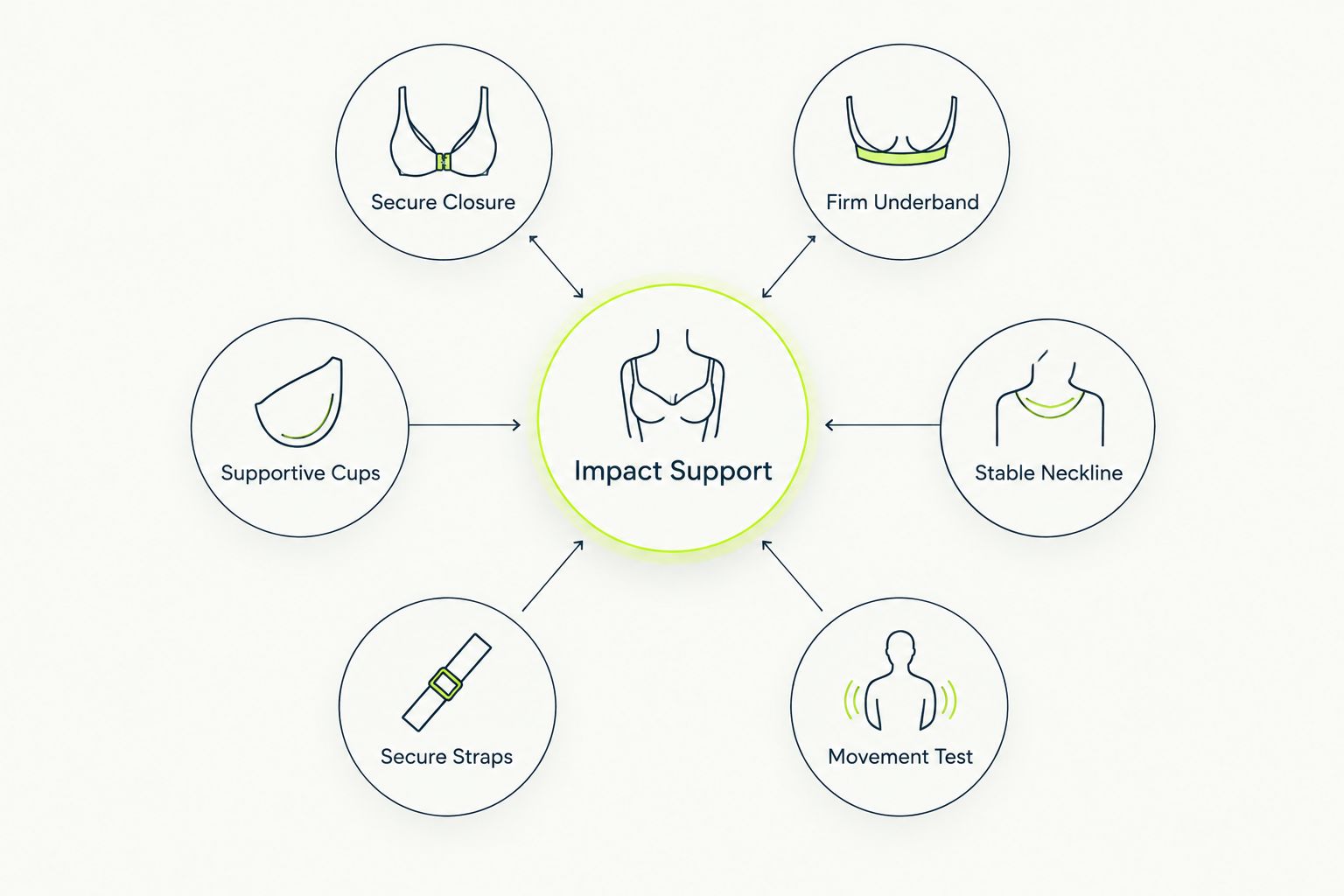
- For running and HIIT, prioritize supportive cups, a firm underband, secure straps, and a stable front closure.
- Skip any front-clasp bra that shifts, gaps, rubs, or needs adjustment during a movement test.
Why this matters
Front access is convenient when pulling a tight sports bra over your head is uncomfortable or difficult. It also makes removal easier after a sweaty session. Neither benefit tells you whether the bra controls movement during running, jumping, or rapid direction changes.
The Tempo Front Clasp Bra gives TLF Apparel shoppers a named front-closure option to assess. Its product name confirms the closure style, but you still need the current product details and your own fit test to determine whether it matches your workout intensity.
The TLF Apparel Tempo Front Clasp Bra is best for shoppers who want front access, but its clasp alone does not prove high-impact support. That distinction prevents you from treating every front-fastening bra as interchangeable in 2026.
Can a front-clasp sports bra handle high-impact workouts?
A front-clasp sports bra can handle high-impact workouts if the entire bra is designed for that use. Look beyond the fastening system and assess how the cups, band, straps, neckline, side panels, and closure work together.
| Sports Bra Construction | Best For | Main Advantage | Main Limitation | Verdict |
|---|---|---|---|---|
| Front clasp with supportive cups and a firm band | Running, HIIT, court drills | Easy to put on and remove | Closure must stay stable under tension | Consider |
| Pullover racerback with firm compression | Jumping, lifting, mixed training | No front hardware | Harder to remove when sweaty | Consider |
| Adjustable back closure with supportive cups | Activities requiring precise band adjustment | Band tension can be changed | Back hardware can feel noticeable | Consider |
| Light compression bra with a front clasp | Walking, stretching, everyday wear | Easy access and a softer feel | Not enough structure for repeated impact | Skip for high impact |
The table shows why closure type is not a support rating. A pullover can be too light for running, while a structured front-clasp design can remain stable. The use case comes from the complete construction and the fit on your body.
In 2026, treat any unsupported claim such as workout-ready or performance-inspired as incomplete. The useful product detail is an explicit support or activity designation paired with construction that remains stable when you move.
How to tell whether a front-clasp bra is ready for impact
Start with the product description, then verify the fit at home before committing to a full session. A high-impact label is useful, but your movement test catches sizing problems that a label cannot.
Check the closure
Fasten the bra and inspect the clasp while standing naturally. It should sit flat rather than pulling forward, twisting, or creating a visible gap between the cups. Move your arms overhead and across your body; the closure should remain in the same position.
A clasp that opens, rotates, pinches, or carries all the tension is a stop sign. The surrounding fabric and cup structure should distribute the load instead of forcing the hardware to do all the work.
Check the underband
The underband is the foundation of sports-bra support. It should stay level around your torso without riding up your back, folding under the bust, or sliding when you raise your arms.
A looser band is not automatically more comfortable during impact. If it shifts, the cups and straps have to compensate, which usually leads to bouncing, shoulder pressure, or repeated adjustments.
Check the cups and neckline
Supportive cups should contain the breast tissue without spilling, cutting in, or leaving empty space. The neckline should remain stable when you bend forward and return upright.
Compression can reduce movement by holding tissue closer to the chest. Encapsulation uses separate cup structure to control each side. Some high-impact bras combine both approaches, but the front clasp does not tell you which construction is present.
Check the straps
The straps should stay on your shoulders without digging in or slipping. Adjustable straps help you correct the fit, but tightening them cannot repair an underband that is too loose or cups that do not contain the tissue.
Crossed and racerback straps can feel secure during rapid movement. Straight straps can also work when the rest of the design provides enough control. Judge the complete fit, not the strap shape in isolation.
Run a movement test
Wear the bra with the top you normally use for training. Perform the movements your workout requires: jog in place, raise your arms, rotate your torso, bend forward, and complete controlled jumps if those movements are safe for you.
Stop if the band rides up, the clasp shifts, the cups gap, breast tissue spills, or the straps require correction. A bra that needs adjustment during a short test will not become more stable once the session gets faster or sweatier.
Front clasp vs. pullover: which is better for high impact?
Neither construction wins for every athlete. A front-clasp sports bra wins on access, while a pullover removes the front fastening point. Both can work for high impact when the band, cups, and straps match the activity and fit correctly.
| Decision Factor | Front Clasp | Pullover |
|---|---|---|
| Best For | Easier dressing and removal | Simple construction without front hardware |
| Access | Opens at the front | Pulls over the head |
| Adjustment | Depends on the specific design | Depends on the specific design |
| Main Risk | Unstable or uncomfortable closure | Difficult removal or excessive compression |
| What To Verify | Clasp security under movement | Stretch recovery and band stability |
Choose a front clasp if access is your priority and the bra passes the movement test. Choose a pullover if you prefer fewer components and can remove it comfortably after training. Skip either style when the product is intended only for low-impact use.
TLF Apparel also carries sports bras with other neckline and strap constructions. Comparing those options alongside a front-clasp design helps you separate the access decision from the support decision.


Why front-clasp sports bra support varies
A bra can feel secure during lifting and unstable during sprint intervals. Impact level changes with the movement, while fit changes with sizing, adjustment, and fabric condition.
- Workout movement: Running and jumping repeatedly load the bra differently from controlled resistance training.
- Cup fit: Gapping, spilling, or a floating center section indicates that the cup shape or size is wrong.
- Band fit: A band that rides up cannot provide a stable base for the cups.
- Strap position: Slipping straps reduce control, while overtightened straps transfer pressure to your shoulders.
- Closure design: The clasp must remain flat, secure, and comfortable through your full range of motion.
- Wear condition: Stretched fabric, damaged hardware, and changed band tension can reduce the stability you had when the bra was new.
Fit also varies between bodies with similar measurements. Weight or height alone cannot determine the correct sports-bra size because bust measurement, torso shape, cup volume, and preferred compression all affect the result.
TLF Apparel product data illustrates the point. The NeoCloud™ V-Neck Sports Bra lists a model at 5 feet 8 inches, 118 pounds, and a 32B bust wearing XS. The Cosmic Seamless Square Neck Sports Bra lists a model at 5 feet 7 inches, 128 pounds, and a 32DD bust wearing medium.
Another TLF Apparel listing for the Tempo Multi-Back Strap Sports Bra includes two models at 128 pounds wearing different sizes. Use model references as context, not as a substitute for the current size chart and your own movement test.
Can you run in a front-clasp sports bra?
Yes, you can run in a front-clasp sports bra when the manufacturer identifies it for running or high-impact activity and the fit stays stable during a running-specific test. Do not run in it solely because the clasp feels secure while standing still.
Test for vertical movement, band ride-up, shoulder pressure, and rubbing around the closure. Your running bra should remain comfortable as your torso rotates and your arms move repeatedly.
Is a front-clasp sports bra good for HIIT?
A front-clasp sports bra is good for HIIT when it controls movement through jumps, rapid transitions, and changes of direction. The clasp must stay flat while the band and cups maintain their position.
HIIT exposes weak fit quickly. If you have to adjust the neckline, straps, or closure between movements during your test, choose a different size or construction for that session in 2026.
Can a front-clasp sports bra work for a larger bust?
Yes, a front-clasp sports bra can work for a larger bust when it provides the cup containment, band stability, strap adjustment, and closure security your body needs. Front access neither guarantees nor prevents that support.
Prioritize the available size range and the relationship between band and cup sizing. A generic small, medium, or large system gives you less information than defined band and cup measurements when your proportions fall outside the brand's standard fit model.
Should you size down for more support?
No, sizing down is not a reliable way to create high-impact support. A smaller bra can compress more while causing spillover, restricted breathing, clasp strain, or shoulder pressure.
Use the current brand size chart, then test the recommended size through your actual training movements. If one area fits and another does not, change the size or construction instead of forcing the clasp shut.
FAQ
Can a front clasp sports bra handle high impact workouts?
Yes, a front-clasp sports bra can handle high-impact workouts when the complete design is intended for high impact and fits securely. The band, cups, straps, and closure must remain stable during running, jumping, and rapid direction changes.
What makes a front-clasp sports bra supportive?
A firm underband, supportive cups, secure straps, adequate coverage, and a stable closure make a front-clasp sports bra supportive. The clasp provides access, but it does not create support by itself.
Can I wear a front-clasp sports bra for running?
Yes, you can wear one for running if it is designated for running or high-impact training and passes a movement test. Skip it if the band rides up, the closure shifts, or the cups gap.
Is a front-clasp bra better than a pullover sports bra?
A front-clasp bra is better for easy dressing and removal, while a pullover eliminates front hardware. Either can support high-impact exercise when its complete construction fits correctly.
Why does my front-clasp sports bra open during exercise?
A front-clasp bra can open when the closure is damaged, improperly fastened, poorly positioned, or carrying tension created by an incorrect fit. Stop wearing it for impact workouts until the cause is corrected.
Should a front-clasp sports bra feel tight?
It should feel firm and secure without restricting breathing, pinching, or forcing breast tissue outside the cups. The band should stay level while the clasp lies flat.
How do I test a sports bra before a high-impact workout?
Recreate the movements in your workout, including arm raises, torso rotation, jogging, and controlled jumps when safe. Reject the fit if the band, cups, straps, or closure shift during the test.
Does a front closure mean a sports bra is high support?
No, a front closure does not mean a sports bra is high support. Check the stated support level, intended activities, cup construction, band design, and fit instead.
One last thing
Test the bra later in the day if that is when you usually train. Your preferred band tension can feel different after meals, hydration, travel, or a full day of movement, and a fit that works in the morning may not be the fit you want for an evening session.
For 2026, use one rule: a front clasp is an access feature, not a support rating. Buy the bra only when its intended activity, complete construction, and movement-test result all match your workout.


