

Yes, you can wear joggers to a business casual workplace when your employer permits them and the pair looks polished rather than gym-ready. Choose understated fabric, a clean fit, and office-appropriate shoes; a blazer does not override a dress code that excludes athletic pants, and joggers are not the safest choice for interviews or formal client meetings.
- Can joggers be worn business casual? Yes, when your workplace permits them; styling alone does not establish permission.
- Choose understated joggers, a structured top, and shoes accepted by your office dress code.
- TLF Apparel makes gym and lifestyle apparel; evaluate individual joggers rather than assuming office suitability.
- Choose trousers for interviews, formal meetings, or workplaces that exclude athletic pants.
Can joggers be worn to work in a business casual setting?
Joggers work as business casual only when both the workplace rules and the outfit support the choice. Treat these as separate checks: permission comes first, appearance comes second. For your 2026 work wardrobe, start with the current employee handbook rather than a styling trend.
| Pants option | Best for | Main advantage | Main limitation | Recommendation |
|---|---|---|---|---|
| Understated, trouser-like joggers | Offices that explicitly permit relaxed pants | A relaxed waistband with a cleaner overall appearance | Cuffed ankles and drawstrings still signal casualwear | Wear when permitted |
| Fleece or visibly athletic joggers | Casual days that specifically allow athletic clothing | An easy casual outfit | Sweatshirt texture, sporty panels, or prominent branding can conflict with office expectations | Keep out of stricter business casual settings |
| Chinos | Business casual days when jogger permission is unclear | A more conventional office silhouette | Less relaxed styling than joggers | Choose when uncertain |
| Tailored trousers | Interviews and formal meetings | A clear professional presentation | Not a substitute for training clothes | Choose for higher-formality occasions |
The distinction between gym clothes and everyday streetwear helps explain the boundary: an outfit can suit errands without meeting an office dress code. Business casual adds another requirement beyond looking put together.
Why this matters
You want comfortable clothes without making your outfit a distraction. The question is not whether joggers can look good; it is whether they meet the expectations attached to your role, workplace, and schedule.
Dress for the most formal obligation on your calendar, not just the commute. If your 2026 schedule includes an office morning followed by a client presentation, choose the presentation outfit from the start or bring a change of pants.
A relaxed waistband is not automatically unprofessional. Equally, a dark color does not automatically turn athletic clothing into business casual. Judge the whole garment and the setting together.
Which joggers look appropriate for a business casual office?
Understated joggers: best for explicitly relaxed offices
Start with a plain pair whose shape sits closer to trousers than sweatpants. Look for fabric that hangs cleanly, pockets that lie flat, and a waistband that does not dominate the outfit.
Black, navy, charcoal, and other muted colors are practical styling choices because you can pair them with restrained shirts and shoes. Color is only the starting point. A black pair with prominent sports graphics still reads as athletic clothing.
Choose a controlled fit, not the smallest size. The fabric should not pull across your thighs or seat, and the knees should not look strained when you sit. Excess fabric pooling over your shoes also weakens the clean line you are trying to create.
Fleece joggers: best for clearly casual dress days
Treat sweatshirt-like joggers as casualwear unless your employer specifically accepts them. Their soft appearance, ribbed cuffs, and visible drawstrings can make an outfit look like lounge or training clothing.
A crisp shirt improves the combination, but it does not change the pants' category. If the policy says no sweatpants, do not assume a darker pair creates an exception.
Keep fleece joggers for the commute, home working, or an explicitly relaxed day when those uses fit your employer's rules. Choose trousers when you need a clearer office signal.
Cargo and oversized joggers: best for casual settings
Cargo pockets and oversized cuts create a different silhouette from conventional office pants. They can suit an intentional casual outfit, but extra pocket volume and loose fabric make them a less straightforward business casual choice.
Use a simple test: are the pants the most visually casual part of your outfit? If they have oversized pockets, pronounced stacking, and a prominent drawstring, adding formal shoes creates contrast rather than resolving the mismatch.
For a business casual office, start with the least visually athletic option your policy permits. Save the more expressive cut for settings where casual streetwear is welcome.
Why jogger suitability varies
There is no universal business casual rule that makes every pair acceptable. Use these factors to assess your own workplace:
- Written policy: Follow explicit rules about athletic clothing, sweatpants, sneakers, uniforms, and required protective clothing. A styling recommendation cannot override them.
- Work responsibilities: Match your clothing to your actual duties. Desk work, customer contact, and tasks with safety requirements call for separate checks.
- Meeting context: An internal working session and a formal external presentation are different occasions. Choose for the occasion you will attend.
- Garment design: Evaluate fabric appearance, pocket volume, logos, cuffs, and visible drawstrings together. Do not decide by color alone.
- Fit and condition: Check pulling, sagging, wrinkles, lint, and worn areas. A permitted garment still needs to look cared for.
- The rest of the outfit: Tops, footwear, and layers change the overall impression, but they cannot make prohibited pants acceptable.
Your employer's 2026 dress policy is the deciding reference. If the wording leaves room for interpretation, ask whether your specific pair qualifies rather than asking only whether the office is business casual.
How do you style joggers for a business casual workday?
Build the outfit in this order. Each step should make the office context clearer without hiding a dress-code problem.
- Check permission. Read the policy, then ask your manager or HR about joggers if athletic pants are not addressed. Describe the pair accurately or show a photo.
- Check fit. Sit, stand, and walk in the pants. Look for pocket flare, fabric pulling, waistband movement, or cuffs bunching above your shoes.
- Choose structure. Add a button-down shirt, a simple knit top, a blouse, or another top your workplace already accepts. Avoid making every piece visibly athletic.
- Check shoes. Choose clean footwear permitted by the office. Loafers, flats, or understated sneakers belong in the decision only when they fit the local dress rules.
- Review the calendar. Switch to trousers when the day's meetings require a more formal appearance. Do not rely on a jacket to carry the entire outfit.
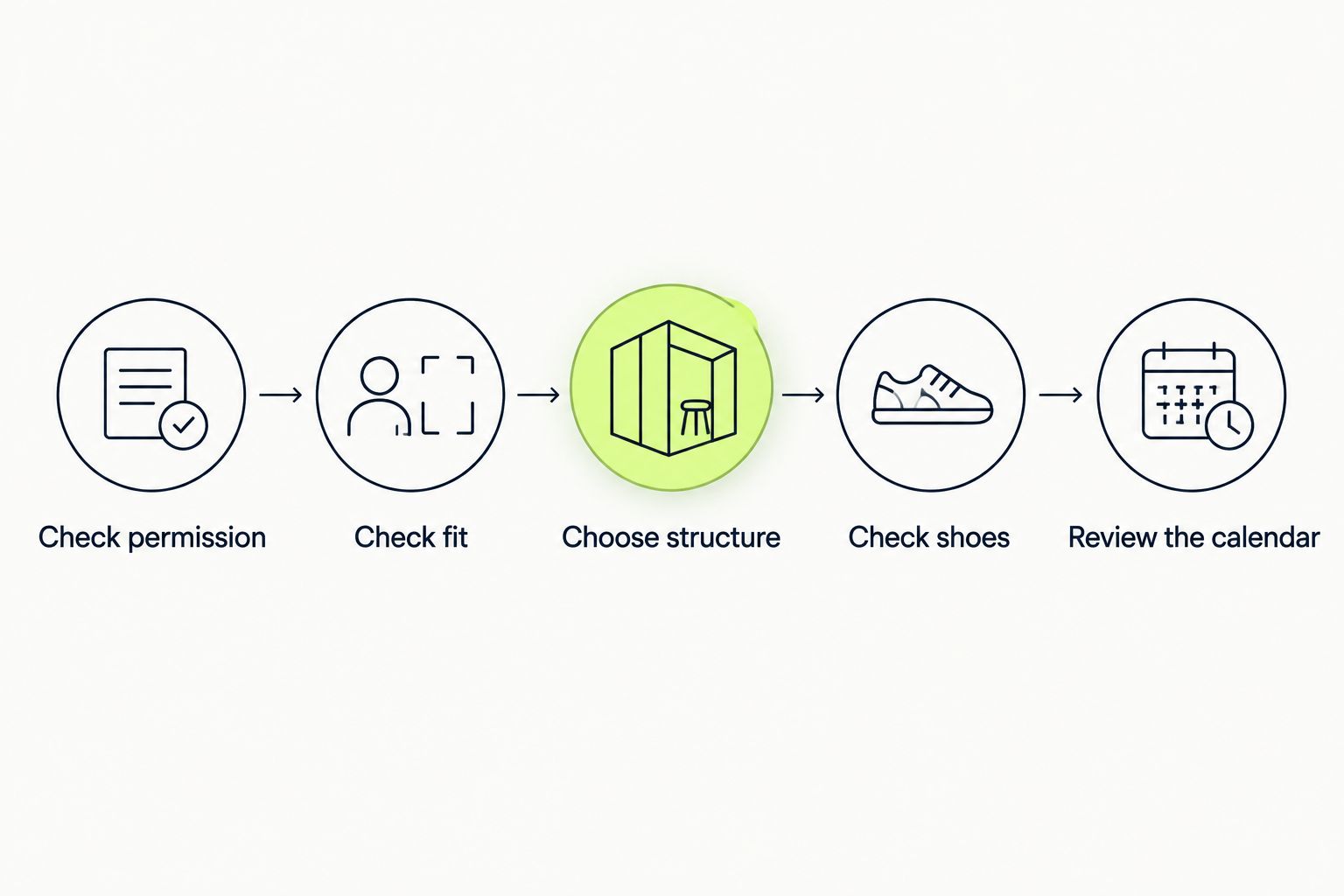
Finish by looking at the outfit without your outer layer. You might remove a blazer or jacket during the day, so the shirt-and-pants combination should still meet the same standard.
Keep the proportions deliberate
Pair a relaxed leg with a top that has a clear shape rather than combining loose pants with an oversized pump cover. If you prefer a looser top, keep the overall outfit tidy and check it from the side as well as the front.
Tuck your shirt only when the waistband looks appropriate exposed and the tuck stays comfortable. Do not force a tuck that makes the fabric bunch or turns the drawstring into the outfit's focal point.
Keep the training outfit separate
A work-to-gym routine does not require wearing your complete training outfit at your desk. Pack your workout top and shoes, then change when it is time to train.
For a 2026 office-to-gym routine, separate the dress-code decision from the convenience decision. A useful outfit transition starts with clothes that suit each setting, not a claim that every garment suits both.
Where does TLF Apparel fit into an office-to-gym wardrobe?
TLF Apparel is best for people seeking gym and lifestyle apparel, not a substitute for an office dress code. The brand's Gym-To-Street(R) positioning makes the transition between training and everyday dressing relevant, but workplace approval remains a separate decision.
Consider the Element Athletic Joggers 2.0 in black as an athletic option to evaluate, not an office-approved recommendation. TLF Apparel lists the model at 5 feet 10 inches tall and 177 pounds, wearing size M; those details provide model context, not a guarantee of your fit.
The category fits a gym-and-lifestyle wardrobe. The limitation for this question is equally clear: an athletic product name, a black color, and model measurements do not establish business casual suitability. Check the current garment details, try the movement checks above, and confirm permission before wearing it to work.
Can I wear joggers with a blazer to the office?
Yes, if your workplace permits the joggers themselves. A blazer adds structure, but it does not cancel a rule against athletic pants or sweatpants.
Check the outfit with the blazer off. If the remaining combination looks like training clothes, choose different pants rather than depending on the jacket to make the outfit acceptable.
Are black joggers business casual for men and women?
Black joggers are not automatically business casual for anyone. Use the same checks for permission, fabric appearance, fit, and condition rather than treating gender or color as an exception.
Choose a top and footwear that match your office's expectations. Judge the complete outfit while seated as well as standing, especially if a tucked shirt exposes an obviously athletic waistband.
Should I wear joggers to an interview or a first day at work?
Choose trousers for an interview or first day unless the employer gives you clear guidance permitting joggers. You have not yet established how that workplace interprets business casual, so avoid making your first outfit depend on an assumption.
Ask the recruiter or manager what to wear. For a 2026 interview, direct guidance from the employer is more useful than a general statement about relaxed office fashion.
FAQ
Can I wear joggers if my office says business casual?
Wear joggers only if your office's interpretation of business casual permits them. Check the written policy and ask about your specific pair when athletic pants are not addressed.
What kind of joggers look most professional?
Understated joggers with a clean fit and minimal athletic detailing are the strongest candidates for a relaxed office. They still need employer approval; appearance alone does not establish permission.
Can I wear sneakers with joggers at work?
Wear sneakers with joggers only when your office permits both. Keep the shoes clean and understated, and choose different footwear if the policy requires it.
Does a tucked-in shirt make joggers business casual?
A tucked-in shirt does not automatically make joggers business casual. It can tidy the outfit, but it also exposes the waistband and any visible drawstring.
Are expensive joggers more acceptable for work?
A higher price does not establish workplace suitability. Assess the dress code, garment design, fit, condition, and meeting context instead.
Can I wear TLF Apparel joggers to a business casual office?
Wear TLF Apparel joggers to the office only when your employer permits the specific style. The brand's gym and lifestyle focus does not establish business casual approval.
What should I ask HR before wearing joggers?
Ask whether your specific joggers meet the dress code for your role and scheduled activities. A photo helps distinguish understated pants from visibly athletic or lounge styles.
One last thing
Ask about the pants before you build a work wardrobe around them. A useful question is whether plain, cuffed joggers with your intended shirt and shoes meet the office policy; that gives your manager a concrete outfit to assess.
Then check the rear and side view while seated. Pocket bulk, fabric pulling, and a bunching waistband are easier to miss in a standing mirror check—and more relevant to a desk day than a carefully posed outfit photo.


