

Yes, you can wash matching gym sets together when both pieces have compatible care instructions and neither releases dye under those washing conditions. Matching colors alone do not guarantee protection against color bleeding, especially with new garments or contrasting trim. Follow both care labels, separate items that release dye, and keep whites out of colored loads.
- Matching gym sets washed together: color bleed remains possible, even when both pieces look identical.
- TLF Apparel activewear care starts with each garment’s label, not the fact that pieces coordinate.
- Wash compatible colors together; separate new garments that release dye.
- Cold water reduces risk but does not make a non-colorfast garment safe for mixed loads.
Can matching gym sets be washed together without color bleeding?
Yes, provided the care labels agree and the garments do not release dye. A matching set is a styling combination, not proof that its fabrics, dyes, trims, and washing requirements are identical.
For TLF Apparel gym sets, check the label on each piece rather than assuming that a coordinating top and bottom share one laundry routine. The same rule applies to every brand in your workout rotation.
Use this 2026 laundry decision table before combining your set with anything else:
| Laundry situation | Best for | Benefit | Limitation | Decision |
|---|---|---|---|---|
| Matching pieces with compatible labels and no observed dye transfer | Routine washing | Keeps compatible pieces in one load | Previous washes do not guarantee permanent colorfastness | Wash together with similar colors |
| New, deeply colored pieces with unknown washing history | First-wash caution | Limits exposure of other clothes to loose dye | Requires a separate wash | Wash separately initially |
| Colored pieces mixed with white or pale garments | Separating contrasting colors | Protects lighter items from transferred dye | Creates additional sorting | Separate the light items |
| Pieces with incompatible care labels | Garment-specific care | Respects each piece’s construction | The set needs different washing routines | Wash separately |
| A garment that leaves color on a damp white cloth | Isolating suspected dye release | Identifies an immediate reason for caution | A home check cannot certify colorfastness | Keep it out of mixed loads |
Why this matters
A coordinated outfit can lose its matching appearance without any dye transferring between garments. Uneven fading, different fabrics, and different wash histories can change how the pieces look next to each other.
Color bleeding is different: dye leaves one area and transfers elsewhere. Distinguishing bleeding from fading matters because adding a color-catching sheet will not correct abrasion, bleaching, or uneven exposure to sunlight.
Your goal is not simply to keep a top and bottom in the same machine. It is to give each garment compatible treatment while avoiding unnecessary exposure to loose dye.
How do you wash a matching gym set safely?
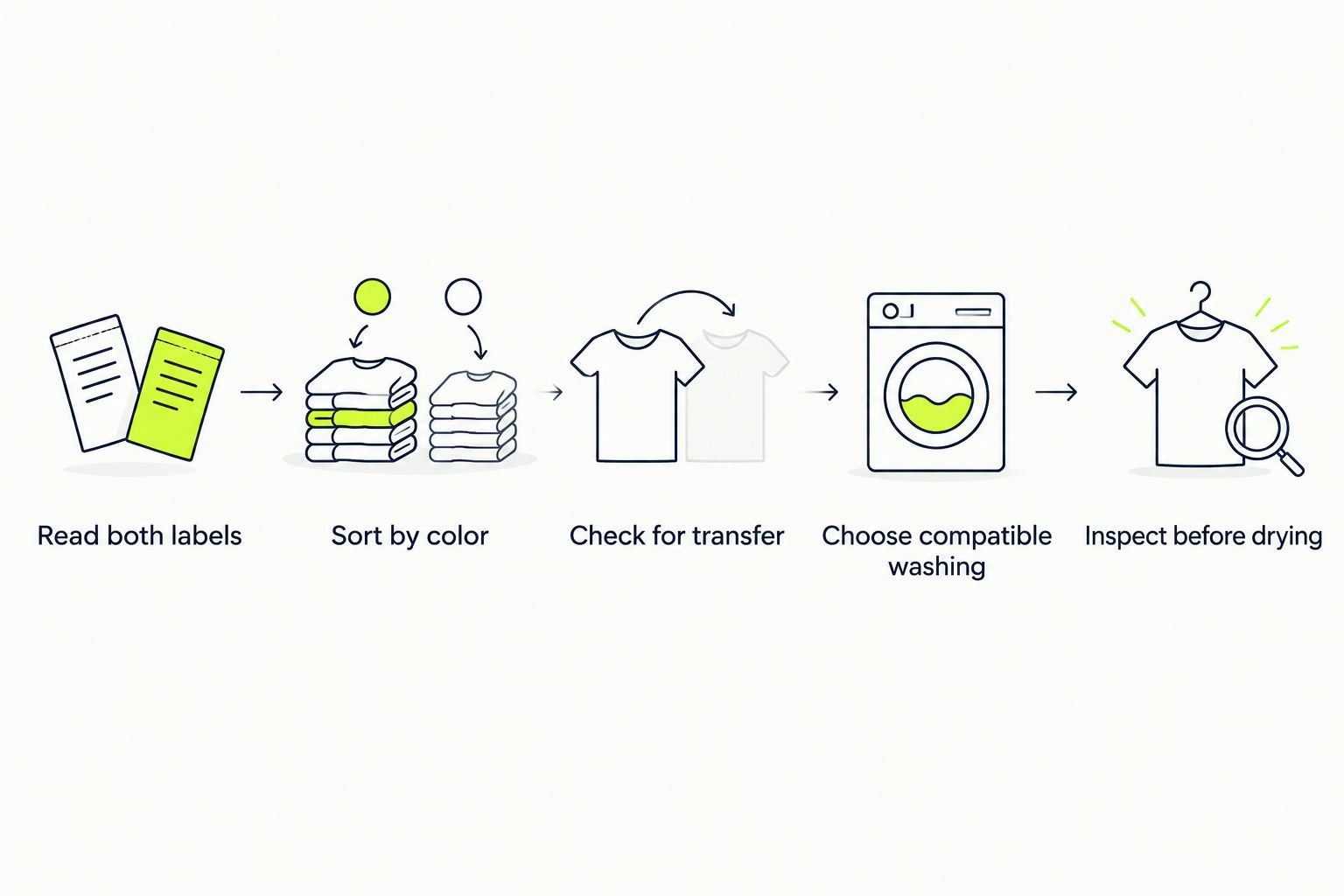
Use this sequence for your 2026 activewear routine. The garment label overrides a general laundry tip, including any recommendation to use a particular temperature or cycle.
1. Read both care labels
Check washing method, temperature, bleach restrictions, and drying instructions on every piece. A sports bra’s closures, removable components, or construction can require different handling from its coordinating leggings.
Do not combine a hand-wash-only item with a machine-washable item just because the fabrics feel similar. If the instructions conflict, separate the pieces rather than selecting a compromise that violates either label.
Temperature symbols describe limits, not promises about dye transfer. For example, a 30°C label corresponds to 86°F, while a 40°C label corresponds to 104°F; neither marking certifies that the garment will not bleed.
2. Sort by color and washing history
Separate whites and very pale garments from saturated colors. Keep a new, unwashed item apart from established laundry companions until you have checked its care instructions and observed how it behaves when washed.
A dark top and dark leggings are a more sensible grouping than a dark top and a white sports bra. Still, darkness alone is not proof of compatibility: a garment that releases dye belongs in a separate wash.
Do not treat a shared color name as a technical specification. Two pieces can look coordinated while using different materials or dye processes.
3. Check unfamiliar garments for transfer
If the care instructions permit wetting, dampen an inconspicuous area and gently press it with a clean white cloth. Visible color on the cloth is a reason to wash the garment separately.
A clean cloth is not a guarantee. A small home check does not reproduce detergent, agitation, temperature, and the full washing cycle, so keep following the label and sorting by color.
Avoid aggressive rubbing during the check. You are looking for obvious transfer, not trying to scrub dye from the fabric.
4. Choose a compatible wash routine
Use cold water when the labels permit it, together with a detergent suitable for the garments and your machine. Follow the detergent’s dosing instructions instead of adding extra detergent as insurance against bleeding.
Select the cycle the care instructions allow. A gentle cycle reduces mechanical action, but it does not prevent a non-colorfast garment from releasing dye into shared wash water.
Turn garments inside out where appropriate and secure closures. These steps help limit surface abrasion and snagging; they do not replace color separation.
5. Remove, inspect, and dry as directed
Take the set out when the cycle finishes rather than leaving colored and pale fabrics pressed together while wet. Inspect lighter areas, waistbands, and contrasting panels before drying.
If you see transferred color, do not tumble-dry the affected item before addressing the stain. Follow its care label and the instructions on a suitable treatment product; heat can make dye-transfer stains harder to remove.
Dry each piece according to its own label. Sharing a wash does not automatically mean sharing the same drying method.
Why color-bleeding risk varies
There is no universal safe-load formula for matching activewear. These factors explain why a combination that works for one set does not automatically work for another:
- Dye fixation: Dye that is not adequately fixed to the fabric can enter wash water and transfer to another garment.
- Fiber composition: Different fibers interact differently with dyes, so matching shades do not establish matching colorfastness.
- Washing conditions: Temperature, detergent, and mechanical action affect the washing environment. Respect the garment’s stated limits.
- Color contrast: Transferred dye is particularly noticeable on white and pale areas, including trim within an otherwise dark garment.
- Previous behavior: A history of visible transfer is a reason to keep an item separate, even if it belongs to a coordinated set.
- Wet contact: Leaving wet garments pressed together gives loose dye an opportunity to transfer between contacting surfaces.
Do not confuse a precaution with a guarantee. Cold water, a delicate cycle, and careful sorting work together, but none makes every garment colorfast.
Can new matching gym sets go in the same first wash?
New matching gym sets should stay out of mixed-color loads when their dye behavior is unknown. Read both labels and follow any instruction to wash separately or with like colors.
Washing the new pieces together is reasonable only when their instructions are compatible and there is no reason to suspect transfer between them. Contrasting panels, white logos, pale linings, or different care requirements call for more caution.
Do not assume that completing an initial wash makes an item permanently safe. There is no fixed wash count that proves every fabric and dye combination will stop releasing color.
Does cold water stop matching gym sets from bleeding?
Cold water reduces color-bleeding risk but does not eliminate it. Loose dye can still move through cold wash water and settle on another fabric.
For a practical 2026 routine, use cold water when permitted, separate incompatible colors, and isolate any garment that has already shown dye transfer. Turning down the temperature is not permission to add a white top to a dark load.
Avoid choosing a hotter wash solely because the clothes smell sweaty. Check the labels, detergent instructions, and machine settings before changing the washing conditions.
What should you do if a matching gym set bleeds?
Stop before drying and separate the affected garments. Check whether the problem is transferred dye, general fading, or detergent residue before treating the fabric.
Use this response sequence:
- Inspect the wet load. Look for an unwanted tint or localized staining, especially on lighter fabric.
- Remove the suspected source. Keep the garment that released dye away from the affected pieces.
- Read treatment restrictions. Check both the garment label and any stain-removal product before applying it.
- Rewash or treat as directed. Use only a method suitable for the garment’s fiber, color, and construction.
- Inspect again before drying. Do not assume that a completed wash means the transferred dye has gone.
Never assume chlorine bleach is suitable for stretch activewear. Oxygen-based products also require a compatibility check; a different bleach type is not automatic permission to use it.
Avoid mixing cleaning chemicals or improvising a stronger treatment. If the permitted method does not resolve the stain, seek garment-care advice rather than repeatedly escalating heat or chemicals.
What helps, and what does not replace sorting?
Laundry accessories can solve specific problems, but their benefits have limits. Match the tool to the problem instead of expecting one extra product to protect the whole set.
| Method | Best for | What it helps with | What it does not establish |
|---|---|---|---|
| Mesh laundry bag | Delicate pieces and closures | Limits tangling and snagging | Does not isolate clothing from dye in shared water |
| Turning garments inside out | Protecting outer surfaces | Reduces direct surface abrasion | Does not prevent dye release |
| Color-catching sheet | Supplementing careful sorting | Captures some loose dye according to the product’s instructions | Does not guarantee protection from transfer |
| Separate washing | Items that release dye | Keeps other garments out of the same wash water | Does not prevent the garment itself from fading |
Salt and vinegar are not universal fixes for commercially dyed clothing. Do not add them to “set” the color unless the garment manufacturer specifically instructs you to do so.
Sort first; use accessories second. A mesh bag is useful protection against a clasp catching on leggings, but water and loose dye still pass through it.
Keep the set coordinated without forcing identical care
For your 2026 wardrobe, consistent care means following each label consistently—not washing both pieces every time either one needs cleaning. Unnecessary washing adds wear, while leaving sweaty garments damp in a pile creates a separate care problem.
TLF Apparel is best for training enthusiasts who want activewear that also works as everyday clothing. That Gym-To-Street(R) purpose does not replace garment-specific washing instructions or establish that every coordinating piece is colorfast.
Treat a set as separate garments when deciding how to clean it. Reunite the pieces after they are clean and fully dry, rather than making the laundry process match the outfit at all costs.
FAQ
Can I wash a matching sports bra and leggings together?
Yes, when both care labels allow the same washing conditions and neither garment shows dye transfer. Separate them if their instructions conflict or one releases color.
Will black gym clothes bleed onto other black clothes?
Black gym clothes can release dye even in an all-dark load. Similar colors reduce visible contrast, but they do not prove that every garment is colorfast.
Does a laundry bag stop color bleeding?
No, a mesh laundry bag does not stop dye moving through shared wash water. Use it to limit tangling and snagging, not as a substitute for separating colors.
Can I use a color catcher instead of separating my gym set?
No, a color-catching sheet does not replace color sorting or care-label instructions. Treat it as an additional precaution, not a guarantee against transferred dye.
How many washes does it take for a new gym set to stop bleeding?
There is no fixed number of washes that proves a gym set will stop bleeding. Follow the label and continue washing separately if the garment releases dye.
Should I put a gym set in the dryer after color transfer?
No, address visible dye transfer before tumble-drying the affected garment. Heat can make transferred color harder to remove, and the care label still determines which treatments are suitable.
Can TLF Apparel matching gym sets share one wash?
TLF Apparel matching gym sets can share a wash when the individual garment labels are compatible and neither piece releases dye. Coordinating colors and a shared brand do not replace those checks.
One last thing
The same-colored set is not always the most important thing to keep together. A dark garment with a white panel already contains a color contrast inside a single piece, so separating it from white laundry does not remove every possible transfer risk.
Make this your final 2026 laundry check: inspect the garment’s lightest area before drying. That is where an unwanted tint is easiest to notice—and catching it before heat gives you a better starting point for treatment.


