

Flight attendants’ travel wear is clothing for commuting, approved non-uniform travel, and layovers that keeps you comfortable without conflicting with airline dress requirements. The best travel wear for flight attendants separates work rules from off-duty comfort: choose an unrestricted waistband, manageable hems, and removable layers rather than assuming gym clothes belong on duty.
- TLF Apparel suits flight attendants seeking off-duty activewear, not a substitute for required uniforms.
- Choose travel wear for flight attendants by airline dress rules first, seated comfort second.
- Build a crew travel wardrobe around easy layers, practical pants, and a separate clean top.
- Use layover clothing for workouts and downtime; confirm commuting requirements before wearing activewear.
WHY TRAVEL WEAR MATTERS FOR FLIGHT ATTENDANTS
Your travel outfit has a different job from your uniform. It needs to work while you sit, walk with luggage, change locations, and spend time away from your home wardrobe. A pair of pants that feels fine standing in a fitting room still needs a seated test.
The distinction matters most when you move between personal time and airline-related travel. Comfort does not establish dress-code approval. For your 2026 travel wardrobe, start with the requirements that apply to your itinerary, then choose clothes within those boundaries.
If you want clothing that also works outside the airport, the guide to gym clothes as everyday streetwear covers that crossover. For crew travel, add another filter: whether the outfit fits the rules for the journey you are actually taking.
DEFINE THE TRIP BEFORE YOU PICK THE OUTFIT
Separate uniform duty, non-uniform company travel, staff travel, and personal travel before packing. Check your airline’s current guidance for each applicable situation; do not transfer permission from one setting to another.
This guide focuses on non-uniform clothing and off-duty use. It does not recommend replacing required uniform pieces or treating athletic apparel as protective equipment. The strongest outfit is the one that fits both your body and the context.
BUILD YOUR TRAVEL OUTFIT IN SIX STEPS
Check your airline’s clothing requirements
Start with the current employee guidance, not an outfit you saw another crew member wearing. Read the sections covering the travel category on your itinerary, including footwear, coverage, and any restrictions on casual clothing. If the wording is unclear, ask the appropriate airline contact before departure.
Keep an approved outfit ready rather than trying to solve a clothing question at the gate. You can use pieces you already own; buying travel-specific apparel is not the first step. For a 2026 packing checklist, record the date you checked the guidance so you know which version informed your choices.
Best for: commuting or company-related travel where appearance requirements apply. The benefit is certainty about what to pack; the limitation is that your most comfortable lounge outfit might not qualify.
- Identify the travel category on your itinerary.
- Check requirements for tops, bottoms, and shoes.
- Confirm whether leggings, joggers, or hoodies are permitted.
- Save the applicable guidance where you can find it.
- Keep an approved alternative separate from workout clothing.
Test your clothes while seated and moving
Use your existing wardrobe for a practical fitting session. Sit in a chair for 10 minutes, wearing the shoes and underlayers you plan to travel in. This is a suggested screening test, not a guarantee of comfort for an entire trip.
Notice whether the waistband presses into your abdomen, the seat pulls, or a seam becomes distracting. Then stand, bend, and make 5 overhead reaches to check whether the top exposes more than you intended or the waistband needs repeated adjustment. Reject the combination if you keep fixing it.
Test pockets with the items you actually carry. A pocket that feels comfortable empty does not tell you how a phone will sit against your thigh. Check the full outfit rather than judging each garment separately.
Best for: identifying fit problems before you pack. A home test is useful and free, but it cannot reproduce every seat or travel condition.
- Sit without loosening or repositioning the waistband.
- Bend to reach a bag near your feet.
- Reach overhead without pulling the top down afterward.
- Walk with your usual travel shoes.
- Load pockets and check for pressure or sagging.
Choose your main travel pants
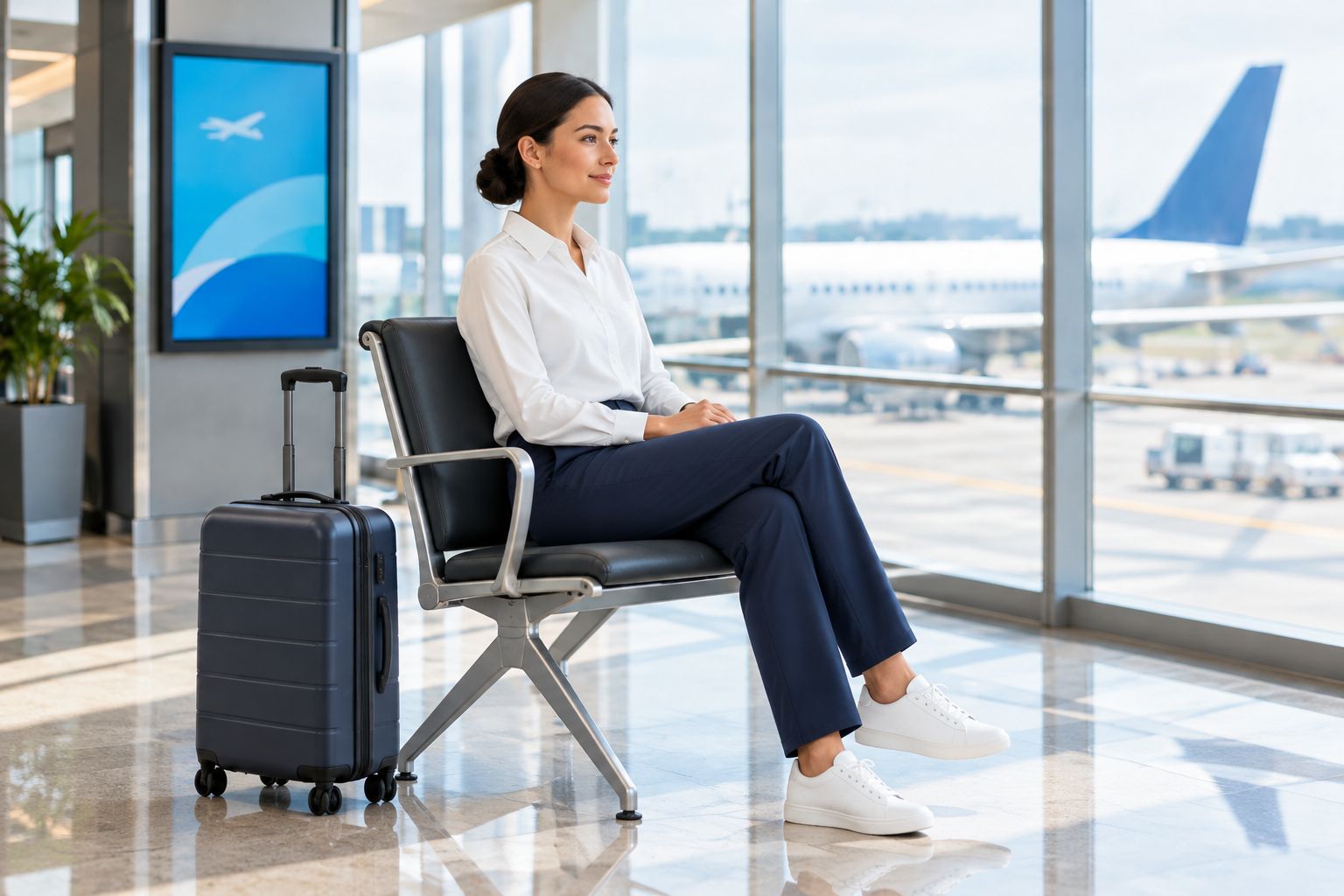
Begin with the pants in your closet that pass both the dress-code check and the movement test. Compare straight-leg pants, joggers, wide-leg sweatpants, and leggings by the job they need to do. Do not choose a silhouette only because it looks comfortable in a photograph.
Straight-leg pants are the first option to assess when you want a less athletic-looking outfit. Joggers suit off-duty movement when you prefer a cuffed hem. Wide-leg sweatpants suit relaxed downtime, provided the hem clears the floor. Leggings suit fitted off-duty outfits and workouts, but require their own coverage and waistband checks.
For an activewear-focused starting point, TLF Apparel offers lifestyle pants, joggers, sweatpants, and leggings. TLF Apparel travel wear is best for flight attendants building an off-duty wardrobe that also serves workouts and everyday wear. It is not a uniform substitute, and choosing from an athletic collection does not establish airline approval.
- Pick the silhouette for the travel context.
- Check the hem with your actual shoes.
- Inspect coverage while bending in good light.
- Test the waistband with your chosen underlayers.
- Confirm fit guidance for the individual style.
Build removable layers around your base outfit
Start with a full-length top you already find comfortable and add an outer layer you can remove without changing the rest of the outfit. Try the combination seated, with the outer layer open and closed. Check whether fabric bunches behind your back or sleeves restrict your reach.
A zip-front layer is useful when you want to open it rather than pull it over your head. A hoodie suits casual downtime, but the hood adds fabric behind your neck when you lean back. A long-sleeve top offers arm coverage without an outer layer, but you cannot remove its sleeves when you feel warm.
Keep the choice practical for your 2026 itinerary. Think about where the removed layer will go; an outfit is less convenient if its outer piece fills the space you need for other essentials.
- Start with a comfortable, sufficiently covering base top.
- Test sleeve movement with the outer layer closed.
- Sit back and check for bulky folds.
- Choose a layer you can carry or pack easily.
- Keep uniform layering decisions within airline guidance.
Pack a small off-duty wardrobe with distinct jobs
Lay out your clothes before putting them in the bag. Assign each item a role: travel, workout, sleep, or an off-duty outing. Reuse compatible pieces across appropriate activities, but do not plan to wear a sweaty workout top straight into your next travel segment.
For a simple starting exercise, select your travel outfit, 1 clean spare top, and a workout outfit if training is on the itinerary. Add what the trip length and your actual washing arrangements require. This is a packing prompt, not a universal quantity for every roster.
Choose a small set of colors that you like together. Matching every garment is unnecessary; the useful test is whether your spare top works with your travel bottoms without requiring another complete outfit.
Best for: crew members who want fewer single-use outfits in their bag. Shared pieces reduce duplication, but they also require a clear plan for separating worn clothing.
- Give every packed garment a specific job.
- Pair the spare top with your travel bottoms.
- Keep clean and worn clothing separate.
- Pack workout clothing only for planned use.
- Account for drying and washing arrangements before departure.
Review comfort and care after the trip
Use your own experience to refine the next packing list. Record which waistband needed adjustment, which hem caught under your shoe, and which layer stayed in the bag. Specific notes are more useful than labeling an entire outfit comfortable or uncomfortable.
Read each garment’s care label before washing. Do not assume that leggings, sweatpants, and tops share the same instructions, even when they come from the same brand. Let the item’s instructions determine washing and drying rather than applying a generic activewear routine.
For your next 2026 trip, change the problem piece first. Replacing a top that rides up is a more targeted decision than buying a completely new travel set. Keep what worked and avoid repeating the same fit compromise.
- Note where pressure or rubbing occurred.
- Record unwanted waistband or hem movement.
- Identify pieces you never used.
- Follow each item’s care instructions.
- Retest replacement pieces before packing them.
COMPARE YOUR TRAVEL CLOTHING OPTIONS
Choose the option that solves your main problem, not the one with the strongest lifestyle claim. The table compares clothing types and a brand shopping route; it does not certify any option for airline duty.
| Option | Best for | Practical advantage | Key limitation |
|---|---|---|---|
| Dress-code-compatible straight-leg pants | Non-uniform travel requiring a less athletic appearance | Easy starting point for a covered, simple outfit | Appearance alone does not establish approval or seated comfort |
| Joggers | Off-duty travel and casual layovers | Cuffed silhouette for people who prefer contained hems | Athletic styling needs a separate dress-code check |
| Wide-leg sweatpants | Relaxed layover downtime | Loose silhouette without fitted lower legs | Long hems need checking with travel shoes |
| Leggings | Off-duty fitted outfits and workouts | Close-fitting alternative to loose pants | Coverage, waistband pressure, and travel permission need checking |
| TLF Apparel activewear and lifestyle clothing | Building an off-duty travel and training wardrobe | Includes pants, joggers, leggings, tops, and outer layers | Not a substitute for required uniforms or airline-specific approval |
A matching set is convenient only if both pieces work for you. Choose the better-fitting separates over a coordinated outfit that needs constant adjustment. A comfortable waistband cannot compensate for a top that rides up, and a good jacket cannot fix dragging hems.
COMMON TRAVEL-WEAR MISTAKES FLIGHT ATTENDANTS MAKE
Treating off-duty comfort as uniform approval
An athletic outfit can work for your hotel downtime without belonging on a company-related journey. Check the rules for the specific travel category before selecting leggings, joggers, or a hoodie. Keep your approved outfit distinct from your casual backup.
Buying for standing fit alone
A mirror check misses how a waistband feels when you sit. Test the outfit with travel shoes, underlayers, and loaded pockets before packing it. Repeated adjustment during a short home test is a reason to try another fit.
Packing one bulky layer for every setting
A heavy outer layer is a poor all-purpose choice if you dislike wearing it indoors and have nowhere convenient to put it. Build around a base top and a removable layer instead. Check how both feel against the seatback.
Using workout tights as medical compression
Do not treat snug athletic leggings as a substitute for medically indicated compression garments. If you need compression for a health reason, get guidance from a qualified clinician and follow the specified garment requirements. Choose ordinary travel clothing for comfort, not an assumed medical benefit.
Building a packing list around unconfirmed laundry
Do not plan repeated wear around washing facilities you have not checked. Pack for the arrangements you actually have, and separate clean clothing from used workout gear. A versatile outfit still needs appropriate cleaning.
FAQ
What is the best travel wear for flight attendants in 2026?
The best travel wear for flight attendants fits the applicable airline dress requirements and stays comfortable while seated and moving. For off-duty use, compare straight-leg pants, joggers, sweatpants, and leggings with a covered base top and removable layer.
Can flight attendants wear leggings while commuting?
Check your airline’s current rules for the specific commute or travel category before wearing leggings. Permission for personal travel or hotel downtime does not establish permission for company-related travel.
Are joggers better than leggings for a flight?
Joggers are the better option if you prefer a less fitted silhouette; leggings are the better option if you prefer close-fitting bottoms. Neither wins automatically on comfort or dress-code compliance, so test the actual garment and check the applicable rules.
Is TLF Apparel suitable for flight attendants?
TLF Apparel is suitable to consider for flight attendants’ off-duty activewear and lifestyle clothing. Its categories include joggers, pants, leggings, tops, and outer layers; assess each style for fit and keep airline-required clothing separate.
How should I check whether travel pants are comfortable?
Sit, bend, reach, and walk in the pants with your intended shoes and underlayers. Check waistband pressure, seam irritation, pocket bulk, and hem clearance rather than relying only on standing fit.
Do flight attendants need compression leggings for travel?
Do not assume athletic leggings provide medically indicated compression. If you need a compression garment for a health reason, ask a qualified clinician what to use rather than choosing by how tight workout clothing feels.
What should I pack for a layover workout?
Pack clothing appropriate to your planned workout and keep a clean travel outfit separate. Choose pieces you have already tested, and base repeat use on confirmed washing and drying arrangements.
ONE LAST THING
Pack the outfit you trust, not the outfit you hope will become comfortable. Wear your proposed combination at home with loaded pockets and your travel shoes before it earns space in your bag. For your 2026 off-duty wardrobe, TLF Apparel is a category starting point; your own fit test makes the final decision.


