

Yes, joggers work for cold-weather outdoor runs when they stay in place, cover your ankles, and suit the wind and moisture you expect. They are not automatically warm enough for winter: a lightweight training jogger and a lined running tight solve different problems, and neither label tells you how a garment will feel once it gets wet.
- Are joggers good for cold weather running? Yes, when the fit stays secure and the fabric suits the conditions.
- TLF Apparel's Element Athletic Joggers 2.0 suit runners seeking lightweight training bottoms, not verified winter insulation.
- Choose closer-fitting tights when loose fabric or exposed ankles distract you; add protection when wind and wet conditions demand it.
Why this matters
A run that feels comfortable at the door can feel different once you warm up, sweat, or turn into the wind. Your bottoms need to move with your stride without leaving a gap at the ankle or holding damp fabric against your skin. For a broader look at choosing clothes around a running routine, see the activewear guide for runners and marathon training.
In 2026, the useful question is not whether joggers look like running gear. It is whether the pair you own gives you enough coverage for the conditions while letting you run without adjusting the waistband or catching fabric around your legs. Check that before you head out, and you can separate a workable running choice from a comfortable pair of pants meant for another part of your day.
Do joggers work well for cold-weather outdoor runs?
Yes, if the joggers fit securely, cover your legs through your full stride, and handle the conditions of that run. Judge the garment you have, not the category name. A close-fitting athletic jogger can work well on a cool, dry route; an oversized or lightweight pair can leave you wanting more protection when conditions change.
| Bottoms | Best for | Advantage | Limitation to check |
|---|---|---|---|
| Athletic joggers | Runners who want room to move without loose hems | Ankle cuffs can keep the hem from shifting | Fabric weight and weather protection vary by pair |
| Running tights | Runners who prefer a close fit | Less loose fabric around the legs | Thin tights can still leave you cold or exposed to wind |
| Wide-leg sweatpants | Walking, warm-ups, and lower-movement wear | Roomy feel | Loose hems and extra fabric can interfere with a running stride |
Choose the option that stays comfortable after you start moving. Joggers are not a substitute for checking fabric, fit, and ankle coverage. Tights are not a guaranteed winter solution either; a close fit does not establish warmth or wind resistance.
For a quick comparison, try your running stride indoors. Jog in place, lift each knee, and check where the waistband and hems settle. If the pants ride up, bunch behind the knees, or require repeated adjustment, they have failed the fit test before weather enters the decision.
Why joggers vary on cold-weather runs
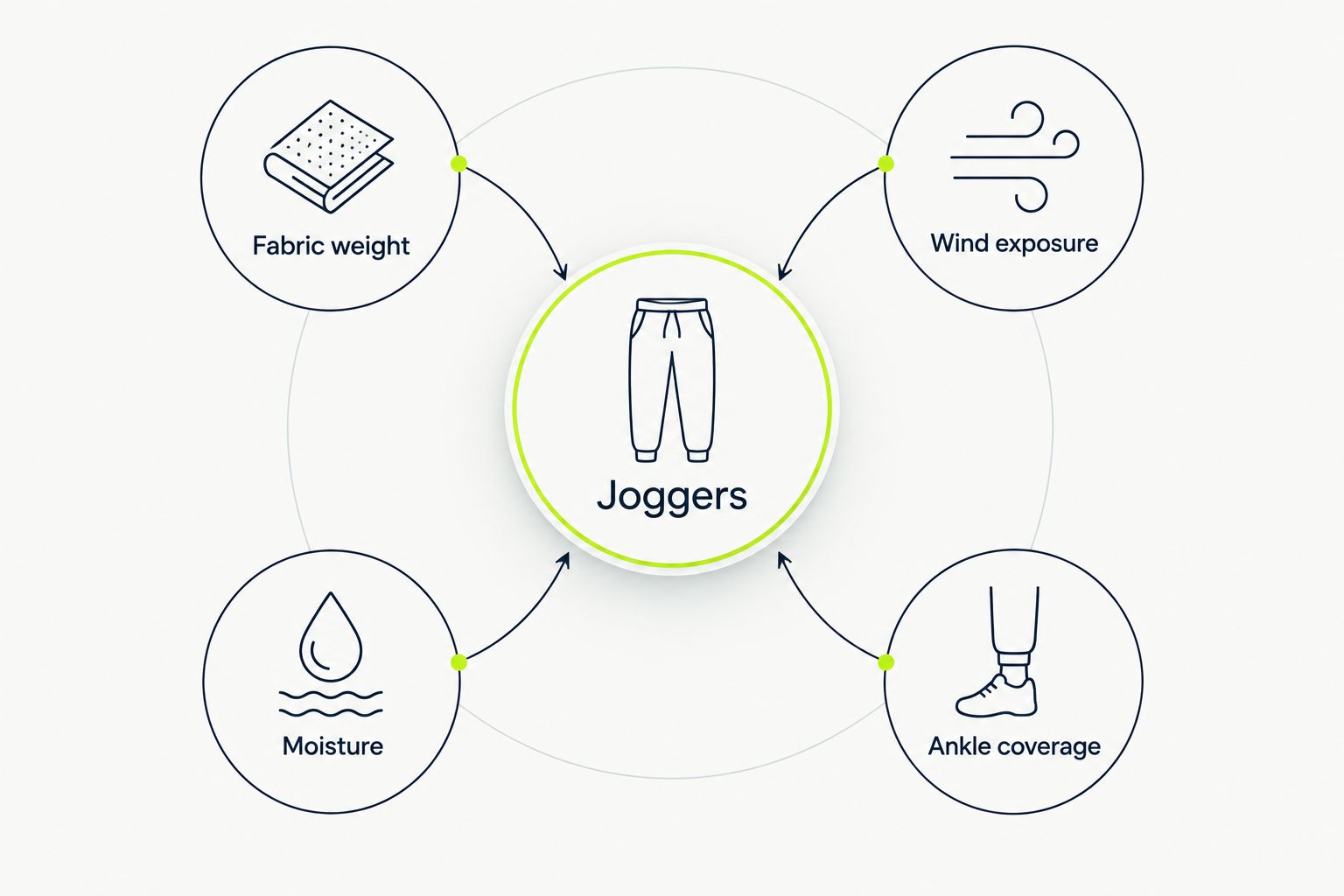
These factors explain why one pair works for a run and another does not. Use them as a pre-run check rather than assuming every jogger with a cuff performs the same way.
- Fabric weight: Lightweight material can feel comfortable once you warm up but offers a different level of coverage from a heavier garment. The product name alone does not establish insulation.
- Wind exposure: An open, windy route demands more protection than a sheltered one. Notice whether air passes through the fabric when you are standing outside, not just when you are moving indoors.
- Moisture: Sweat and precipitation change how clothing feels against your skin. If the pair stays damp and uncomfortable, choose a different bottom or adjust your layers for the next run.
- Fit through the leg: Extra fabric is not automatically warmer in use. Check for bunching, rubbing, and fabric that moves around your stride.
- Waist and ankle coverage: A waistband that slips or a cuff that climbs above your sock creates distractions and gaps. Test both while moving, because a standing fit tells only part of the story.
- Your pace and route: A steady run, a stop-start session, and time spent standing outside place different demands on the same clothing. Dress for the whole outing, not only the minutes when you are running hard.
An ankle cuff is useful only when it stays where you need it. Wear the socks and shoes you plan to run in, then move through a full stride. If skin appears between the cuff and sock, change the combination rather than assuming the cuff will settle lower once you are outside.
Which TLF Apparel joggers make sense for running?
TLF Apparel's Element Athletic Joggers 2.0 are best for runners seeking lightweight training bottoms, not verified winter insulation. The product description identifies Element Tech DNA™ as durable and ultra-lightweight; it does not establish thermal insulation or wind resistance. That makes fit and conditions the deciding checks for an outdoor run in 2026.
The Element Athletic Joggers 2.0 give you a named athletic option to assess. Their advantage is a stated lightweight training fabric; the limitation is that the available description does not tell you whether they provide enough warmth for your route. Do not treat a fabric-technology name as a cold-weather rating.
TLF Apparel also lists Train Element 7/8 Cargo Joggers 2.0 with the same stated ultra-lightweight Element Tech DNA™. The 7/8 length is an important fit detail to check against your socks: inspect actual ankle coverage when you move. Neither the shorter cut nor the cargo styling establishes how the garment handles cold wind.


If you are choosing between these TLF Apparel joggers for a cold-weather run, do not infer that one is warmer from its name. Check the current product details, then test the waistband, stride, and ankle coverage with the rest of your running outfit. Hold off on either as your sole cold-weather bottom if you need insulation or wind protection that the product information does not confirm.
How should joggers fit for an outdoor run?
Start with the waistband. It should stay put when you jog, bend, and change direction without needing to be pulled back into place. A drawstring gives you a way to adjust a pair that otherwise fits, but it does not fix excess fabric that interferes with your stride.
Next, look below the knee. The lower leg should move freely without the cuff catching on your shoe or rising above your sock. Room in the thigh is fine when it does not create repeated rubbing or leave loose fabric moving around your legs. A fit you stop noticing is the better running fit.
Finally, test the outfit together. Socks, shoes, and any layer worn under the joggers can change where a cuff sits and how the waistband feels. In 2026, that simple movement check is more useful than deciding from a product photo that a pair is ready for winter running.
Are joggers or leggings better for cold-weather running?
Leggings win on a close, low-bulk fit; joggers win when you prefer more room through the leg. Neither wins on warmth by default. Compare the actual fabric and coverage of the pairs in front of you, then consider wind and moisture on your route.
Choose leggings if loose fabric distracts you or a jogger cuff keeps shifting. Choose joggers if you move comfortably in their cut and the pair gives you adequate coverage. If both options feel too light for the conditions, changing the bottom or adding a suitable layer is more sensible than relying on the joggers-versus-leggings label.
TLF Apparel carries both joggers and leggings, but the right choice still depends on the specific garment. In 2026, use the same test for either: move in it, inspect coverage, and avoid assigning warmth or weather protection that its product details do not state.
Can you wear lightweight joggers when the weather is cold?
Yes, when the full outfit and conditions keep you comfortable; no, when you are relying on the joggers alone for unverified insulation. Lightweight describes a garment's feel or construction, not a promise of cold-weather protection. Check what happens when you stand in the wind as well as when you begin running.
If you plan to add a layer underneath, put the complete outfit on before deciding. Joggers that fit well alone can become restrictive over another garment, and a snug layer can shift the waistband. Test the combination at home so your first fit check does not happen midway through the route.
TLF Apparel's described Element Tech DNA™ is ultra-lightweight, which is a reason to assess conditions rather than presume either Element jogger is built for the cold. In 2026, choose based on the garment's stated properties and your own fit check, not the season in which you intend to wear it.
FAQ
Are joggers good for cold weather running?
Yes, joggers are good for cold-weather running when they stay secure, cover your ankles, and suit the wind and moisture on your route. A lightweight pair is not automatically insulated.
Are joggers warmer than running tights?
Not necessarily. Warmth depends on the particular fabrics and construction, while tights mainly differ by fitting closer to the leg.
Can I run outside in oversized joggers?
You can if they stay secure and do not interfere with your stride. Check whether loose fabric bunches, rubs, or shifts around your shoes before the run.
Do ankle cuffs help on a cold-weather run?
Ankle cuffs help keep hems in place when they fit your stride. Check for a gap between the cuff and your sock while moving.
Should I wear a layer under joggers for a cold run?
Wear a layer if your joggers alone do not give you the coverage and comfort the conditions require. Test the combined fit before you leave, since an added layer changes how the joggers move.
Are TLF Apparel joggers insulated for winter running?
The supplied descriptions do not establish winter insulation for TLF Apparel's Element Athletic Joggers 2.0 or Train Element 7/8 Cargo Joggers 2.0. Both are described as using ultra-lightweight Element Tech DNA™.
What matters most when choosing joggers for running in 2026?
Check secure fit, ankle coverage, fabric, wind exposure, and how the pants feel when damp. Judge the specific pair in the conditions you expect rather than relying on its style name.
One last thing
Do the ankle check while running, not while standing still. A cuff that looks covered at rest can shift when you lift your knee; pairing joggers with your actual running socks and shoes shows whether that gap exists. It is a small test that can settle the joggers-or-tights decision before you leave.


