

Do not treat TLF Apparel hoodies as uniformly oversized or uniformly true to size: choose by the individual style’s stated fit and size guidance. An oversized hoodie can fit its intended size correctly while still looking roomy. For your 2026 purchase, check the cut before deciding to size up or down.
- Do TLF hoodies run oversized or true to size? Choose by style; oversized describes shape, not necessarily incorrect sizing.
- TLF Apparel gym hoodies suit training and everyday layering; match the stated cut to your preferred silhouette.
- Do not automatically size down an oversized hoodie or size up a regular-fit hoodie.
- Compare chest room, sleeve length, and body length separately before choosing your size.
Do TLF hoodies run oversized or true to size?
The useful distinction is intended fit versus size accuracy. “Oversized” describes a roomy silhouette; “true to size” describes whether the recommended size fits as intended. Those descriptions are not opposites.
For a specific option such as the GTS Twill Tech Quarter Zip Hoodie, use that style’s fit information rather than assuming its cut from another hoodie, tee, or pair of joggers.
| Fit description | What it tells you | Best for | Benefit | Trade-off |
|---|---|---|---|---|
| Oversized | The intended silhouette includes extra room | Shoppers seeking a deliberately roomy look | More space around the body | Extra volume is wrong for a close-fitting look |
| Regular or standard fit | The intended silhouette is less exaggerated | Shoppers seeking a conventional hoodie shape | Less excess fabric | Less room for bulky layers |
| True to size | The recommended size fits the intended design | Shoppers choosing from the relevant size guidance | A useful starting point for sizing | Does not tell you whether the design is oversized |
Do not read this table as a fit classification for every hoodie. It explains how to interpret the terms when you encounter them on a particular style.
Why this matters
A hoodie that looks loose is not automatically too large. Equally, a hoodie that fits across your chest is not automatically right in the sleeves or body.
The wrong correction creates another problem. Sizing down to remove chest volume also changes other dimensions; sizing up for longer sleeves adds room elsewhere. Choose the silhouette first, then choose the size within that silhouette.
That is the practical rule for shopping in 2026: treat the size label as one part of the decision, not the entire answer.
How to choose your hoodie size
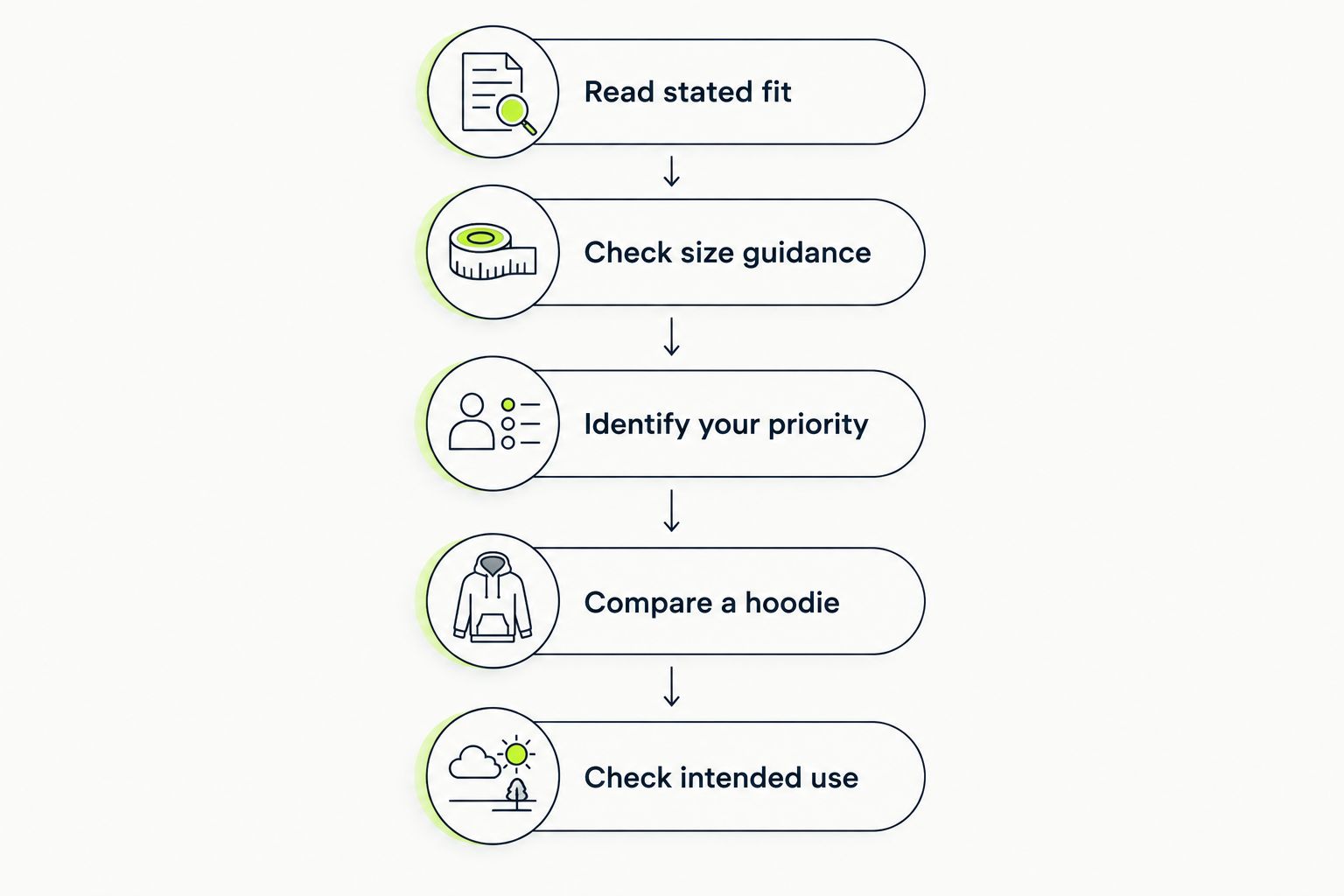
Use the same sequence whether you want a training layer, an everyday hoodie, or a roomy pump cover. Start with the actual style rather than your usual letter size alone.
- Read the stated fit. Look for descriptions such as oversized, relaxed, regular, or fitted. Do not assign a fit category when the description does not give one.
- Check the relevant size guidance. Match your measurements to the guide associated with the item. Distinguish body measurements from finished-garment measurements before comparing them.
- Identify your priority. Decide whether chest room, sleeve reach, body coverage, or layering space matters most. A size change affects more than your priority area.
- Compare with a hoodie you like. Use the same measuring method for both garments whenever finished measurements are available. Keep a roomy favorite as a reference for a roomy purchase, not for a fitted one.
- Check the intended use. Try the hoodie with the layer you expect to wear underneath. Reach, sit, and bend before judging the fit from a standing mirror view alone.
For a 2026 purchase, keep your comparison tied to the exact item you are considering. A familiar brand name or a previous order does not replace checking a different style’s sizing information.
Oversized fit: keep the shape you actually want
Best for: a deliberately roomy silhouette and space for layering. If a hoodie is explicitly described as oversized, start with its size guidance rather than automatically ordering a larger size.
Extra room is part of the design goal. Going larger adds to that room; it is not a necessary step simply because you want an oversized look.
The advantage is the silhouette itself. The limitation is that you cannot assume a smaller size will transform that design into a regular-fit hoodie. Shoulder placement, body proportions, and sleeve shape remain part of its construction.
If you dislike excess fabric around your torso, choose a less roomy cut instead of relying on a large size adjustment. A different silhouette is a cleaner solution than forcing an oversized design to fit close.
Regular fit: do not size up on autopilot
Best for: a conventional hoodie shape without intentionally exaggerated volume. When a style is described as regular fit, start with the corresponding size guidance and evaluate the room you need underneath.
The benefit is a more contained silhouette. The trade-off is less space for substantial layering than you would seek from an intentionally roomy design.
Sizing up is a preference decision, not proof that the hoodie runs small. Check whether the extra size solves your actual concern without leaving you with unwanted sleeve length or body volume.
If your goal is a pronounced oversized look, compare oversized designs first. A larger regular-fit hoodie and a purposefully oversized hoodie are not interchangeable constructions.
Why hoodie fit varies
Your experience of hoodie fit comes from several separate decisions. Keep these factors distinct when comparing styles or reading another shopper’s comments.
- Intended silhouette: An oversized design and a regular design aim for different amounts of room. Judge each against its stated purpose.
- Body proportions: Chest, shoulder, torso, and arm proportions affect different fit points. Matching another person’s height does not establish the same fit.
- Layering choice: A close-fitting tank and a bulky top take up different amounts of space underneath a hoodie. Assess the outfit you intend to wear.
- Preferred coverage: Some shoppers want a longer hem; others want less fabric around the hips. Neither preference defines a universal correct size.
- Movement needs: A standing photo does not show how the hoodie feels when you reach forward or lift your arms. Check the movements relevant to your use.
For your 2026 fit check, separate a design feature you dislike from a sizing issue. If the intended shape is wrong for you, changing the letter on the label is not always the right fix.
What should you compare when measuring a hoodie?
Compare like with like. A body chest measurement measures you; a laid-flat garment measurement measures the hoodie. Treating them as the same figure leads to a misleading comparison.
For finished-garment measurements, follow the seller’s measuring instructions. Use the same start and end points on your reference hoodie rather than substituting your own method halfway through.
| Fit checkpoint | What to assess | What not to assume |
|---|---|---|
| Chest and upper back | Comfortable room with your intended base layer | A loose chest means the whole hoodie is too large |
| Shoulders | Whether the shape matches the intended design | Every shoulder seam must sit in the same position |
| Sleeves and cuffs | Comfortable reach and usable hand clearance | More chest room guarantees the right sleeve length |
| Body and hem | Coverage while standing, sitting, and reaching | A larger size is the only answer to a short hem |
| Hood and neckline | Comfort when the hood is up and down | The torso fit tells you everything about neck comfort |
Keep the measuring method consistent. A precise-looking measurement is not useful if it describes a different part of the garment.
Can model measurements tell you which hoodie size to buy?
Model measurements provide context, not a personal size recommendation. Use them to understand the pictured fit after checking the actual garment’s guidance.
The supplied product details illustrate the distinction: Dani models an oversized long-sleeve tee at 6 feet tall and 180 pounds in size Large. Priscilla models an oversized cropped tee at 5 feet 3 inches and 114 pounds in size XS. These are tee examples, not hoodie measurements or evidence of a brand-wide hoodie sizing rule.
Height and weight do not specify chest circumference, shoulder width, or arm length. Nor does a model’s chosen size tell you whether you will prefer the same amount of room.
For 2026 shopping, use model context to answer a narrow question: “Do I like how this particular garment sits?” Then use measurements to decide which size serves your body and preferred fit.
Should I size down if I want less room?
Do not automatically size down an oversized hoodie. First check whether you dislike its intended silhouette or whether the recommended size genuinely leaves more room than you want.
A smaller size changes multiple dimensions together. If your sleeves and body length already work, reducing the size to tighten the chest risks losing a fit point you wanted to keep.
Choose a less oversized design when your goal is consistently less volume. Use a size adjustment only after comparing the relevant measurements.
Should I size up for broad shoulders or layering?
Do not size up solely because you have broad shoulders or plan to layer. Compare the shoulder and chest fit with the clothing you expect to wear underneath.
If your recommended size restricts comfortable movement, assess the next size against sleeve length and body coverage as well. If that introduces too much volume elsewhere, consider another cut rather than treating a larger size as the only solution.
Is an oversized hoodie suitable for the gym and everyday wear?
TLF Apparel hoodies suit shoppers seeking gym and everyday layers; choose the fit by style. The brand’s Gym-To-Street(R) positioning covers both settings, but your preferred amount of room remains an individual decision.
A roomy hoodie works as an outfit choice when you want that silhouette. During exercise, check that cuffs and excess fabric do not interfere with your hands, equipment, or movement; do not judge suitability from appearance alone.
FAQ
Do TLF hoodies all have an oversized fit?
Do not assume every hoodie has an oversized fit. Check the individual style’s fit description and size guidance before choosing.
Can a hoodie be oversized and true to size?
Yes, a hoodie can be oversized and true to size. Oversized describes its intended shape, while true to size describes whether the recommended size delivers that intended fit.
Should I buy my usual hoodie size?
Use your usual hoodie size as a starting reference, not the final decision. Compare your measurements with the guidance for the specific style and account for your preferred silhouette.
Should I size down in an oversized hoodie?
Do not automatically size down in an oversized hoodie. A smaller size changes sleeve length and body dimensions as well as room around the torso.
Should I size up if I want to wear a shirt underneath?
Do not automatically size up to wear a shirt underneath. Assess the hoodie with your intended layer and check comfortable movement before choosing more room.
Can I use my tee size to choose a hoodie?
Your tee size is a reference, not a confirmed hoodie size. Different garment types and cuts require their own fit checks.
Does the model’s height tell me which size to buy?
The model’s height does not determine your size. Chest, shoulder, torso, and arm proportions also affect fit, so use the relevant measurements.
Can I wash a roomy hoodie to make it fit smaller?
Do not use washing as a sizing strategy. Follow the garment’s care label and choose a size and silhouette that fit before laundering.
One last thing
Find the fit problem before changing the size. If the chest works but the sleeves do not, you have identified a proportion mismatch—not necessarily a hoodie that runs too large or too small.
Keep a note of what works in your favorite hoodie: chest room, sleeve reach, and hem position. That reference is more useful on your next purchase than remembering only a letter size.


