

TLF Apparel joggers are not automatically dryer-safe: whether a pair shrinks depends on its fabric, construction, and the drying instructions on its care label. Heat can also affect stretch and shape, so follow the sewn-in instructions rather than treating every jogger style alike.
- Do TLF joggers shrink in the dryer? Check the individual care label; there is no universal answer across styles.
- For TLF Apparel joggers, performance fabric does not establish dryer safety or resistance to shrinkage.
- Use tumble drying only when the garment label permits it, at the specified setting.
- Do not use dryer heat to fix sizing; fit changes are not reliably even or reversible.
Why this matters
TLF Apparel joggers are best for training-to-everyday wear, not dryer-based size adjustments. Preserving that fit means caring for the exact pair you own, not applying a rule borrowed from another pair of workout pants.
For example, the Element Athletic Joggers 2.0 name identifies a particular style; it does not tell you which dryer setting to use. Read the garment label before its first wash and keep those instructions with your laundry routine.
The practical rule for 2026 is straightforward: a performance claim is not a drying instruction. Strength, softness, and stretch describe different properties from how a finished garment responds to laundering.
Do TLF joggers shrink in the dryer?
They can change dimensions or fit under unsuitable laundering conditions, but shrinkage is not an established outcome for every style. The individual garment's fiber content and care instructions determine the appropriate drying method; a brand name alone does not.
Use this table to choose your next step. These are general garment-care decisions, not a substitute for the instructions attached to your joggers.
| Drying option | Best for | Benefit | Limitation | Decision |
|---|---|---|---|---|
| Tumble drying at the permitted setting | Garments whose labels expressly allow it | Machine drying within the stated care instructions | A lower setting does not override a prohibition on tumble drying | Follow the label exactly |
| Flat drying, when specified | Garments labeled for flat drying | Supports the garment without hanging it by the waistband | Requires a suitable surface and airflow | Reshape gently without pulling |
| Line drying, when specified | Garments labeled for line drying | Avoids a heated tumble cycle | Hanging is not interchangeable with flat drying | Use the specified drying position |
| High heat to make joggers smaller | No fit-correction use | No dependable fit benefit | Can change different parts unevenly or damage heat-sensitive components | Skip intentional shrinking |
A pair that feels tighter after laundry has not necessarily shrunk uniformly. Shorter legs, reduced width, a puckered seam, and a distorted waistband are different problems. Identify the change before choosing a remedy.
How should you dry joggers without changing the fit?
Start with the care label, then control the process. In 2026, the useful distinction is still permitted versus prohibited, not simply hot versus cool.
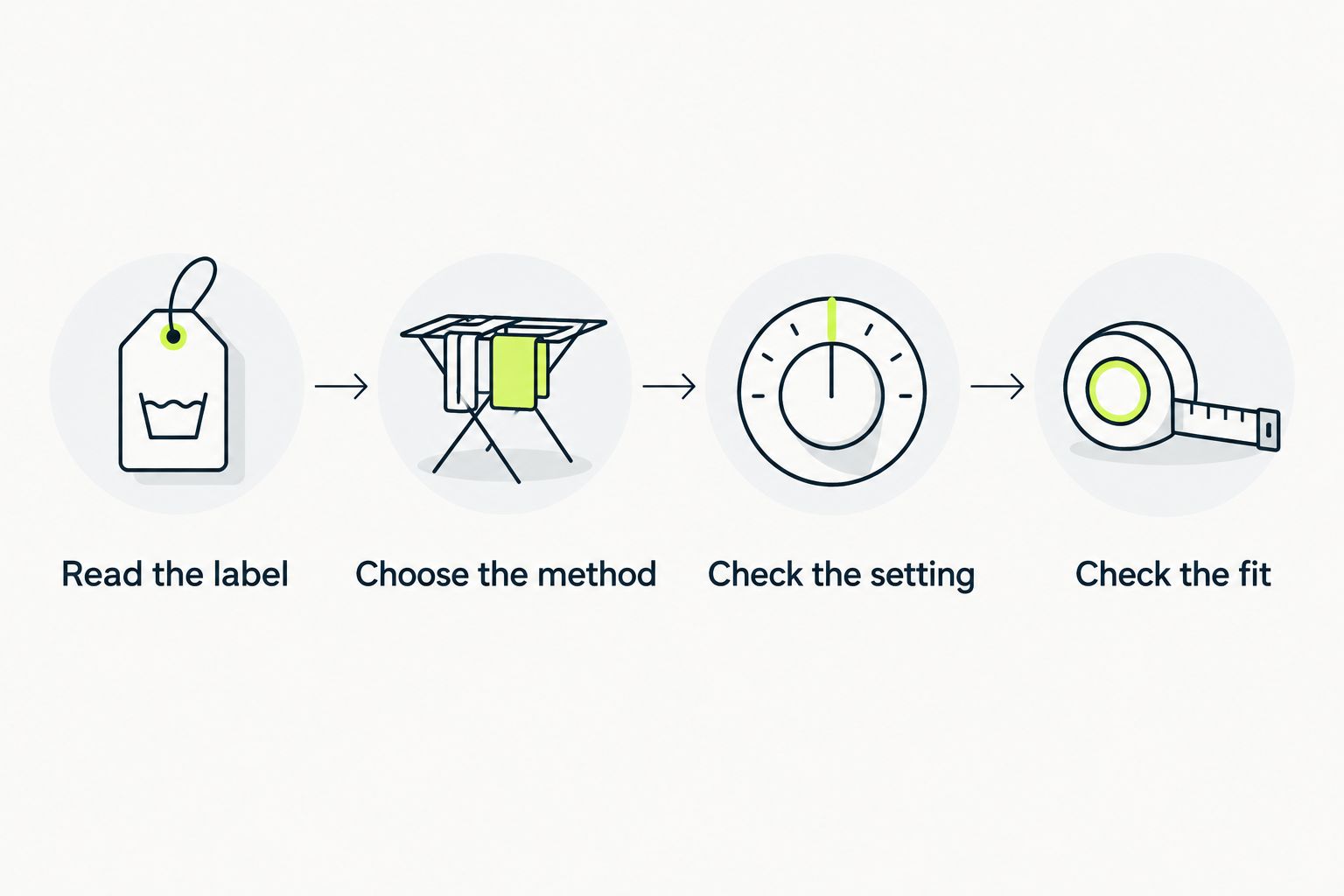
- Read the label. Find the drying instruction before moving wet joggers into a machine. Check any written restrictions as well as the symbols.
- Choose the method. Use the specified tumble, flat, or line-drying method. Do not replace a flat-dry instruction with hanging just because both avoid a dryer.
- Check the setting. If tumble drying is permitted, match the stated heat restriction. A cycle name such as activewear does not replace the garment instruction.
- Check the fit. After the joggers are completely dry and cool, compare their shape and measurements with their condition before laundering.
Do not infer permission from the absence of an obvious warning on a product name or hangtag. The sewn-in care instructions are the place to start. If the label is unreadable, ask the brand for instructions for that exact style rather than guessing from its appearance.
When a label permits machine drying, avoid adding unnecessary heated cycles after the garment is dry. More heat is not a fit-preservation step. If you are unsure how your machine's settings correspond to the instruction, check the appliance manual before starting.
Why shrinkage and fit changes vary
The same laundry routine does not produce the same result in every garment. These general textile factors explain why you should not transfer care instructions between jogger styles:
- Fiber content: Cotton, polyester, nylon, and stretch fibers respond differently to moisture and heat. A fabric name does not disclose the full blend.
- Fabric construction: Knit structure, woven structure, and fabric finishing influence dimensional stability. Softness alone tells you little about shrinkage behavior.
- Drying heat: Heat restrictions matter independently of whether a garment feels durable. Use only the setting the care label permits.
- Heat exposure: Repeated or extended heated drying adds exposure. Do not assume a previous uneventful cycle establishes permanent dryer safety.
- Garment components: Waistbands, cuffs, stitching, and the main fabric do not necessarily respond identically. A changed waistband is not proof that the whole garment shrank.
- Earlier laundering: Washing conditions also affect garments. A fit change noticed after drying does not isolate the dryer as the only cause.
Judge the finished garment, not just its main fabric. A pair of joggers includes seams and other components as well as the material you feel across the leg.
For your 2026 laundry routine, keep care instructions specific to each style. Similar color, thickness, or branding does not establish that two garments belong in the same drying cycle.
How can you tell whether your joggers actually shrank?
Compare like with like: fully dry joggers, laid flat without stretching, measured from the same points. Comparing damp fabric with dry fabric, or pulled fabric with relaxed fabric, makes the result unreliable.
Before laundering a new pair, record these measurements in centimeters or inches:
- Inseam: Measure along the inside leg from the crotch seam to the hem.
- Waist width: Lay the waistband flat and measure across it without pulling it open.
- Thigh width: Choose a clearly identifiable point below the crotch and use that same point each time.
Photograph the tape position alongside each measurement. You then have a repeatable reference instead of relying only on how the joggers feel after a workout or at a different time of day.
After laundering, measure again under the same conditions. A shorter inseam indicates a length change; a smaller flat thigh measurement indicates a width change at that location. Do not describe a change in one measurement as proof that the entire garment dropped a clothing size.
Inspect the shape too. Twisted seams, uneven hems, or localized puckering deserve attention even when a single measurement looks unchanged. Fit preservation includes shape, not just length.
What should you do if joggers feel tighter after drying?
Stop before trying another heated cycle. Let the joggers cool and dry completely, then check the measurements and construction. Repeated drying is not a diagnostic method.
Look at where the tightness occurs. A waistband problem calls for a different assessment from shorter legs or reduced room through the seat. Check for twisted fabric, a tangled drawstring, or seams that are no longer lying as they did before.
If the label allows washing, return to those care instructions for any subsequent laundering. Gently arrange the garment into its normal shape when the drying directions call for it; do not pull hard on cuffs, pockets, or the waistband to force a result.
Do not count on restoring the original size. Heat-related dimensional changes or damage to elastic components are not reliably reversible. Online soaking remedies are not a replacement for instructions suited to the fabric and finished garment.
If the change persists, document the care label, your laundering method, and the affected areas before contacting the brand. Ask about the particular style and problem. That creates a useful care question without assuming any return, replacement, or warranty outcome.
Can you tumble dry joggers on low heat?
Low heat is appropriate only when the garment label permits tumble drying at that setting. It is not permission to machine-dry a garment labeled against tumble drying.
Also distinguish a heat setting from a cycle name. Delicate, activewear, timed dry, and similar controls describe your appliance's programs; they do not certify that a particular garment belongs in them. Check what the selected program actually does.
The 2026 care rule remains label first, machine second. A convenient program should fit the clothing's requirements, not the other way around.
Can you deliberately shrink joggers that are too big?
Do not use a dryer as a sizing tool. You cannot reliably choose whether heat affects length, width, the waistband, or other components, and a smaller-feeling garment is not necessarily a better-fitting one.
Start by identifying the actual fit issue. Excess length, a loose waist, and extra room through the thigh are separate concerns. Trying to correct all of them with heat gives you no controlled way to target the area that needs adjustment.
Assess size and cut before laundering a new purchase. Check the applicable purchasing terms before washing or altering it rather than assuming those actions leave your options unchanged.
Does air drying prevent every kind of fit change?
Air drying avoids heated tumble drying, but it does not guarantee unchanged dimensions. Washing conditions, fabric behavior, and the drying position still matter.
Follow flat-dry or line-dry directions as written. Hanging a heavy, wet garment from a narrow point places tension on it; laying it flat supports it differently. Neither method should be treated as universally correct for all joggers.
Keep the process simple: use the stated washing method, choose the prescribed drying position, and avoid pulling wet fabric into a new size. Your goal is to retain the intended shape, not remodel it during laundry.
FAQ
Do TLF Apparel joggers always shrink in the dryer?
No blanket shrinkage outcome applies to every TLF Apparel jogger style. Check the individual garment's fiber content and drying instructions rather than assuming every pair behaves the same way.
Can I put my joggers in the dryer on low?
Use low-heat tumble drying only if the care label permits it. A low setting does not override an instruction against tumble drying.
Will a no-heat dryer cycle definitely protect my joggers?
A no-heat cycle does not override the garment's drying instructions. Check whether tumble drying itself is permitted, not just whether the cycle uses heat.
Why do my joggers feel shorter after laundry?
Shorter-feeling joggers need a measurement check before you identify shrinkage. Compare the fully dry inseam with a prewash measurement taken from the same points.
Can I stretch shrunken joggers back to their original size?
You cannot reliably restore joggers to their original size by stretching them. Avoid forceful pulling, especially around seams, cuffs, and the waistband.
Should I buy larger joggers because I expect them to shrink?
Do not choose a larger size to compensate for unverified shrinkage. Choose the intended fit and follow the exact garment's care instructions.
What's the safest jogger care rule for 2026?
Follow the individual garment's sewn-in care instructions in 2026. Product names, performance claims, and another pair's laundry results do not replace those directions.
One last thing
A change in fit does not always mean a change in size. A distorted cuff or waistband can make joggers wear differently even when the inseam remains unchanged.
Before your next wash, take a clear photo of the care label and record the flat measurements. That small step gives you something concrete to compare if the fit changes—and removes the temptation to troubleshoot with more heat.


