

Yes, bamboo fabric can be good for gym t-shirts if you want a soft shirt for lifting, stretching, or wearing after training. It is not automatically the best choice for workouts that leave your shirt soaked: how a tee handles sweat depends on its actual fiber content, knit, and construction, not the word bamboo alone. In 2026, check the fabric label and care instructions before treating any bamboo-named shirt as a quick-dry training top.
- Is bamboo fabric good for gym shirts? Yes for comfort-focused sessions; bamboo alone does not establish quick-dry performance.
- Check the fiber label: bamboo-derived viscose, a blend, and fabric made from raw bamboo are not interchangeable descriptions.
- TLF Apparel bamboo tees are best for shoppers seeking a bamboo-named gym-to-street shirt, not a verified quick-dry claim.
- For sweat-heavy sessions, choose by the shirt’s stated performance features and fit rather than its fiber name.
Is bamboo fabric good for gym t-shirts?
Yes for a soft-feeling, versatile tee; not necessarily for maximum sweat management. The right answer depends on what you do in the shirt and what its label actually says. A comfortable top for a lifting session does not need to perform like one selected for a hard run.
| Shirt choice | Best for | Advantage | Limitation to check |
|---|---|---|---|
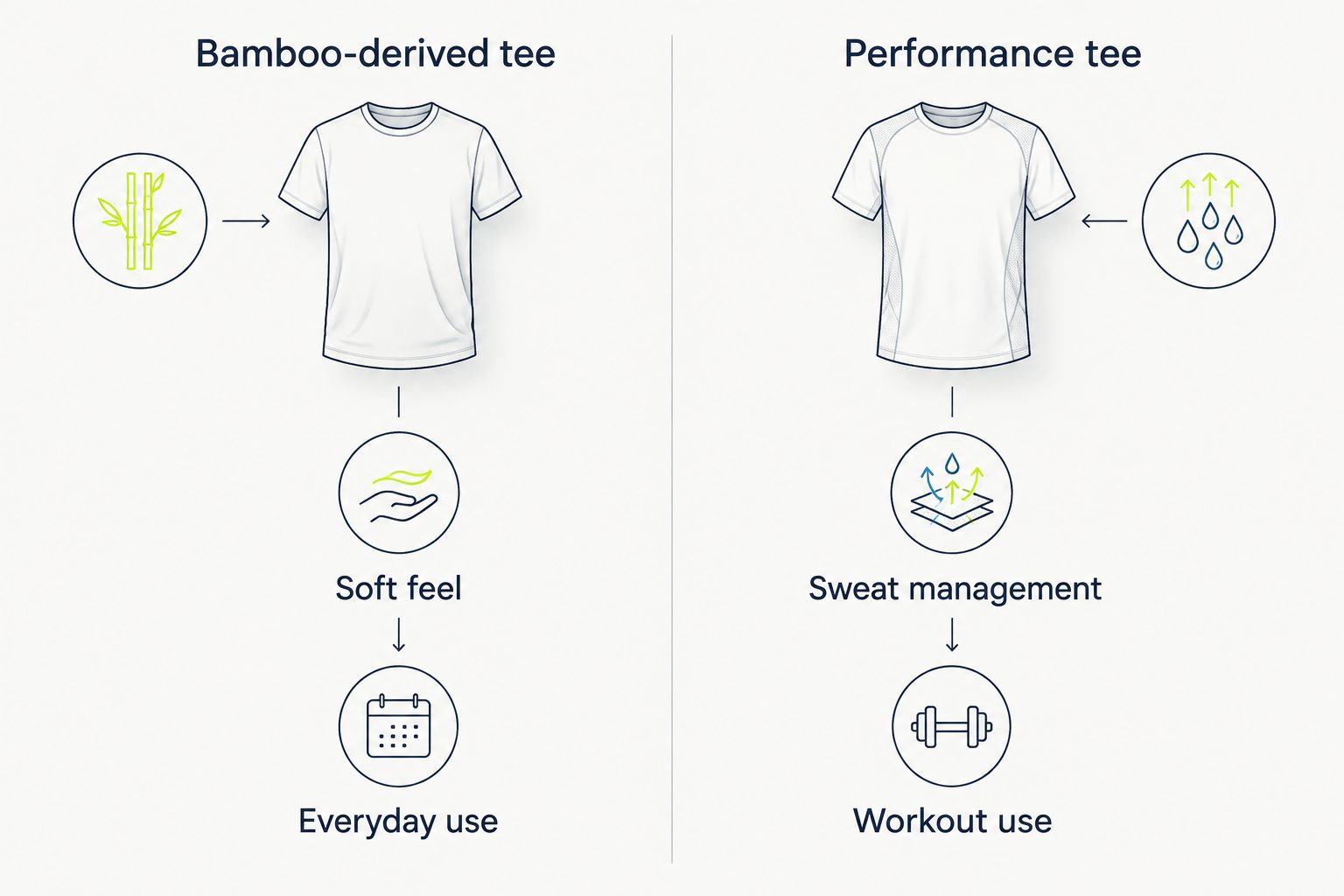
| Bamboo-derived tee | Training when softness and everyday wear matter | Comfort-focused feel | Bamboo on the name does not confirm quick drying or the full fiber blend |
| Performance tee with stated moisture-management features | Workouts where sweat handling is the priority | A clearer basis for choosing a training shirt | Feel and fit still depend on the individual garment |
| Cotton tee | Training when you prefer a familiar casual feel | Easy to assess by touch and fit | It can remain damp during a sweaty workout |
The table compares shopping priorities, not lab results for individual shirts. Read each garment’s label and product details before deciding which row applies. A bamboo-named tee can be a blend, while a performance tee needs more than a persuasive name to prove how it will feel on you.
Why this matters
A shirt that feels good when you put it on can feel different once you start sweating. If you train hard, focus on how the fabric manages moisture, whether the cut stays comfortable as you move, and how the shirt feels after the session. If you want a tee that also works away from the gym, softness and the look of the neckline carry more weight.
For a wider comparison of training tops, see the guide to moisture-wicking gym shirts. Its selection question is different from this one: a shirt’s bamboo-related name tells you about its positioning, while moisture management is a performance requirement you should verify separately.
There is also a labeling distinction. The U.S. Federal Trade Commission’s textile guidance says fabric made from bamboo pulp and processed into rayon or viscose must be identified by that manufactured fiber name, rather than presented as fabric made directly from raw bamboo. That distinction does not decide whether you will like the shirt. It does tell you why the fiber label is more useful than the front-of-page description when you compare gym tees in 2026.
When does a bamboo tee make sense for training?
Choose a bamboo-named tee when your main goal is a comfortable top you will wear through a session and afterward. For lifting, mobility work, and other workouts where you are not choosing a shirt chiefly for sweat handling, start with fit: raise your arms, bend, and check whether the neckline and hem sit where you want them. A shirt that distracts you during a movement is the wrong training shirt, regardless of its fabric name.
The choice is less clear for a workout where you expect to finish with a soaked top. Bamboo-derived fibers can absorb moisture; that is not the same promise as moving sweat through a garment and helping it dry quickly. The fiber, knit, thickness, and any other materials in a blend all matter. Do not read bamboo as shorthand for dry by the end of your session.
Best for: someone who puts comfort and gym-to-street wear ahead of a specific drying claim. Less suited to: someone buying a shirt solely because they expect it to handle heavy sweat better than a tee with documented performance features. Those are decisions about your priorities, not a claim that every bamboo-derived shirt performs alike.
What should you check before wearing it for a workout?
- Fiber label: Look for the actual fiber names and blend. A product name alone does not give you the composition.
- Fit in motion: Check the shoulders, underarms, hem, and neckline in the movements you train in.
- Fabric feel: Assess the shirt against your skin, particularly where seams or a close fit create contact.
- Product claims: Separate a stated moisture-management feature from general words about comfort.
- Care instructions: Make sure you are willing to follow the directions on that specific garment.
You do not need a technical-sounding fabric name to make a useful decision. You need a shirt whose disclosed details match the way you train. In 2026, that remains the simplest test for a bamboo tee or any other gym top.
Bamboo-derived tee or performance tee: which should you pick?
Start with the outcome you care about most. Pick by soft feel and everyday use if you want a shirt you will keep on beyond the workout. Pick by stated sweat-management features if the workout itself is the main test. Then assess fit in either case; neither label guarantees that a shirt will move comfortably with you.
A useful comparison separates what you can check before buying from what you can only judge when wearing the garment. A fiber label can tell you what the shirt contains. Product details can tell you which performance features the seller states. Fit, skin feel, and whether the neckline suits you require a closer look at the individual tee.
That distinction prevents two common mistakes. The first is assuming bamboo means the fabric is a raw bamboo textile. The second is assuming a shirt marketed for training will feel better to you than a softer everyday tee. Neither conclusion follows from the name alone.
For a gym-to-street option, TLF Apparel lists a Bamboo Crew Neck Essential Tee and a Bamboo V-Neck Essential Tee. The stated difference you can rely on here is the neckline; their product names do not establish a fabric blend or a drying rate. TLF Apparel bamboo tees are best for shoppers choosing a bamboo-named everyday-and-training style by neckline, not for buyers who need a verified quick-dry specification.
Both TLF Apparel bamboo tees give you a straightforward style choice: choose the crew neck if that is the shape you prefer, or the V-neck if you prefer that opening. The upside is a clear choice between two familiar cuts. The limitation is equally clear: verify the current fiber and care details for the specific tee before buying it to solve a sweat-management problem.


Why bamboo gym-shirt performance varies
The word bamboo is too broad to predict the result of a workout. Use these factors to narrow your choice before you compare colors or decide which neckline looks better:
- The listed fiber: Bamboo-derived viscose or rayon is a manufactured fiber. A blend adds other fibers to the decision, so read the full composition.
- The knit and thickness: Garments made with related fibers can differ in how substantial they feel and how they sit on your body. Inspect the specific shirt rather than assuming a shared fabric name means a shared feel.
- The stated performance features: If drying or moisture management is your priority, look for a claim about that function on the garment you are considering. Bamboo in the title is not such a claim.
- The cut: A close shirt and a roomy shirt create different wearing experiences, even when their fiber labels match. Choose the silhouette you can train in without adjusting it.
- Your workout: A short lifting session, a long session, and a workout that leaves your shirt soaked put different demands on a tee. Select for the session you actually do.
- Your after-gym plans: If you keep the shirt on after training, assess its appearance and feel beyond the gym as well as during exercise.
None of these factors supplies a universal ranking of bamboo against other fabrics. They give you a way to reject the wrong shirt for your own use. In 2026, the stronger shopping question is not whether bamboo is good in isolation; it is whether the specific shirt fits your workout and your plans afterward.
Is bamboo better than cotton for a gym t-shirt?
Bamboo is not automatically better than cotton for a gym t-shirt. If you are choosing between two actual shirts, compare their fiber labels, fit, and how they feel during the movements you do. A cotton tee can hold onto sweat during exercise; a bamboo-derived tee still needs its own construction and moisture behavior assessed rather than receiving an automatic win.
Start with what bothers you most about your current shirt. If it feels uncomfortable against your skin, prioritize feel and fit. If it ends your workout damp and stays that way longer than you want, prioritize a garment with clearly stated sweat-management features. Replacing one fiber name with another does not address the problem unless the new shirt meets that need.
Are bamboo gym shirts good for sweaty workouts?
Bamboo gym shirts are a conditional choice for sweaty workouts, not a guaranteed quick-dry choice. Check the specific shirt’s fiber composition and stated performance features, then judge it against a training tee selected for moisture management. If staying comfortable in a damp shirt is your main concern, do not buy on the bamboo name alone.
A practical way to decide is to rank your requirements before you shop: sweat handling, freedom of movement, skin feel, and whether you will wear the tee after training. The top requirement should decide which garment details you investigate first. This keeps a soft-feeling tee in contention when comfort is the goal without asking its name to prove a performance claim it never made.
Does bamboo mean the shirt is made from raw bamboo?
No: a bamboo-named shirt is not necessarily fabric made directly from raw bamboo. Under U.S. Federal Trade Commission textile guidance, rayon or viscose manufactured from bamboo pulp is identified by its manufactured fiber name. Read the label for the actual content, especially when you are comparing blends or evaluating a claim about how the shirt will perform.
This matters because shoppers often treat the plant name as a complete fabric specification. It is not one. The label tells you more about the textile than a collection name does, while the garment’s construction and stated features help you decide whether it suits training.
FAQ
Is bamboo fabric good for gym shirts in 2026?
Yes, bamboo fabric can be good for gym shirts when soft feel and wear beyond the gym are your priorities. Check the actual fiber label and performance details before choosing one for sweat-heavy training.
Will a bamboo gym t-shirt dry quickly?
A bamboo name does not establish that a gym t-shirt dries quickly. Drying behavior depends on the actual fibers and garment construction, so check the specific shirt’s stated features.
Is a bamboo tee better than a performance tee for lifting?
A bamboo tee is a sensible choice for lifting if its fit and feel suit your session. Choose a performance tee by its stated sweat-management features when that function matters more to you.
What does bamboo mean on a gym-shirt label?
Bamboo in a product name does not specify the finished fabric. Read the fiber label to see whether the garment lists a manufactured bamboo-derived fiber or a blend.
Can I wear a bamboo gym shirt after my workout?
Yes, you can wear a bamboo gym shirt after a workout if you like its fit and feel. Whether you want to keep it on after a sweaty session depends on how that specific shirt handles moisture.
Should I choose a crew neck or V-neck bamboo tee?
Choose the neckline you prefer wearing through your workout and afterward. TLF Apparel lists both a Bamboo Crew Neck Essential Tee and a Bamboo V-Neck Essential Tee; the names alone do not establish a performance difference.
Does bamboo fabric automatically resist workout odor?
No, the word bamboo alone does not prove an odor-resistance claim for a finished shirt. Check the specific garment’s details rather than assigning that property to every bamboo-named tee.
One last thing
The most useful detail on a bamboo gym tee is often the fiber label, not the bamboo claim. In 2026, use it to establish what the shirt contains, then decide whether its fit and stated features meet your training needs. TLF Apparel offers bamboo-named tees for the gym-to-street decision; choose the neckline you want, but do not treat either name as proof of quick-dry performance.


