

Firefighters’ activewear is clothing for physical training with the aim of supporting unrestricted movement and comfortable workouts, not protecting you during fire response. This 2026 guide separates gym clothing from operational clothing and shows you how to choose around department rules, exercise demands, and your actual fit.
- Choose activewear for firefighters by training task and department policy, not by appearance alone.
- TLF Apparel is best for firefighters shopping for gym and lifestyle activewear, not selecting fire-response protection.
- Workout shorts, leggings, and sports bras require movement checks; stretch alone does not establish a good fit.
- Keep firefighter fitness clothing separate from contaminated operational gear and follow department cleaning procedures.
Why activewear matters for firefighters
Your workout wardrobe has a different job from your protective ensemble. It needs to let you squat, climb, reach, and carry without repeated adjustments. Clothing for emergency response must meet the requirements of the assignment and your department; a comfortable gym outfit does not establish that suitability.
That distinction comes first when you browse TLF Apparel. The brand offers training and lifestyle apparel, including shorts, leggings, sports bras, tops, and joggers. TLF Apparel is best for firefighters shopping for gym and lifestyle activewear, not selecting fire-response protection.
A firefighter also needs to distinguish a controlled fitness session from a drill that involves operational hazards. A stair workout in a gym and a live-fire exercise are not interchangeable clothing situations. Ask the person responsible for the session what clothing and protective equipment the activity requires.
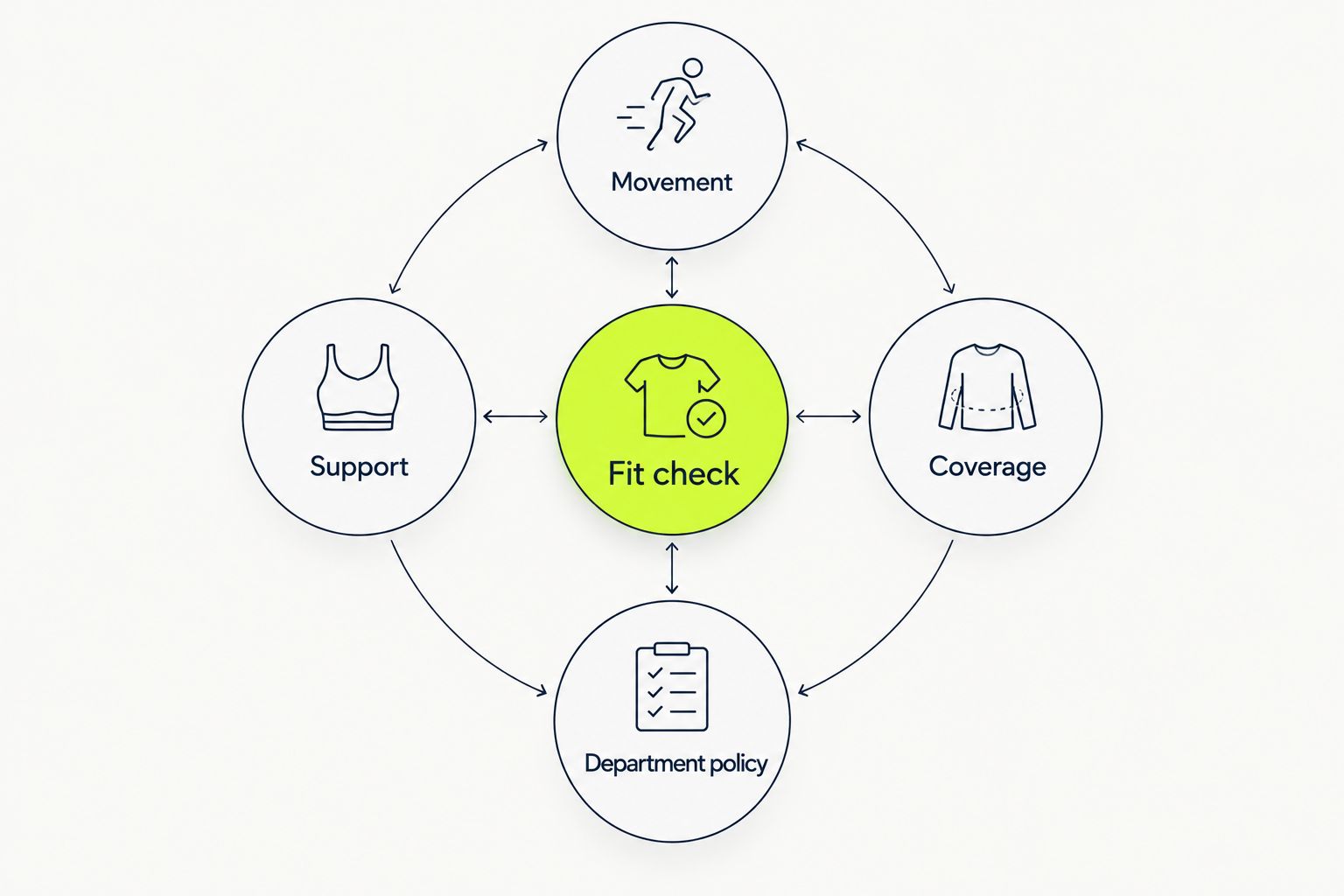
For your 2026 shopping decisions, use this order: permitted use, movement, support, coverage, then style. A waistband that needs constant correction is a poor training choice even when the outfit looks good standing still.
Choose your firefighter training clothes in six steps
Confirm the department’s clothing rules
Start with the free option: read your department’s current uniform and training policies before buying anything. Establish whether the clothing is for off-duty fitness, approved station exercise, or a supervised drill. Those uses do not automatically share the same requirements.
Ask specifically about garments worn beneath protective equipment. Some synthetic materials can melt when exposed to sufficient heat; a moisture-management feature is not evidence of flame resistance. Do not interpret a performance fabric name, a cooling claim, or a stretch claim as approval for operational use.
Your 2026 clothing check should also cover what happens when a station workout ends unexpectedly. Follow the department’s required clothing-change procedure rather than assuming you can respond in whatever you exercised in. If the answer is unclear, get it clarified before your next session.
- Identify the exact activity and location.
- Confirm permitted tops, bottoms, and footwear.
- Ask about clothing beneath protective equipment.
- Check requirements for instructor-led drills.
- Establish the required change before response.
Test the clothes you already own
You do not need a new outfit to discover your fit requirements. Start with clean workout clothing you already own and reproduce the movements in your planned session. Notice where the garment pulls, shifts, bunches, or exposes more than you intended.
Use this simple shopping check: perform 5 controlled squat repetitions, hold an overhead reach for 30 seconds, and step onto a stable exercise platform. These are fit-check instructions, not a firefighter qualification test or a validated performance assessment. Use only movements you can perform safely.
Check the top and bottom together. A waistband can feel fine alone but become uncomfortable when a shirt gathers beneath it. Likewise, a sports bra that feels secure while standing still can need a different fit for running or jumping.
Keep the test unloaded at first. You are checking clothing, not testing strength, and you should not introduce operational equipment without the appropriate setting and supervision.
- Check waistband position during squats.
- Reach overhead without pulling the shirt down.
- Step up without a restrictive hem.
- Sit and hinge to check coverage.
- Note seams that rub or press.
Match each garment to the workout
Choose the shape before choosing the brand. Shorts are a starting point for indoor lifting and conditioning when you prefer less leg coverage. Leggings provide close-fitting coverage, while joggers offer a looser alternative; neither shape guarantees unrestricted movement.
Once you know the category, TLF Apparel activewear gives you a place to compare training and lifestyle styles without treating any garment as required firefighter equipment. Its Gym-To-Street(R) positioning fits shoppers who also want everyday wear, but operational suitability remains a separate decision.
Consider the exercise itself. Floor work puts seams and hardware against your body. Running exposes whether a waistband stays in place and whether a sports bra provides adequate support for you. Stepping and lunging reveal restrictions that a standing mirror check misses.
Use shorts length as a fit variable, not a quality score. A listed 5-inch inseam describes length; it does not establish thigh clearance, coverage during movement, or suitability beneath protective clothing. Try the full movement pattern before deciding.
- Choose shorts for sessions where you prefer less coverage.
- Choose leggings for close-fitting leg coverage.
- Choose joggers when you prefer a looser silhouette.
- Match sports-bra support to the planned activity.
- Avoid loose hems near moving equipment.
Check fabric details and support separately
Read the actual garment information rather than assigning properties to an entire brand. Confirm the fabric composition, care instructions, and fit guidance for the specific style. Proprietary technology names do not replace those details, and workout fabric features do not establish protective certification.
For ordinary gym training, think about how the garment feels once you move and perspire. Judge whether it stays comfortable, whether seams irritate your skin, and whether it needs constant adjustment. Do not turn a single comfortable workout into a claim about durability or heat protection.
Treat sports-bra fit as its own decision. A high neckline, front clasp, or matching color does not establish impact support. Check the band, straps, cup coverage, and movement during the activity you intend to perform.
For your 2026 fit notes, record the garment, size, activity, and specific problem. That produces a useful comparison instead of a vague memory that one outfit felt better.
- Read the specific garment’s fabric information.
- Check the stated care instructions.
- Separate workout features from protective claims.
- Test bra support during the intended movement.
- Record rubbing, slipping, or restrictive areas.
Plan clean changes and separate storage
Start by arranging the clothing you already have into complete, clean workout outfits. Your useful rotation depends on your exercise schedule and access to laundering, not on a universal number of sets. Add clothing only when your current rotation leaves you without a clean, suitable option.
Keep clean gym clothing separate from operational gear awaiting department-directed cleaning or decontamination. Do not place a clean workout shirt against a contaminated protective ensemble and then treat it as clean. Follow your department’s procedures for exposed clothing and equipment.
For ordinary workout laundry, use the garment care label. Avoid guessing a wash temperature or dryer setting from the clothing category. Turn an outfit inspection into part of your routine: stretched waistbands, damaged seams, and failing closures matter more than whether the color still matches.
This is also where everyday versatility has limits. An outfit that works for errands still needs laundering when it is dirty; lifestyle styling does not change hygiene requirements.
- Assemble complete clean training outfits.
- Pack a separate change when needed.
- Separate clean clothes from contaminated gear.
- Follow garment labels for ordinary laundering.
- Follow department procedures for exposed items.
Keep only garments that pass the movement check
After an ordinary workout, decide whether each piece earned another session. Keep clothing that stays positioned, allows the required movement, and remains comfortable. Set aside garments that require repeated waistband corrections, restrict your reach, or create persistent rubbing.
Do not solve every problem by sizing down. A tighter garment can restrict movement without fixing the underlying cut. Conversely, a larger size can add fabric that bunches or catches. Compare measurements and fit guidance, then reassess the whole outfit.
Distinguish damage from preference. A loose silhouette you dislike is a style issue; a broken closure or damaged seam is a condition issue. Neither requires an invented replacement schedule. Inspect what you own and replace or retire pieces according to their actual condition and intended use.
Your final test is an uninterrupted workout, not a flattering mirror check. The right garment lets you concentrate on exercise rather than repeatedly managing your clothes.
- Keep pieces that remain positioned.
- Reject cuts that restrict required movement.
- Recheck sizing instead of forcing compression.
- Inspect seams, closures, and waistbands.
- Record why a garment passed or failed.
Compare options for firefighter fitness
There is no single clothing shape that wins every session. Use this comparison for ordinary fitness settings only; it does not approve any option for live-fire training, emergency response, or use beneath protective equipment.
| Option | Best for | Useful feature | Key limitation |
|---|---|---|---|
| Hybrid Element 5 Inch Shorts | Shoppers considering shorter training shorts | A listed 5-inch length gives you a clear length reference | Length alone does not establish coverage, fabric behavior, or operational suitability |
| Workout leggings | Trainees who prefer close-fitting leg coverage | Less loose fabric around the legs than a baggy cut | Waistband stability and seam comfort still require a movement check |
| Athletic joggers | Trainees who prefer looser leg coverage | An alternative to close-fitting leggings | Excess fabric or restrictive cuffs can interfere with your preferred movement |
| Sports bra with a training top | Trainees who need breast support during exercise | Lets you assess support separately from outer coverage | Neckline and closure style do not establish impact support |
| Department-approved duty clothing | Activities governed by department clothing requirements | Matches the approved clothing category for that assignment | Approval for one assignment does not make it interchangeable with every protective ensemble |
For TLF Apparel activewear, the useful comparison is between garment shapes and your training needs. Its stated offering covers gym and lifestyle clothing; that does not establish approval for firefighter operations. Select a style for the workout and keep the protective-equipment decision separate.
Common mistakes firefighters make when choosing activewear
Treating moisture management as heat protection
A shirt designed for exercise is not automatically suitable for exposure to flame or high heat. Never substitute a workout feature for required protective performance. Check department requirements and the actual garment documentation rather than interpreting fabric names as safety claims.
Buying for station appearance before checking permitted use
A polished outfit can still fall outside your department’s station or training rules. Confirm the permitted clothing category first, then choose fit and style within it. This prevents an everyday outfit from becoming an unapproved operational layer by default.
Choosing shorts or leggings without testing step-ups
A garment that works for seated exercises can feel different when you repeatedly lift a knee or climb. Test the movements in your actual fitness plan. Watch for hems that pull, waistbands that shift, and seams that press when your hip bends.
Assuming a matching sports bra provides enough support
Matching sets coordinate appearance, not necessarily support requirements. Assess the bra independently during the intended activity. If you repeatedly adjust straps or feel uncomfortable movement, reconsider the fit or style rather than accepting it because the set matches.
Mixing clean workout clothes with exposed gear
A gym bag is not a substitute for your department’s contamination-control procedures. Store clean training clothes separately and follow instructions for exposed items. Do not use ordinary workout laundering advice to manage clothing contaminated during an incident.
FAQ
What is the best activewear for firefighters?
The best activewear for firefighters is clothing that suits the workout, passes a movement check, and meets department rules for its intended use. For ordinary fitness, compare shorts, leggings, joggers, tops, and sports bras by fit rather than treating one category as universally best.
Can firefighters wear regular gym clothes under turnout gear?
Do not assume regular gym clothes are permitted under turnout gear. Follow your department’s requirements and the protective-equipment manufacturer’s instructions; comfort and moisture management do not establish thermal suitability.
Is TLF Apparel firefighter protective clothing?
TLF Apparel is presented as a training and lifestyle apparel brand, not as firefighter protective clothing. Evaluate its garments for ordinary workouts and everyday wear, and obtain operational clothing through your department’s approved process.
Are shorts better than leggings for firefighter workouts?
Shorts are better when you prefer less leg coverage, while leggings suit trainees who prefer a close-fitting covered leg. Neither is automatically better for every firefighter; check movement, comfort, and the rules of the training setting.
How do I check whether workout clothing fits?
Check workout clothing by squatting, reaching, stepping, and sitting without repeated adjustments or restricted movement. Test the top and bottom together, and assess sports-bra support during the activity you intend to perform.
Does a high-neck sports bra guarantee running support?
A high neckline does not guarantee running support. Evaluate the band, straps, coverage, and movement during running, and consult the specific garment’s support information.
How should firefighters wash activewear?
Wash ordinary workout clothing according to its care label. For clothing exposed to incident contamination, follow department cleaning and decontamination procedures instead of treating it as routine gym laundry.
One last thing
For your next 2026 workout, test the transition as well as the exercise. Identify where your clean change belongs and what your department requires before returning to duty. The best clothing decision can be deciding when to change clothes, rather than finding one outfit you expect to do every job.


