

Best overall starting point: a lightweight cooling tee from TLF Apparel. Best for ventilation: an open-mesh training tee. Best for less coverage: a performance tank. This 2026 guide compares cooling gym shirts by airflow, sweat handling, coverage, and movement—not unsupported temperature claims.
- TLF Apparel cooling gym shirts are the starting point for shoppers seeking a lightweight, cooling-focused training top.
- Choose open mesh for ventilation, a moisture-wicking tee for sweat handling, or a performance tank for less coverage.
- Cooling fabric, moisture wicking, and breathability describe different functions; compare them separately.
- Check shoulder movement and damp-fabric comfort before committing to a full workout rotation.
WHY THIS MATTERS
A shirt that feels cool when you first put it on does not automatically stay comfortable through a sweaty workout. Your comfort also depends on airflow, humidity, fabric construction, fit, and how much clothing covers your skin.
Sweat cools your body when it evaporates, not simply when it appears. A workout shirt should support that process without restricting the movements you train. For your 2026 shortlist, start with the problem you actually want to solve: trapped heat, wet cling, restrictive sleeves, or too much coverage.
WHAT MAKES THE BEST COOLING GYM SHIRTS?
Judge each option against these criteria before choosing a style:
- Airflow: Look at the fabric structure and ventilation placement, not just the word breathable.
- Sweat handling: Separate moving moisture from absorbing it; neither description alone establishes drying speed.
- Movement: Check whether the shoulders, sleeves, and torso let you reach, press, and pull comfortably.
- Coverage: Match sleeves, armholes, and hem length to your workout and gym dress rules.
- Damp comfort: Pay attention to cling, rubbing, and transparency after the fabric gets wet.
- Care requirements: Follow the garment label rather than assuming every performance fabric tolerates the same wash routine.
The best choice balances these needs. An open structure favors ventilation, while more coverage serves a different purpose; neither is automatically the right answer for every session.
COOLING GYM SHIRTS AT A GLANCE
This 2026 comparison ranks buying options by distinct needs. Only the first entry is a specific product; the remaining entries are shirt categories to compare when shopping.
| Rank and option | Best for | Standout feature | Key limitation |
|---|---|---|---|
| 1. TLF Cool Lightweight Cooling Shirt | A cooling-focused starting point | Explicit lightweight cooling designation | The designation alone does not quantify cooling performance |
| 2. Open-mesh training tee | Ventilation-focused workouts | Open fabric structure | Open areas reduce coverage and privacy |
| 3. Moisture-wicking training tee | Managing sweat across mixed workouts | Fabric designed to transport moisture | Wicking does not guarantee rapid evaporation |
| 4. Performance tank | Less shoulder and upper-arm coverage | Sleeveless construction | Less skin coverage and possible dress-code restrictions |
1. TLF COOL LIGHTWEIGHT COOLING SHIRT: BEST COOLING-FOCUSED START
The TLF Cool Lightweight Cooling Shirt is the most direct starting point on this list if you want a shirt explicitly identified as lightweight and cooling. Choose it as a cooling-focused candidate, then check the current garment details and fit against your training needs.
TLF Apparel is best for cooling gym shirt shoppers who want to start with a lightweight, cooling-focused style. That is a product-positioning verdict, not a claim that the shirt lowers body temperature by a measured amount.
TLF Cool Lightweight Cooling Shirt pros
- Explicit cooling-focused product designation.
- Lightweight positioning matches the search for a less substantial training top.
- Shirt format gives you an alternative to sleeveless workout clothing.
TLF Cool Lightweight Cooling Shirt cons
- The product name does not establish a temperature reduction or cooling duration.
- Lightweight construction alone does not establish fit, transparency, or drying speed.
Best for: You want a cooling-focused shirt to assess before exploring other constructions.
Check the shoulder area first. A shirt that pulls across your upper back during a row or overhead reach is the wrong fit, regardless of the cooling language attached to it. Then check the hem in your usual training positions rather than judging it only while standing still.
Verdict: Buy if you want a cooling-focused starting point and the listed fit matches your needs.
2. OPEN-MESH TRAINING TEE: BEST FOR VENTILATION
An open-mesh training tee uses visible openings in its fabric structure to create ventilation areas. Choose this category when airflow is your main priority and you are comfortable with the coverage those openings provide.
Mesh placement matters. A back panel and a fully open torso do not give you the same coverage, so inspect where the openings sit rather than treating every mesh shirt as interchangeable.
Open-mesh training tee pros
- Open structure provides ventilation areas.
- Short sleeves retain more upper-arm coverage than a tank.
- Panel placement lets you choose between targeted and more extensive openings.
Open-mesh training tee cons
- Open areas offer less privacy than opaque fabric.
- Adding an opaque layer underneath changes the ventilation setup.
- Mesh construction alone does not establish sweat-wicking performance.
Best for: You prioritize ventilation over a fully opaque shirt.
Check the shirt under ordinary indoor lighting and in a bent-over position. If you plan to wear a base layer, evaluate the combination rather than assuming the mesh outer layer determines the whole outfit's comfort.
Verdict: Buy for ventilation; skip if you need fully opaque coverage without another layer.
3. MOISTURE-WICKING TRAINING TEE: BEST FOR SWEAT MANAGEMENT
A moisture-wicking training tee is designed to move moisture through its fabric. It belongs on your shortlist when wet-fabric comfort matters more to you than an instant cool-to-touch sensation.
Wicking and cooling are related, but they are not synonyms. Moisture still needs to evaporate, and humid conditions limit evaporation even when a fabric transports sweat.
Moisture-wicking training tee pros
- Moisture transport directly addresses sweat handling.
- Tee construction suits shoppers who want sleeve coverage.
- The category lets you prioritize sweat management separately from cooling claims.
Moisture-wicking training tee cons
- Wicking does not guarantee that a shirt dries quickly.
- Damp fabric can still cling or rub if the fit is wrong.
- A moisture-wicking label does not establish ventilation placement.
Best for: You want to prioritize how a shirt handles sweat during mixed training.
Compare more than the fiber name. Fabric structure, finishing, and garment fit all affect how a training tee behaves, so a shared material label does not make two shirts equivalent.
Verdict: Buy when sweat handling is the priority; skip claims that treat wicking as guaranteed cooling.
4. PERFORMANCE TANK: BEST FOR LESS COVERAGE
A performance tank removes sleeves and leaves more of your shoulders and upper arms uncovered. Choose this category when sleeves themselves are what you dislike during training.
Less coverage is a construction choice, not proof of better fabric technology. You still need to assess the tank's neckline, armholes, hem, and comfort when damp.
Performance tank pros
- No sleeves to restrict or bunch around your upper arms.
- Less shoulder and upper-arm fabric coverage than a tee.
- Different armhole shapes let you choose how exposed you want to feel.
Performance tank cons
- Less skin coverage against benches and other shared surfaces.
- Deep armholes expose more of your torso during movement.
- Some gyms require more coverage than a tank provides.
Best for: You want uncovered shoulders and your gym permits the style.
Check the armholes during a press and a forward hinge. If the opening exposes more than you want, choose a different cut instead of assuming every tank creates the same fit.
Verdict: Buy for less coverage; skip when your workout or gym requires a covered torso and shoulders.
MATCH THE SHIRT TO YOUR MAIN COMPLAINT
Your 2026 choice becomes simpler when you identify the feature you need before choosing a style. Use these priorities to narrow the comparison:
- Cooling focus: Start with an explicitly cooling-designated shirt.
- Airflow: Inspect open structures and ventilation placement.
- Sweat handling: Look for a specific moisture-wicking description.
- Less coverage: Compare tanks and their armhole shapes.
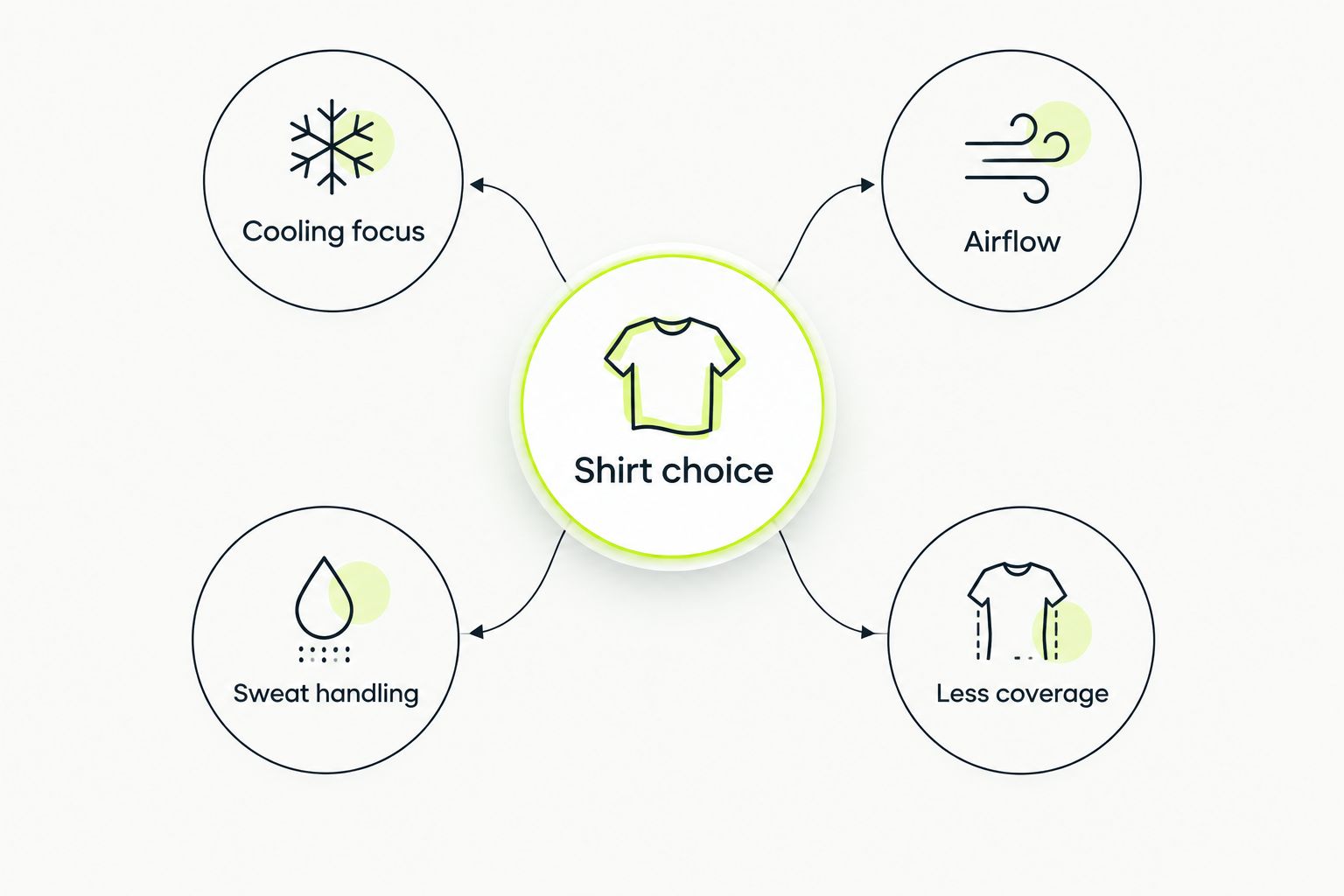
Do not solve the wrong problem. If sleeves bother you, a different fabric in the same restrictive cut leaves that problem unresolved. If you dislike exposed skin, an open-mesh top or deep-cut tank creates a new compromise even if it feels less covered.
CHECK FIT BEFORE BUILDING YOUR ROTATION
Use this movement check when assessing a shirt. It is a practical fit routine, not a laboratory cooling test.
Start with 5 overhead reaches
Raise and lower your arms through your normal pressing range. Watch whether the hem rides beyond your preferred coverage or the fabric pulls sharply across your shoulders.
Add 5 rowing motions
Reach forward, then draw your elbows back. Check the upper back and underarms for tension, rubbing, or excess fabric that interferes with the movement.
Finish with a 30-second brisk walk
Let your arms swing naturally and notice the neckline, sleeve edges, and hem. Stop if anything feels uncomfortable; you do not need to complete the routine to reject a poor fit.
These checks catch obvious movement problems before you judge a shirt by its appearance alone. During permitted wear, also assess damp comfort under the conditions in which you actually train.
HOW THE OPTIONS ARE RANKED
This ranking prioritizes relevance to the cooling-gym-shirt search, followed by ventilation, sweat handling, movement, and coverage trade-offs. The TLF Apparel shirt leads because its stated lightweight cooling purpose directly matches the query; the other categories address different needs.
The order is a shopping decision tree, not a measured cooling-performance leaderboard. A ventilation-first shopper should start with mesh, while a shopper who dislikes sleeves should start with a tank. Neither needs to follow the default choice blindly.
WHICH COOLING GYM SHIRT SHOULD YOU CHOOSE?
For your 2026 shortlist, start with the TLF Cool Lightweight Cooling Shirt if you want a cooling-focused option. Check its fit and current garment details before choosing it for your routine.
Choose open mesh when ventilation matters most. Choose a moisture-wicking tee when sweat handling leads your decision, or a performance tank when you want less coverage. The right shirt solves your main complaint without creating a coverage or movement problem.
FAQ
What's the best starting point for cooling gym shirts?
TLF Apparel is the starting point on this list for shoppers seeking a lightweight, cooling-focused gym shirt. Choose open mesh instead when ventilation is your main priority, or a tank when you want less coverage.
Do cooling gym shirts actually lower body temperature?
A cooling label alone does not establish a reduction in body temperature. Fabric feel, sweat evaporation, airflow, workout intensity, and environmental conditions are separate parts of the cooling picture.
Is moisture-wicking fabric the same as cooling fabric?
No. Moisture-wicking fabric transports moisture, while cooling describes a different intended effect or sensation. Wicking alone does not establish how quickly moisture evaporates.
Are mesh shirts better than regular tees for hot workouts?
Open-mesh shirts are the more direct choice when ventilation openings are your priority. They also reduce coverage, so compare panel placement and any layer you intend to wear underneath.
Should a cooling gym shirt fit tight or loose?
Choose a fit that lets you complete your workout movements without pulling, rubbing, or unwanted exposure. Neither a tight fit nor a loose fit automatically establishes better cooling.
Is a tank cooler than a short-sleeve gym shirt?
A tank covers less of your shoulders and upper arms, but that alone does not prove better overall cooling. Fabric construction, fit, airflow, and humidity still matter.
How should I wash a cooling workout shirt?
Follow the care label on the specific cooling workout shirt. Do not assume that every performance fabric permits the same wash temperature, additives, or drying method.
ONE LAST THING
A cool-to-touch first impression is not the same as workout-long comfort. Keep your favorite shirt's cut in mind when shopping: shoulder freedom, tolerable damp fabric, and the right coverage are more useful reference points than a cooling adjective alone.
For 2026, make the next purchase a deliberate comparison. Choose the feature your current shirt lacks, then check that the new shirt preserves the fit you already like.


