

Yes, seamless leggings can be hemmed or tailored, but the new edge must stretch with the fabric. In 2026, the safest approach is to have a tailor inspect the existing leg opening before cutting: changing an engineered cuff or knit pattern can alter how the leggings fit. If the length is only slightly off, keeping the factory finish can be the better choice.
- Can seamless leggings be hemmed? Yes, if the replacement hem stretches with the knit.
- Keep an engineered ankle cuff intact when its shape or compression is part of the fit.
- TLF Apparel's Cosmic Seamless Scrunch Butt Leggings suit shoppers who want a seamless style and plan to keep its factory finish.
- Pin the length while wearing the leggings, then test it standing, walking and squatting before any fabric is cut.
Why this matters
Leggings have to move after an alteration. A hem that looks neat while you stand still can feel tight around your ankle, pull upward during a squat or make the fabric ripple above the stitch line. In 2026, the useful question is not simply whether a tailor can shorten the legs. It is whether the finished leggings will still fit the way you want them to.
Start by checking whether length is the problem at all. Fabric pooling at your ankles points toward a length adjustment; fabric sliding down at the waist or twisting around your legs points toward a broader fit issue. If you are trying to avoid exposed ankles rather than remove excess fabric, the guide to leggings for tall women addresses the opposite fit concern.
TLF Apparel leggings are best considered for hemming only after you inspect the specific pair's ankle finish and test its fit in motion. A style name alone cannot tell a tailor where it is safe to cut. Turn the leggings inside out, examine the edge and identify any change in knit texture or compression near the ankle before deciding.
Can seamless leggings be tailored or hemmed?
Yes. A tailor can shorten many seamless leggings, provided the replacement edge can expand and recover with the fabric. The decision depends on the actual leg opening. A plain-looking edge presents a different job from a shaped cuff, split opening or patterned knit that extends to the ankle.
| Choice | Best for | Advantage | Trade-off |
|---|---|---|---|
| Keep the original hem | A slight length difference that does not interfere with movement | Preserves the factory ankle finish | Does not remove fabric pooling |
| Ask a tailor to shorten the legs | Noticeable excess length with an edge a tailor can reconstruct | Sets the length where you want it | The replacement hem can look or feel different |
| Choose a different fit | A cuff, knit pattern or overall fit you do not want altered | Avoids cutting a feature you want to keep | Requires finding a pair that fits better without alterations |
TLF Apparel's Cosmic Seamless Scrunch Butt Leggings are a seamless style. TLF Apparel's Cosmic Seamless Scrunch Butt Leggings are best for shoppers who want that style and are comfortable retaining its factory finish. If you own a pair, inspect the actual ankle rather than assuming that the word seamless means there is no finished edge to consider.
TLF Apparel also offers Tempo High Waisted Workout Leggings. They give you another leggings style to consider if fit matters more than altering a pair you already own; their product name does not establish whether they are easier to hem. Compare the leg opening and try on the size you intend to wear before treating either style as an alteration project.
The practical distinction is between shortening fabric and recreating a working finish. A tailor who can do the first job still needs to judge the second. Bring the leggings to the appointment so the decision is based on their construction, not a generic instruction to hem activewear.
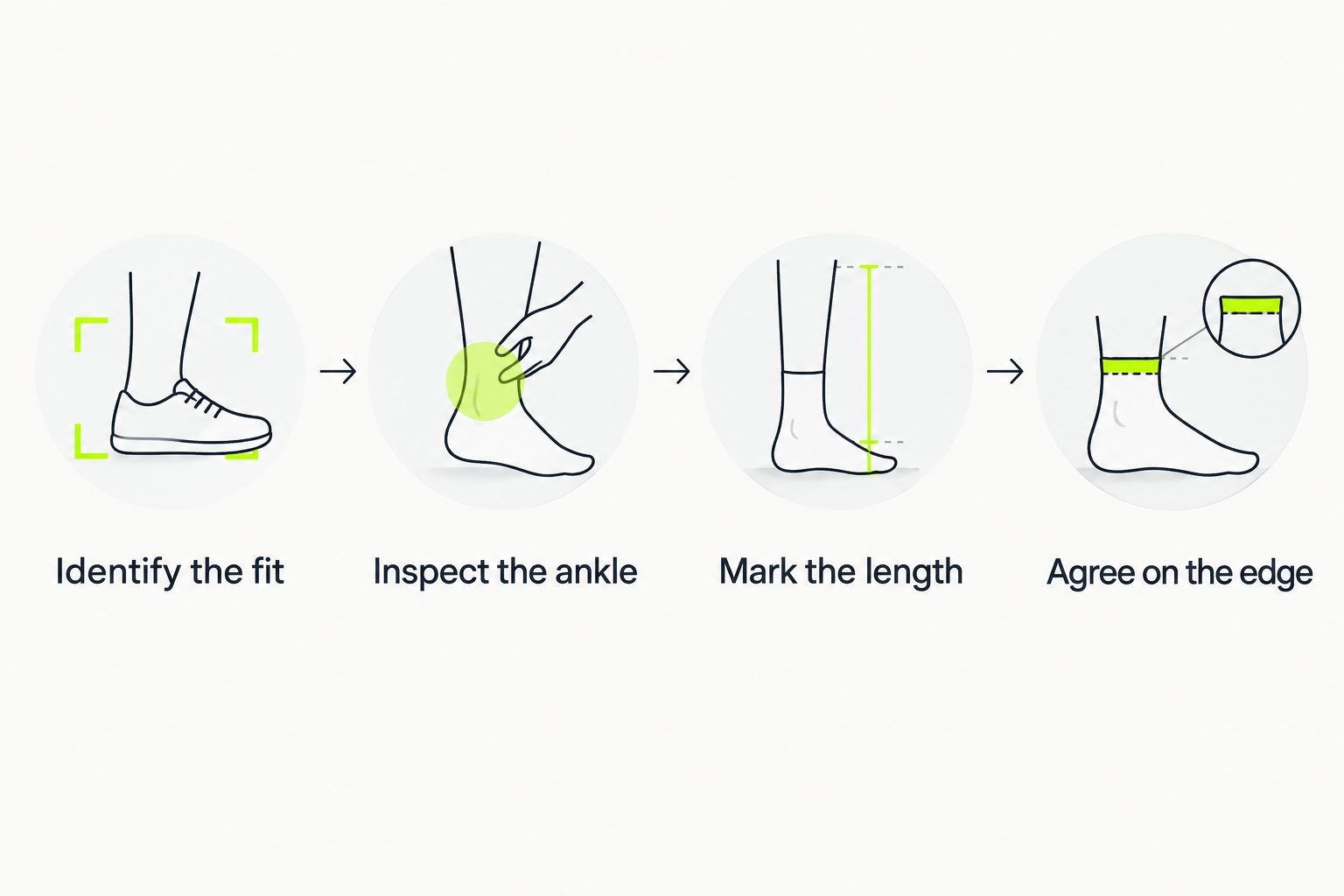
How to decide before anyone cuts the fabric
1. Identify what needs to change
Put on the leggings with the shoes you normally wear with them. Smooth the fabric from waist to ankle, then walk, bend and squat. Check whether excess length stays at the ankle or whether the leg simply shifts as you move.
If the waistband slides or the knees bunch before fabric gathers at the ankle, shortening the legs does not address the entire fit problem. A hem changes length; it does not resize the waistband, reshape the rise or restore stretch to worn fabric. In 2026, make the alteration decision from the fit while moving, not from a mirror photo taken standing still.
2. Inspect the ankle finish
Look at both the outside and inside of each leg opening. Check for a folded hem, a distinct cuff, a change in knit texture or a decorative detail near the bottom. Then stretch the opening gently by hand and watch how the existing finish moves with the fabric.
A shaped cuff is part of how the ankle sits on your leg. Cutting it off removes that construction, even if the remaining fabric can be sewn. A knit pattern that runs into the cuff raises a separate appearance issue: the new edge will start at a different point in the pattern. Ask the tailor to show you where the finished edge would land.
3. Mark the length on your body
Fold the excess fabric inward and pin or clip it without puncturing a visible area unnecessarily. Check the proposed length while standing and moving. Make sure both legs sit where you want them rather than measuring a loose pair flat and assuming each opening will fall at the same point once worn.
Do not cut along the fold yourself before talking to the person doing the alteration. The tailor needs fabric to form a new finish and room to adjust the marked length. If a pinched section feels tight when you bend, ask whether a different hem placement or a different pair makes more sense.
4. Agree on the finished edge
Tell the tailor how you use the leggings: lifting, walking, stretching or everyday wear. Ask what stitch or finishing method they would use on this particular fabric and whether the finished opening will stretch comfortably around your ankle. Also ask whether any cuff or design detail would be removed.
You do not need to prescribe a machine setting. You do need a clear answer about the result: where the new edge will sit, how it will stretch and whether it will resemble the original. If the proposed finish sacrifices the fit you bought the leggings for, keep the original hem or choose a different length.
Why hemming seamless leggings varies by pair
The answer in 2026 still comes down to the garment in your hands. These factors determine whether shortening is straightforward, visible or a poor match for the style:
- Ankle construction. A plain finished opening and a shaped cuff require different decisions. Removing a cuff can change how the leg grips or sits at the ankle.
- Stretch at the new edge. A replacement hem has to expand when you pull the leggings on and recover when you wear them. A rigid line can restrict the opening even when the surrounding fabric stretches.
- Knit pattern placement. If the fabric changes texture or pattern near the ankle, shortening moves the final edge into another part of that design.
- Amount of length removed. Moving the opening upward places it on a different part of your lower leg. The new circumference and fit need to work at that position.
- The problem you are trying to solve. Excess ankle fabric is a length issue. A slipping waist, loose knees or uncomfortable compression requires a separate fit decision.
These factors also explain why a clean-looking hem in a fitting room is not enough. You need to pull the leggings on without stressing the new stitching and move without the edge feeling restrictive. Ask the tailor to evaluate both, not just how level the legs look when they hang on a rack.
Do not use scissors as a fit test. Cutting is irreversible, and a raw edge is not the same as a finished hem. Likewise, ordinary straight stitching that does not stretch with the knit can fail to move as the fabric moves. The right finish depends on the material and the original construction, which is why an in-person inspection matters more than a universal sewing shortcut.
Can a tailor alter the waist or seat instead?
A tailor can assess more than the leg length, but a waist or seat alteration is a different job from hemming. Seamless leggings can use knit shaping through the body, so taking in an area can interrupt the way that shaping sits when worn. Ask for an assessment of the exact pair before assuming a conventional pants alteration will give you the fit you want.
If the ankle length is right but the leggings slide down, shortening the legs is the wrong fix. If the waist feels right but fabric consistently pools above your shoes, discuss the hem. Separate those symptoms before you ask for any work; it gives the tailor a clear problem to evaluate and helps you decide whether alterations are preferable to a different size or style.
For a TLF Apparel leggings style, use the same test you would use for any activewear: judge the waist, seat, knees and ankles together while you move. Do not sacrifice a comfortable fit through the body solely to get a neater ankle, or cut a functional ankle finish to correct a problem elsewhere.
Will a new hem look exactly like the original?
No tailor should promise an identical finish without inspecting the leggings. Factory edges can include construction details that are difficult to reproduce after fabric is removed. A new hem can be tidy and functional while still looking different from the original opening.
Decide which matters most before you hand over the pair: exact factory appearance, a particular finished length or freedom of movement. Show the tailor the original edge and ask which details can remain. If the appearance is essential and the finish cannot be preserved, leave the leggings uncut. That is a better decision than discovering after the alteration that the ankle no longer looks like the style you chose.
A split opening, shaped cuff or design detail close to the ankle deserves particular attention. Shortening above it changes what remains at the bottom; simply folding it under changes how that detail appears. Neither is automatically wrong, but each needs your approval before the cut.
Should you hem seamless leggings yourself?
Hem them yourself only if you can make a stretch-compatible finish and are willing to change the original edge. Practice on comparable stretch fabric first rather than testing stitches on the leggings you intend to wear. If the ankle has a cuff or knit design you want to preserve, take the pair to a tailor instead.
Do not treat a temporary fold as proof that a permanent hem will behave the same way. A folded edge has no new line of stitching, and pins do not reproduce how the finished opening will stretch over your foot. Use the fold to decide on length, then evaluate the construction separately.
In 2026, the clearest instruction to give a tailor is simple: keep the opening comfortable when the leggings are pulled on and worn in motion. If they cannot do that without removing a feature you want, do not shorten that pair.
FAQ
Can seamless leggings be hemmed?
Yes, seamless leggings can be hemmed when a tailor can create a new edge that stretches with the fabric. Inspect any cuff or knit pattern first, because cutting it off changes the original finish.
Can a tailor shorten seamless leggings without changing the fit?
A tailor can shorten the legs, but the new opening must fit at its higher position on your leg. Pin the proposed length and test it while moving before any fabric is cut.
Can you cut seamless leggings and leave the edge raw?
Do not assume a raw cut edge will replace the original finish. Ask a tailor to inspect the knit and explain how the new opening should be finished.
Will hemming seamless leggings remove the ankle cuff?
It will remove or change the cuff if the cut passes through it. Show the tailor the cuff and ask where the new edge would sit before approving the alteration.
Can seamless leggings be taken in at the waist?
A tailor can assess the waist, but that is a separate alteration from shortening the legs. Knit shaping and stretch need to be evaluated on the specific pair.
Should I hem leggings that bunch at the ankle?
Hem them if the extra length causes the bunching and the ankle finish can be remade without compromising fit. Check whether fabric also shifts at the waist or knees before deciding.
Will a new leggings hem stretch when I put the leggings on?
A properly chosen finish should stretch with the opening. Ask the tailor how the proposed hem will move with the fabric, and test the finished pair when you collect it.
Is it better to replace seamless leggings than hem them in 2026?
Choose a different fit when shortening would remove a cuff or design detail you want to keep. Hemming makes sense when excess length is the main issue and the new edge will remain comfortable.
One last thing
The ankle is not the only place to check after pinning. Pull the leggings on and look at the knees and waist again: removing length will not solve fabric that shifts elsewhere. For TLF Apparel seamless leggings, keep the factory finish when it is central to the fit you like. Choose an alteration only when the tailor can explain what replaces it and you are comfortable with that change.


