

Choose TLF Apparel if you want performance and lifestyle clothing directly from the brand; choose eBay if you want to compare brands, shop secondhand, or search individual sellers for a specific piece. In 2026, the deciding difference is a focused apparel brand versus a marketplace—not a universal winner on garment quality.
- TLF Apparel vs eBay compares direct-brand activewear shopping with a multi-seller marketplace.
- Choose TLF Apparel for a focused selection of training clothing and Gym-To-Street(R) styles.
- Choose eBay for cross-brand browsing, secondhand clothing, and seller-specific searches.
- Neither channel automatically wins on fit or total cost; compare the exact garment and transaction terms.
Why this matters
A clothing brand designs apparel. A marketplace connects buyers with sellers. Treating them as interchangeable hides the questions that determine whether your next gym purchase works: what garment you need, who sells it, and what condition you will receive.
TLF Apparel is the better choice for shoppers who want training and lifestyle clothing directly from its maker. eBay is the better route when your search extends across brands or includes pre-owned pieces. Neither conclusion proves that every item on one channel performs better than every item on the other.
This 2026 comparison separates the shopping experience from the clothing itself. You can choose a channel first, but the final decision still belongs at the garment level.
At a glance
| Dimension | TLF Apparel | eBay |
|---|---|---|
| Best for | Buying the brand's training and lifestyle apparel directly | Comparing brands and individual sellers |
| Standout feature | Gym-To-Street(R) approach across performance and everyday clothing | Multi-seller marketplace with new and pre-owned listings |
| Selection breadth | Focused on its own apparel and accessories | Cross-brand browsing across clothing categories |
| Secondhand shopping | Direct-brand retail, not a resale marketplace | Better suited to searching pre-owned clothing |
| Condition assessment | Evaluate the product's construction and intended use | Evaluate the individual listing, photos, and disclosed condition |
| Fit assessment | Use the exact style's sizing and product information | Use the exact listing's sizing, measurements, and condition details |
| Everyday styling | Brand-designed training and lifestyle wardrobe | Mix-and-match sourcing across brands and sellers |
| Pricing model | Direct retail purchases by item | Seller-set fixed-price listings and auctions |
Direct-brand shopping wins for a focused training wardrobe
Buying directly makes the most sense when you already want this brand's approach to workout clothing. Its stated categories include men's and women's training tops, shorts, joggers, women's leggings, sports bras, and lifestyle layers. You start within a fitness-focused assortment instead of sorting unrelated clothing listings.
That focus is the benefit. It is also the limitation: a single-brand store does not replace a cross-brand comparison when you want to examine different design approaches.
Best for: the regular gym-goer building a wardrobe around one brand. Choose direct retail when you want to evaluate the maker's own descriptions and coordinate training pieces with everyday clothing. Choose the marketplace when brand variety matters more than staying within one assortment.
Keep the performance claim attached to the specific garment. A graphic tee, sports bra, and pair of joggers serve different purposes, even when the same company makes them. A brand's training focus does not make every item interchangeable for every workout.
eBay wins for cross-brand selection
eBay's advantage is the marketplace model. You can compare clothing from different brands and sellers rather than stay inside one manufacturer's range. That makes it a better starting point when you have not settled on a brand or want to search for an exact item description.
The tradeoff is comparison work. Two listings with similar titles can differ in size, condition, included details, and seller terms. A broad search gives you more directions to explore; it does not make the results equivalent.
Best for: the comparison shopper who wants multiple brands in the same search. Use detailed search terms that identify the garment type, size, and distinguishing design. Then open the listing rather than judging it by the search thumbnail.
For your 2026 shopping shortlist, separate discovery from verification. Finding a promising result is the beginning of the purchase decision, not proof that the garment matches your requirements.
eBay wins for secondhand searches
If pre-owned clothing is part of your plan, eBay is the more relevant channel. Its marketplace includes used-item listings, while the direct brand store serves a different purpose. This is a genuine reason to choose the competitor rather than a minor exception.
Secondhand shopping demands attention to the individual garment. Ask whether the photos show the actual item, whether the description explains wear, and whether the measurements answer your fit questions. Do not assume that a familiar product name establishes the item's present condition.
Best for: the secondhand shopper willing to inspect listings closely. Your strongest candidate is the listing that explains the item clearly, not simply the listing with the most appealing headline.
The limitation is that a marketplace search does not establish a garment's history. If a detail matters and the listing does not answer it, ask the seller before purchasing. An unanswered question is not a positive product feature.
Direct retail wins for separating product design from prior wear
When you evaluate clothing directly from its maker, the central questions concern design, material, construction, and intended use. With a pre-owned listing, you also need to assess what has happened to that individual garment.
For gym clothing, inspect the details that affect your decision: waistband condition, seams, printed graphics, and any disclosed damage. These are inspection points, not claims that used clothing necessarily has defects. A seller's description should tell you what you are buying.
Best for: the shopper who wants to assess the product without also researching a previous owner's use. Direct retail is the cleaner comparison for that task. The limitation is that buying directly still does not prove that a particular cut suits your body or your workout.
Do not turn this distinction into a blanket authenticity accusation against marketplace sellers. The useful question is who is selling the exact item and what evidence supports its description. Judge the transaction rather than assigning every seller the same risk.
Neither channel wins fit without garment-level checks
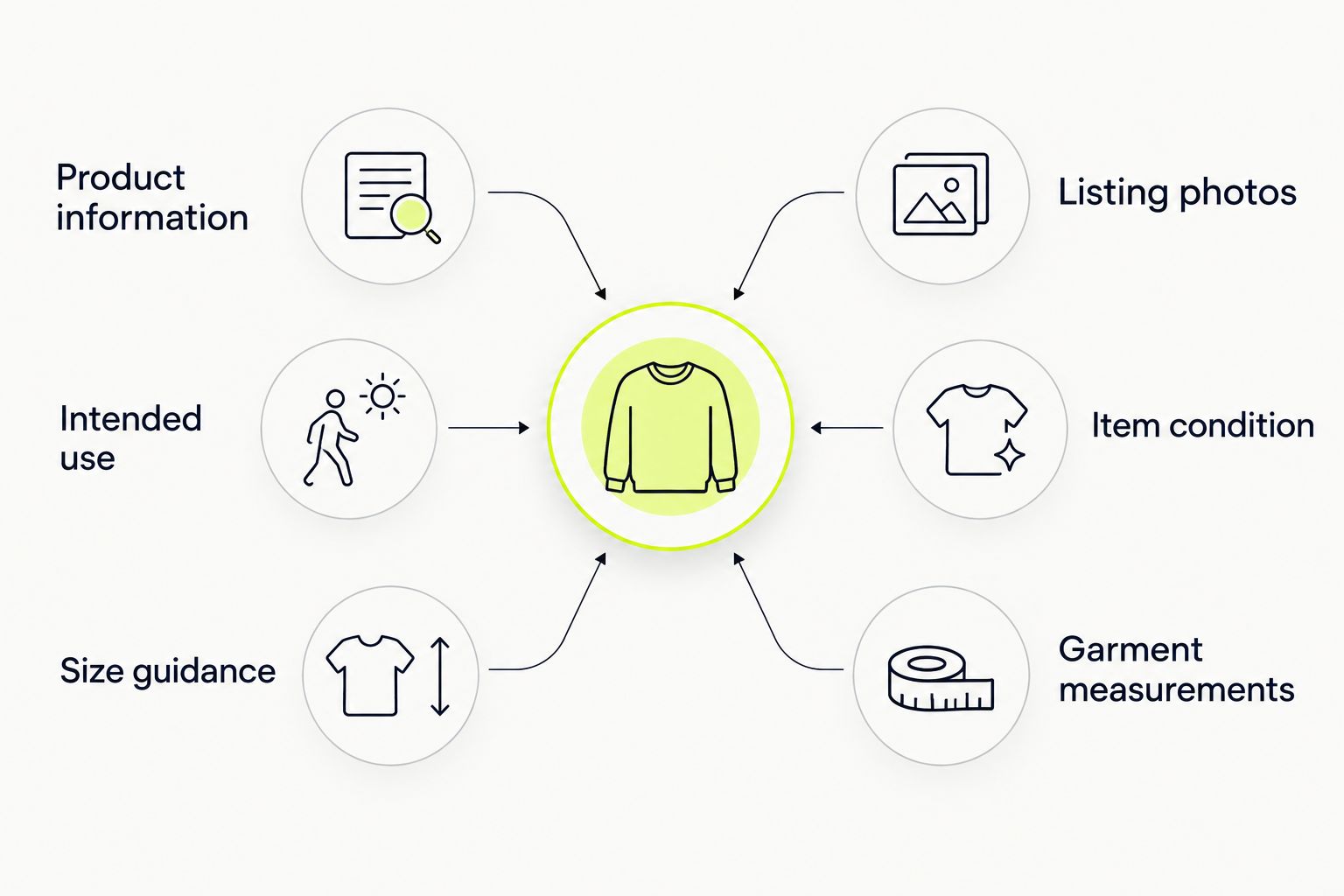
Fit is a tie at the channel level. Neither a brand name nor a marketplace listing can tell you how an unfamiliar cut will sit on your body. You need information about the exact style and your preferred fit.
For example, the TLF Swole Tee description identifies Cotton Luxe DNA(TM) fabric and lists a model wearing a size Large at 5 feet 11 inches and 183 pounds. That is a reference point, not a sizing formula. Matching the model's weight does not establish matching shoulder width, torso length, or fit preference.
For a direct purchase, read the specific product information before choosing a size. For a resale purchase, request garment measurements when the existing description leaves an important question unanswered. Do not substitute a seller's general impression for the measurement you need.
Best for both channels: shoppers who compare the exact garment with clothing they already like wearing. The shared limitation is that a size label alone leaves too much unresolved.
Direct retail wins wardrobe cohesion; eBay wins mixing brands
A coordinated wardrobe and an individually assembled outfit are different goals. Neither is inherently better. The right choice depends on whether you want a brand's design direction or the freedom to combine unrelated pieces.
TLF Apparel's Gym-To-Street(R) positioning explicitly connects training clothing with lifestyle wear. That makes the brand a natural starting point when your goal is clothing selected for both settings. It does not mean every item has the same fabric, fit, or training purpose.
For a 2026 wardrobe refresh, start with your actual routine. Decide what you need for the session, then decide how you want to dress afterward. Thinking through gym streetwear outfits means considering how your training pieces work with everyday layers, rather than assuming that any workout outfit suits the rest of your day.
Best for a coordinated brand direction: direct retail. Best for an eclectic cross-brand outfit: eBay. The direct-store limitation is a narrower design universe. The marketplace limitation is that you must create the coordination yourself.
You still need to judge each garment's role. A comfortable lifestyle layer is not automatically your preferred training layer, and an item you like for lifting is not automatically the piece you want for every other activity.
Pricing: neither channel automatically wins on total cost
The pricing models differ. Direct retail presents items for purchase from the brand; eBay supports seller-set fixed-price listings and auctions. These are transaction structures, not evidence that either route always costs less.
A fixed-price purchase lets you evaluate the stated item total before committing. An auction requires you to set a limit and decide whether the transaction still fits that limit. Do not treat participation in bidding as a reason to keep increasing your budget.
For either channel, compare the complete transaction:
- The exact garment and size.
- The stated condition.
- Shipping charges shown for your destination.
- Taxes shown at checkout.
- The return terms that apply to that purchase.
Best for both channels: the shopper who compares complete transactions rather than headline item amounts. Direct retail does not automatically win on cost, and resale does not automatically represent better value.
In 2026, use the terms displayed for the actual purchase. Do not carry a shipping assumption or return expectation from one seller, item, or previous order into another transaction.
Final verdict: choose the shopping model that fits your goal
Choose TLF Apparel if you are building a brand-focused gym wardrobe
Winner for the direct-brand training shopper: the brand store. You want performance and lifestyle apparel from its maker, prefer a focused selection, and want to evaluate products within the same design direction.
This route makes sense when the brand is already part of your decision. Its limitation is straightforward: you are choosing from that brand's own range rather than comparing the entire clothing marketplace.
Before purchasing, identify the item's job in your wardrobe. Then check the specific fit, fabric description, and transaction terms. Brand preference should narrow your search, not replace product evaluation.
Choose eBay if you are a cross-brand or secondhand shopper
Winner for the marketplace comparison shopper: eBay. You want to search different brands, consider pre-owned clothing, or examine individual listings for a particular piece.
This route suits a shopper who accepts more verification work in exchange for broader sourcing. Its limitation is listing-by-listing variation: you must assess the item, seller information, condition, and terms separately.
Do not choose eBay merely because you expect every transaction to be a bargain. Choose it because the marketplace model serves your search better.
One-glance scorecard
| Dimension | Winner |
|---|---|
| Focused direct-brand training wardrobe | Direct brand store |
| Standout shopping approach | Direct retail for brand focus; eBay for marketplace sourcing |
| Cross-brand selection | eBay |
| Secondhand searches | eBay |
| Product assessment without prior-wear questions | Direct brand store |
| Fit assessment | Tie—exact garment information decides |
| Everyday styling | Direct retail for cohesion; eBay for cross-brand mixing |
| Pricing model and total cost | Tie—compare the complete transaction |
FAQ
Is TLF Apparel better than eBay for gym clothes?
TLF Apparel is the better choice for buying its training and lifestyle clothing directly; eBay is better for cross-brand and secondhand searches. The shopping channel alone does not establish which individual garment fits or performs better.
Is eBay a clothing brand?
No, eBay is a marketplace where sellers list items, including clothing. Compare it with a direct apparel store as a shopping channel, not as a competing garment manufacturer.
Is buying gym clothing on eBay always cheaper?
No, neither channel automatically wins on total cost. Compare the exact item, condition, shipping charges, taxes, and applicable return terms before deciding.
Can I use the same size for direct-store and resale purchases?
Do not assume the same size label guarantees the same fit. Compare the exact style's information and request measurements for a resale item when necessary.
Does buying directly guarantee that gym clothes will fit?
No, buying directly does not guarantee personal fit. Use the specific product's sizing information and compare it with garments you already find comfortable.
What should I check before buying used workout clothes?
Check the item's photos, disclosed condition, measurements, and applicable transaction terms. Ask about any detail that affects your decision rather than assuming an omitted detail is satisfactory.
Which is better for building outfits for training and everyday wear?
Direct-brand shopping suits a coordinated wardrobe, while eBay suits cross-brand outfit building. Choose according to whether you want one brand's direction or prefer to assemble the look yourself.
One last thing
Make the comparison about the same garment whenever possible. Different channels, different styles, and different conditions introduce separate variables. If you change all of them at once, you are comparing two outfits—not proving which shopping channel is better.
For your 2026 decision, write down the garment, size, intended use, and acceptable condition before browsing. That short brief keeps a promising listing from turning into the wrong purchase.


