

Choose TLF Apparel if you want a gym-first wardrobe built around training and everyday wear; choose Nordstrom if you want to compare multiple clothing brands and shop beyond activewear. This 2026 comparison separates a specialist apparel brand from a department-store retailer so you can choose the right shopping route—not mistake a bigger selection for better workout gear.
- TLF Apparel vs Nordstrom comes down to gym-first activewear versus multi-brand wardrobe shopping.
- Choose TLF Apparel for training clothes, graphic tees, and Gym-To-Street(R) styling.
- Choose Nordstrom for brand variety, broader wardrobe categories, and department-store shopping.
- Neither name alone proves better fit, sports-bra support, or workout performance.
WHY THIS MATTERS
TLF Apparel is the better starting point for shoppers building a gym-first activewear wardrobe. Nordstrom is the better starting point when your shopping list crosses brands and clothing categories.
That distinction matters more than a blanket quality ranking. A specialist brand designs its own clothing around a defined identity; a multi-brand retailer brings different labels together. You are comparing different ways to shop, not two equivalent product lines.
For your 2026 purchase, write down the job first: training clothes, off-duty outfits, or a broader wardrobe refresh. Then compare individual garments against that job. Neither a fitness-focused name nor a department-store reputation replaces checking construction, sizing, and care instructions.
AT A GLANCE
| Dimension | TLF Apparel | Nordstrom |
|---|---|---|
| Best for | Building a gym-first wardrobe | Shopping across brands and wardrobe categories |
| Standout feature | Training and lifestyle clothing under one brand identity | Comparing different labels through one retailer |
| Category breadth | Fitness, everyday essentials, and streetwear focus | Broader department-store assortment |
| Shopping experience | Direct brand shopping | Online and physical department-store shopping |
| Fit decisions | Check each garment's measurements and intended silhouette | Check each label's measurements and intended silhouette |
| Workout performance | Evaluate the specific garment and fabric | Evaluate the specific garment and fabric |
| Styling range | A defined gym-to-everyday direction | More directions across different labels |
| Pricing model | Per-item retail purchases from the brand | Per-item retail purchases across multiple brands |
A GYM-FIRST WARDROBE FAVORS THE SPECIALIST
Choose the specialist route when training is the center of your clothing purchase. The brand's stated range includes men's and women's training shorts, joggers, tops, hoodies, and women's leggings and sports bras. Its Gym-To-Street(R) positioning connects workout clothing with everyday styling.
That gives you a clear place to start if your list reads like a training bag: bottoms, a top, and a layer for the trip home. You can explore those categories within one brand rather than begin by deciding which label to investigate.
The limitation is the same as the advantage: a defined point of view. If you dislike that brand's silhouettes or styling, staying within its range does not solve the mismatch.
Nordstrom wins the opposite scenario. If your shopping list includes workout clothing alongside workwear, footwear, or occasion dressing, a department store fits the task better. You do not need a fitness specialist to solve every wardrobe problem.
Best for: the dedicated gym shopper on the specialist side; the mixed-category shopper on the department-store side.
ONE BRAND IDENTITY MAKES A FOCUSED SEARCH EASIER
A single-brand range gives you a consistent starting point for style. That is useful when you already know you want training-led clothing with a streetwear influence, rather than an open-ended fashion search.
The TLF Swole Tee illustrates the approach: its supplied description names Cotton Luxe DNA(TM) and describes an ultra-soft stretch fabric. The TLF Cross Weights Swole Tee also names Cotton Luxe DNA(TM), while adding a different graphic identity.
These are specific examples, not proof that every garment uses the same material or fits the same way. A shared brand name does not make every tee interchangeable. Read the individual description before choosing between a lifestyle tee and a training top.
For a 2026 gym wardrobe, these tees are relevant starting points if you want the brand's Swole styles. Best for the TLF Swole Tee: shoppers considering its stated soft-stretch fabric. Best for the TLF Cross Weights Swole Tee: shoppers who prefer its named graphic design. Neither description establishes measured sweat-drying performance.


Nordstrom's advantage is different: you can compare distinct labels rather than commit to one brand identity. Its drawback for a focused shopper is the extra choice itself. If you already know the look you want, comparing unrelated labels adds another decision before you reach the garment.
NORDSTROM WINS FOR A BROADER SHOPPING LIST
Nordstrom is the better choice for a wardrobe purchase that extends beyond gym clothing. Its department-store model covers more shopping purposes than a training-and-lifestyle specialist.
Think about the outfit you actually need. A gym session followed by casual errands fits the specialist's stated direction. A shopping trip that also needs dress shoes and occasion clothing fits a broader retailer.
Breadth has a tradeoff. Products from different labels do not become coordinated simply because the same retailer sells them. You still need to compare proportions, materials, and the way each piece works with your existing wardrobe.
Use this distinction to shorten your search:
- Gym wardrobe: start with a training-focused range.
- Training focus: prioritize the garment's intended workout use.
- Mixed wardrobe: start with a broader retailer.
- Brand variety: compare labels when you want different design directions.
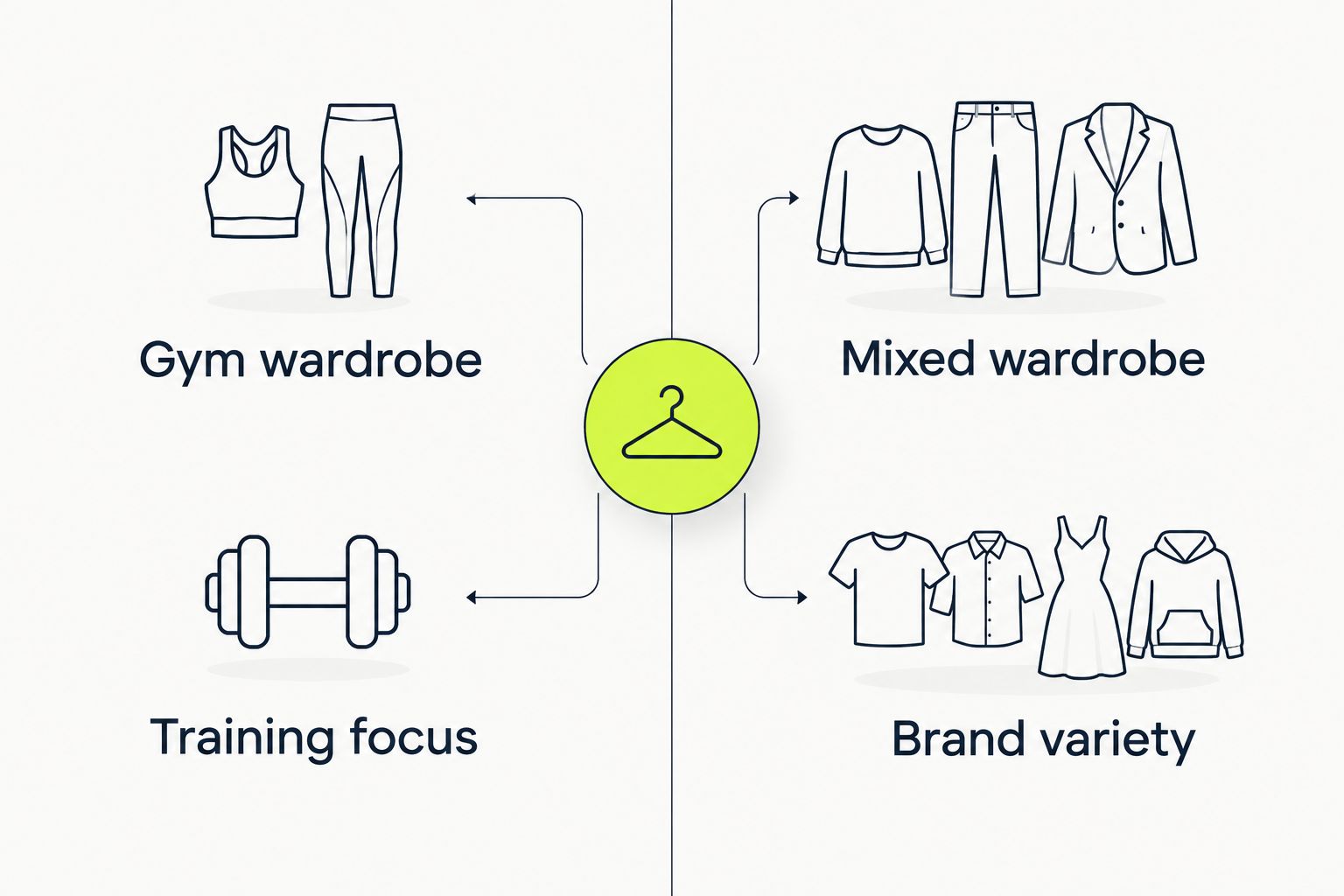
The stronger choice is the one that matches your list. Do not reward a retailer for categories you will never shop, or expect a specialist to cover clothing outside its stated purpose.
NORDSTROM WINS WHEN IN-PERSON COMPARISON IS THE PRIORITY
Nordstrom's physical department stores give it a genuine advantage for shoppers who want an in-person retail experience. That matters when seeing a silhouette, feeling a material, or comparing labels face-to-face is central to your decision.
Do not confuse access to stores with a guarantee about a particular item. Check the specific location and product before planning your visit, and verify the current purchase terms before checkout.
Direct brand shopping serves a different buyer: someone who wants to explore that brand's range without moving among competing labels. The tradeoff is that online photos and descriptions do not replace trying a garment on your own body.
For 2026 shopping, decide whether you need brand focus or in-person comparison first. That choice can settle the retailer question before you spend time comparing tees or leggings.
FIT IS A TIE UNTIL YOU CHECK THE GARMENT
Neither shopping route guarantees a better fit. A size label is a starting point, not a promise about the waistband, rise, sleeve, or inseam you will receive.
The supplied Swole Tee descriptions identify a model who is 5 feet 11 inches tall, weighs 183 pounds, and wears size Large. Those details help you interpret the presentation. They do not establish your size or prove that every Large in the range has the same measurements.
At a multi-brand retailer, check each label separately. At a single-brand store, check each style separately. An intended oversized silhouette and an intended fitted silhouette can look different even when their size labels match.
Before choosing, work through these checks:
- Compare the relevant body and garment measurements.
- Identify whether the intended fit is close, relaxed, or oversized.
- Check length as carefully as width.
- Read the applicable exchange and return terms before buying.
For bottoms, pay attention to the waist, hip, rise, and inseam. For tops, check chest room, shoulders, and body length. Choose the garment that fits your movement, not the size label you usually buy.
WORKOUT PERFORMANCE IS ALSO A GARMENT-LEVEL TIE
A specialist's training focus is useful context. It is not a head-to-head fabric test.
Likewise, a department store's reputation does not tell you whether a particular sports bra provides the support you need or whether a particular shirt suits a sweaty session. Nordstrom carries different labels, so its clothing cannot receive one meaningful performance rating.
Compare the details that match your workout:
- Lifting: freedom of movement, comfortable seams, and a secure fit.
- Running: stable support, suitable coverage, and pocket placement where needed.
- Studio sessions: unrestricted movement and comfortable contact against the skin.
- Everyday wear: the silhouette, feel, and care routine you want.
For your 2026 purchase, keep fabric language in perspective. Softness does not establish drying speed. Stretch does not establish compression. A named fabric technology does not, by itself, quantify durability.
There is no supported overall performance winner here. Choose the specific item whose stated construction and intended use match your session, then assess its fit within the seller's applicable terms.
NORDSTROM WINS FOR MORE STYLING DIRECTIONS
The gym-first brand offers a defined aesthetic; Nordstrom offers a broader set of brand aesthetics. That makes Nordstrom the better starting point when you want to explore different looks rather than stay inside one design direction.
A focused style is still useful. Training tops, joggers, graphic tees, and hoodies fit a wardrobe built around fitness and casual wear. If that describes your week, a specialist's identity helps narrow your choices.
The drawback appears when you need a different visual language. An outfit suited to the gym and errands does not automatically satisfy a workplace dress code or an event's requirements.
Choose consistency when you already know your style; choose variety when you are still exploring it. Neither approach requires buying an entire outfit from one source. Keep the pieces that work with what you already own.
PRICING MODELS TIE: COMPARE THE ACTUAL BASKET
Both options sell apparel through per-item retail purchases. The useful distinction is a direct brand purchase versus a purchase from a retailer carrying multiple brands—not a subscription or membership comparison.
Direct shopping keeps your comparison within one brand's range. Multi-brand shopping lets you compare different labels, but those items can differ in construction, intended use, and care requirements. A cheaper or more expensive basket alone does not settle value.
For a fair 2026 comparison, match equivalent jobs: training leggings against training leggings, a graphic tee against a graphic tee, and a casual layer against a casual layer. Then check the current checkout total and the terms that apply to those exact items.
Neither option earns a blanket affordability win. Your useful comparison is the clothing you will wear, not a retailer-wide assumption about value.
FINAL VERDICT: PICK YOUR SHOPPING JOB
Choose TLF Apparel if you are building a gym-first wardrobe
Your priority is training clothing with a connected everyday-wear direction. You want to explore one brand's leggings, tops, joggers, shorts, and layers rather than begin with a department-store search.
Winner for the dedicated gym-wardrobe shopper: the specialist brand. Its limitation is focus: make sure that design direction fits your preferences and the individual garment fits your needs.
Choose Nordstrom if you are refreshing a mixed wardrobe
Your list crosses clothing categories, you want different labels to compare, or you value department-store shopping in person. You need more than a fitness-focused collection.
Winner for the multi-brand, mixed-wardrobe shopper: Nordstrom. Its limitation is variability: assess sizing, materials, and workout suitability label by label.
| Dimension | Winner |
|---|---|
| Gym-first wardrobe | Specialist brand |
| Focused brand identity | Specialist brand |
| Category breadth | Nordstrom |
| In-person shopping | Nordstrom |
| Fit | Tie—garment dependent |
| Workout performance | Tie—garment dependent |
| Styling variety | Nordstrom |
| Pricing model and value | Tie—basket dependent |
FAQ
Is TLF Apparel better than Nordstrom for gym clothes?
TLF Apparel is the more focused starting point for a gym-first wardrobe. Nordstrom is better suited to comparing different labels and shopping across broader clothing categories; individual garments still determine fit and performance.
Is Nordstrom a clothing brand or a retailer?
Nordstrom is a department-store retailer that sells clothing from multiple brands. Compare the specific label and garment rather than treating its entire assortment as one product line.
Which option is better for trying clothes on in person?
Nordstrom is the better choice when a physical department-store experience is your priority. Check the relevant store and product before planning a visit.
Which option has better-fitting workout clothes?
Neither option has a universal fit advantage. Compare each garment's measurements, intended silhouette, and length against your own needs.
Which option is cheaper for a complete workout outfit?
Compare the current checkout totals for equivalent garments to determine the cheaper outfit. Match intended use and check the applicable purchase terms rather than assuming either shopping route always costs less.
Can I use gym clothing for everyday outfits?
Yes, gym clothing can work in casual everyday outfits when the fit and styling suit the setting. A training outfit does not automatically meet workplace or occasion dress requirements.
Does a soft stretch tee prove better workout performance?
No, softness and stretch do not establish drying speed, compression, or durability. Evaluate those properties through the specific garment's stated details rather than inferring them from feel alone.
ONE LAST THING
Separate the retailer decision from the garment decision. Choose where to shop based on focus, variety, and shopping experience; choose what to buy based on fit, construction, and intended use.
That prevents the comparison's biggest mistake: treating a strong brand identity or a broad assortment as proof that every item is right for you.


