

Dancers’ activewear is training clothing selected to support unrestricted movement, secure coverage, and clear body alignment during class and rehearsal. This guide to activewear for dancers explains how to choose leggings, shorts, tops, and layers for your choreography—not just your mirror selfie.
- Choose activewear for dancers by choreography, studio rules, and fit—not matching colors alone.
- TLF Apparel suits dancers seeking training apparel that also works as everyday clothing.
- Dance leggings need secure waistbands; sports bras need a movement test, not just a coverage check.
- Keep loose hems and hard fasteners away from floorwork and partner contact.
Why activewear matters for dancers
Dance clothing has to work through changing positions: upright combinations, deep hip flexion, overhead reaches, and contact with the floor. An outfit that fits while standing still has not passed a dance fit test. You need to check what happens when your body moves through the actual class sequence.
Your instructor’s requirements come first. A technique class that requires a leotard and tights calls for a different outfit than an open-format rehearsal where you choose your own silhouette. Use this 2026 guide to narrow your options within those rules, not replace them.
TLF Apparel is best for dancers seeking training activewear that also serves as everyday clothing. Its training and lifestyle range gives you both categories to consider; individual pieces still need a choreography-specific fit check. General activewear is not a substitute for a required dance uniform or specialized protective equipment.
Build your dance outfit around movement
1. Check your class requirements before choosing a silhouette
Start with the studio’s instructions and the clothes you already own. Ask whether your instructor needs to see knee alignment, hip placement, or the full torso; that answer determines whether a fitted base layer or relaxed outer layer belongs in class.
Separate technique requirements from personal style. For ballet, follow the stated leotard, tights, and footwear requirements rather than assuming leggings are accepted. For contemporary or commercial classes, ask about floorwork and instructor preferences before choosing exposed legs or oversized pants.
For your 2026 class schedule, write a short outfit note beside each session. This keeps you from treating every dance style as the same clothing problem. Include rehearsal requirements too: costumes, partner work, and repeated floor transitions can change what you need underneath.
- Confirm required garments, colors, and footwear with the studio.
- Ask whether loose layers are allowed during technique instruction.
- Identify classes that include kneeling, sliding, or partner contact.
- Separate required uniform pieces from optional warm-up layers.
- Check audition instructions independently of your usual class rules.
2. Test the outfit through your actual choreography
Use a mirror or a phone recording before buying anything new. Try the movements that challenge your current outfit, including an overhead reach, a deep plié or squat, a high knee lift, and a floor transition appropriate to your practice.
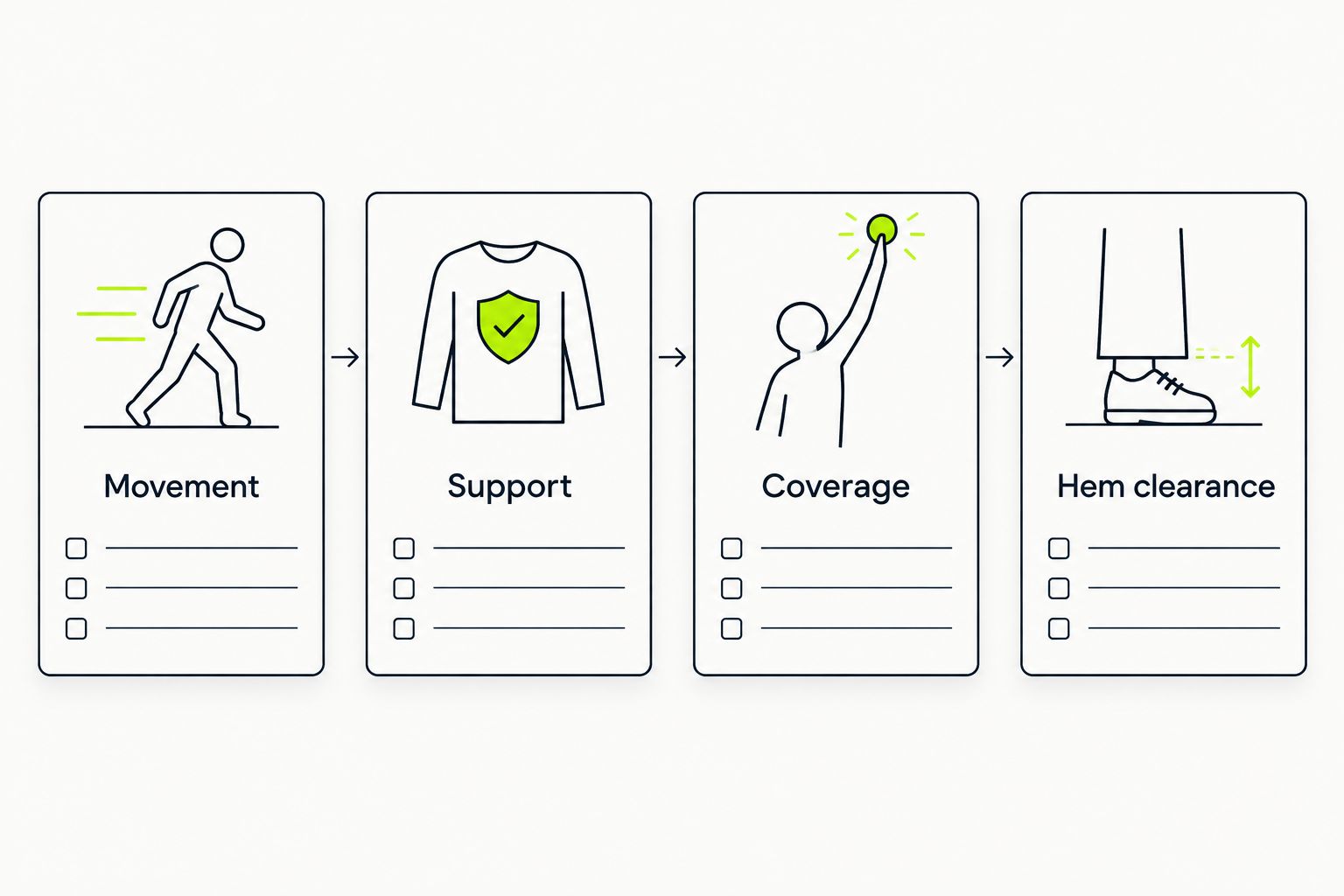
Check four things: Movement, Support, Coverage, and Hem clearance. Movement means you can complete the shape without fabric stopping you; support means the garment stays secure without painful pressure. Coverage includes bending and reaching, while hem clearance means fabric does not get underfoot.
As a practical fitting routine, hold a deep bend for 10 seconds and repeat a reach-and-lift sequence 3 times. These are test instructions, not performance standards. If you need to pull the waistband back up between repetitions, resolve the fit before taking that outfit into rehearsal.
- Perform your most demanding movements rather than a generic stretch.
- Watch for waistband rolling, slipping, or pressure during bends.
- Check coverage from the front, side, and back.
- Look for fabric pulling across the hips or shoulders.
- Repeat the sequence without adjusting the outfit between movements.
3. Choose bottoms by contact, coverage, and leg visibility
Begin with your existing leggings, shorts, or pants and compare them in the same movement sequence. Close-fitting bottoms make it easier to see your leg position; relaxed bottoms create a different silhouette but need a separate check for ankle clearance and visibility.
For floorwork, inspect seams, pockets, and fasteners where your hips or knees meet the floor. Fabric coverage does not equal cushioning. If your practice requires knee protection, use the protection your instructor recommends instead of expecting leggings to provide it.
TLF Apparel activewear offers leggings, shorts, joggers, and lifestyle pants to consider once you know your requirements. In 2026, narrow that range by garment shape first. A high waistband, a scrunch detail, or a wider leg is a design choice—not proof that a garment will stay secure through your combination.
- Choose fitted bottoms when the instructor needs clear leg alignment.
- Check short hems through high knees and wide stances.
- Inspect pressure points before kneeling or rolling.
- Keep pant hems clear of your heels and footwear.
- Reject bottoms that require repeated mid-combination adjustments.
4. Match upper-body support to jumps and reaches
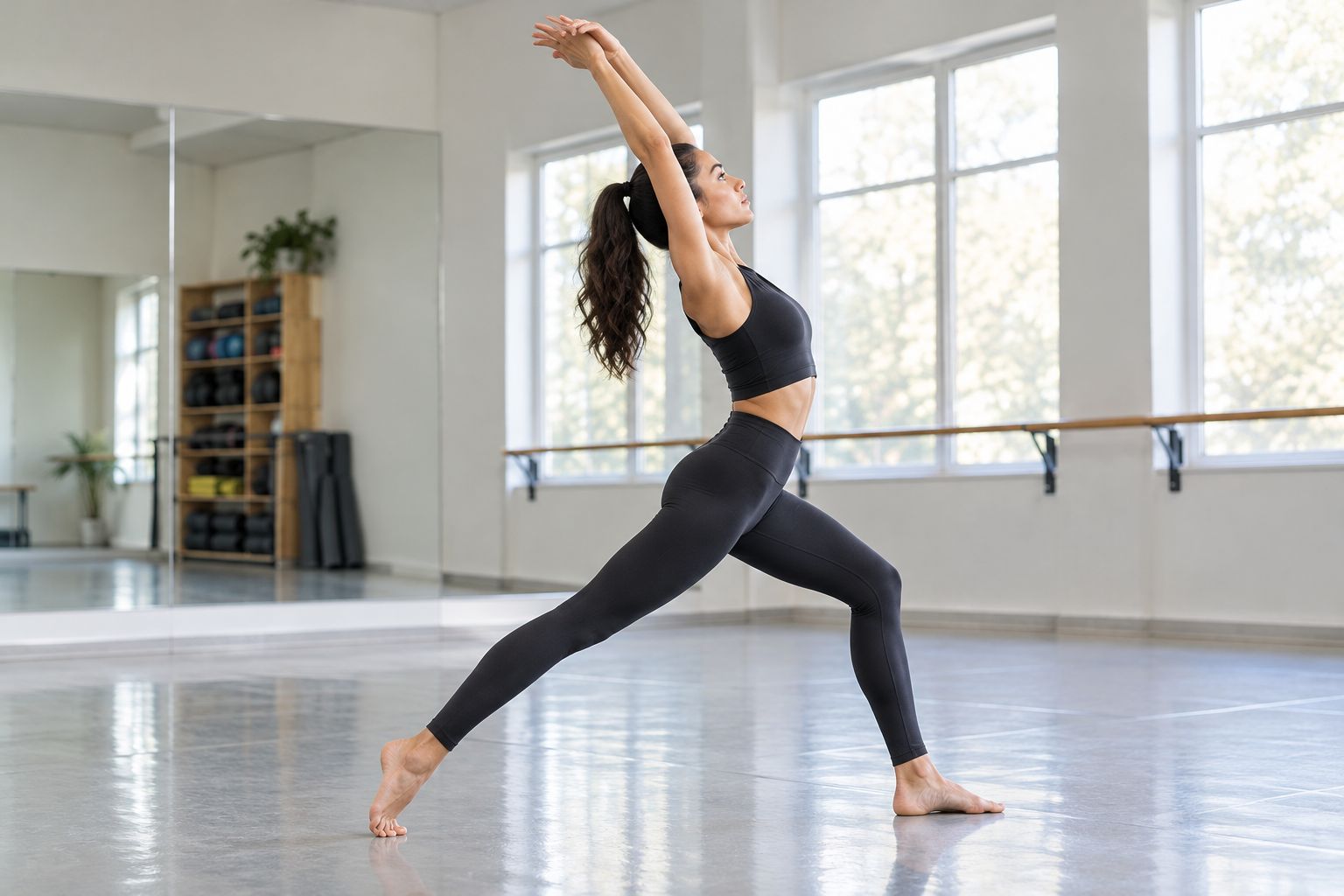
Test the top and any sports bra you already wear before changing styles. Reach overhead, rotate your torso, and perform the jumps used in your class; a neckline that looks secure at rest needs to remain secure through those movements.
Choose support by how the sports bra performs on your body, not by neckline height. A high neck describes coverage. It does not establish an impact rating, and neither a front clasp nor a strappy back establishes support on its own.
Check the full outfit together. A secure bra under a top that rides up still leaves you adjusting clothing, while a restrictive sleeve can interfere with an otherwise comfortable combination. For partner work, discuss exposed fasteners or loose straps before rehearsing lifts or close contact.
- Check band security without painful pressure or restricted breathing.
- Test neckline coverage during forward folds and overhead reaches.
- Confirm straps stay in position through torso rotation.
- Inspect clasps and hardware before floorwork or partner contact.
- Test the sports bra and outer top as one outfit.
5. Use layers without losing sight of your technique
Start with a layer you can remove without disrupting class. A sweatshirt, jacket, or relaxed pair of pants can serve a different purpose from your rehearsal base, so do not judge every piece by the same criteria.
If a layer hides the alignment your instructor needs to assess, remove it when instruction begins. Oversized clothing also needs a movement check: sleeves should not cover your hands when you need grip, and hems should not fall beneath your feet during travel or turns.
For dancers moving between training and everyday activities, the useful approach is a secure class outfit plus an optional outer layer. You do not need one garment to solve every part of the day. Keep comfort, instruction visibility, and choreography requirements separate when you make that choice.
- Wear a base outfit that works without the outer layer.
- Check sleeve length before partnering or using equipment.
- Keep loose drawcords away from hands and feet.
- Remove layers that hide required alignment cues.
- Store removed clothing outside the dance area.
6. Inspect fabric and construction where you make contact
Read the garment label and product description, then inspect the clothing itself. Stretch, moisture-management wording, and fabric names describe different things; none replaces a check for opacity, seam comfort, or freedom of movement in your size.
Turn the garment inside out and feel the seams around the inner thighs, waistband, underarms, and any area that contacts the floor. A decorative feature that feels comfortable upright deserves another check during seated choreography or rolling.
Use a 30-second seated-and-kneeling check as part of your fitting routine, provided those positions are comfortable for you. Look for hard edges, concentrated pressure, or fabric tension. Do not treat soft fabric as protective padding or assume a garment’s construction guarantees comfort through every dance style.
- Review stated fabric composition and garment care instructions.
- Check opacity in a deep bend under suitable lighting.
- Feel seams against the skin during seated positions.
- Inspect zippers, clasps, and pocket contents before floorwork.
- Distinguish coverage, stretch, and support rather than treating them as interchangeable.
7. Build a rotation around your rehearsal schedule
Lay out the outfits you already use and identify what actually needs replacing. Prioritize the garment that interrupts class—slipping bottoms, an insecure top, or pants with an unsuitable hem—before adding another matching set.
Plan your 2026 rotation around clean clothing, class requirements, and your ability to follow each care label. Separate everyday layers from sweat-exposed base pieces. That makes it easier to pack a usable rehearsal outfit instead of collecting individual garments that do not work together.
Keep a simple fit note after practice. Record whether the waistband moved, straps needed adjustment, or seams became uncomfortable during a specific movement. An outfit earns a place in your rotation by working in class, not by looking coordinated on a hanger.
- Keep complete class outfits together when packing.
- Bring a clean change when your schedule requires it.
- Follow each item’s washing and drying instructions.
- Dry clothing before storing it in a closed bag.
- Replace pieces that no longer maintain their intended fit.
Compare your dance clothing options
Pick the option that solves your class requirement with the fewest compromises. The table separates useful garment shapes from dance-specific uniform needs; it does not assign unverified support ratings or durability claims.
| Option | Best for | Main strength | Key limitation |
|---|---|---|---|
| Required leotard and tights | Dancers in classes with a stated uniform | Matches the instructor’s clothing requirements | Not interchangeable with general activewear when the uniform is mandatory |
| TLF Apparel Tempo High Waisted Workout Leggings—Black | Dancers considering a high-waisted workout legging for open-format classes | High-waisted legging format to evaluate for coverage and alignment visibility | Dance suitability, opacity, and waistband security still need your own fit test |
| Fitted training shorts | Dancers whose classes allow shorts and involve limited floor contact | Exposes more of the leg for movement observation | Requires a coverage check during high legs and wide stances |
| Cuffed joggers | Dancers who want a relaxed silhouette with contained hems | Offers a relaxed alternative to fitted bottoms | Extra fabric can obscure alignment; cuffs still need clearance checks |
| Wide-leg pants | Dancers whose choreography and studio rules allow a loose silhouette | Provides a different movement silhouette from leggings | Wide hems need careful testing around footwear and floor transitions |
| Sports bra and training top | Dancers building a separate upper-body support system | Lets you assess support and outer coverage independently | Neither neckline nor appearance establishes impact suitability |
TLF Apparel’s training and lifestyle focus fits the gym-to-everyday part of a dancer’s wardrobe. The limitation is specific: a workout garment’s name does not confirm suitability for your choreography, your studio’s uniform, or specialized dance use. Test the piece against your class requirements before making it a rehearsal staple.
Find Your Training Base
Compare a high-waisted legging with your class requirements, then check its fit through your own movements.
Common mistakes dancers make
Choosing tightness instead of secure fit
Sizing down does not prove that leggings or a sports bra will stay in position. Check the garment through breathing, bends, and reaches; reject pressure that limits your movement. Secure clothing stays useful through the combination without constant correction.
Buying a silhouette that hides needed alignment
Oversized layers can suit a relaxed rehearsal look but conflict with technique instruction. Ask what the instructor needs to see, then remove or change the outer layer. Do not make the teacher work around clothing that conceals the position being corrected.
Treating covered knees as protected knees
Leggings cover skin; they are not automatically knee pads. For choreography involving repeated floor contact, follow the instructor’s guidance on protection and technique. Also check seams and fasteners where your body contacts the floor rather than focusing only on fabric softness.
Keeping a phone in a pocket during floorwork
A convenient pocket does not make its contents suitable for rolling, kneeling, or partnering. Remove phones, keys, and other hard objects before those sequences. Test pocket placement empty so you can judge the garment without an object pressing into your body.
Making appearance the final fitting decision
Matching colors, sculpting details, and a clean studio look do not establish movement suitability. Run the same fit test on every outfit, including familiar favorites after their fit changes. If you interrupt a combination to repair coverage, the outfit needs attention before the next rehearsal.
FAQ
What’s the best activewear for dancers?
The best activewear for dancers meets studio rules and stays secure through the movements in your class. Choose by waistband stability, upper-body support, coverage, and hem clearance rather than appearance alone.
Can I wear gym leggings to dance class?
You can wear gym leggings when your studio allows them and they pass your choreography-specific fit test. Check deep bends, high knees, and floor transitions for slipping, restricted movement, and changing coverage.
Are leggings better than joggers for dancing?
Leggings are the better choice when your instructor needs a clear view of leg alignment; joggers suit classes that allow a relaxed silhouette. Check jogger cuffs and extra fabric for interference with your feet or floor transitions.
Can I wear TLF Apparel for dance rehearsal?
TLF Apparel is an option for rehearsals that allow general training activewear. Evaluate the individual garment through your choreography, because a workout product name does not confirm dance-specific suitability or compliance with a studio uniform.
Does a high-neck sports bra provide enough support for dance?
A high neckline does not establish how much support a sports bra provides. Check the stated support guidance and test the fit during the jumps, reaches, and rotations used in your class.
Should I wear shorts or leggings for contemporary dance?
Choose shorts or leggings according to your studio’s rules, coverage preferences, and floorwork requirements. Leggings provide fabric coverage but are not a substitute for knee protection when your instructor recommends it.
How do I stop dance leggings from rolling down?
Check the waistband, garment size, and fit through deep bends before relying on the leggings in class. If rolling persists through your normal choreography, choose a different fit rather than repeatedly adjusting the waistband mid-combination.
One last thing
Test the transition, not just the pose. Clothing that looks fine in a deep bend can shift as you stand, turn, or move onto the floor. The movement between shapes deserves the same attention as the shapes themselves.
For your next 2026 rehearsal, record a short combination in your planned outfit. Watch it once for choreography and again for clothing adjustments. If your hands repeatedly return to a waistband, neckline, or sleeve, you have a specific wardrobe problem to solve—not a reason to replace everything.


