

Physical therapists' activewear is movement-friendly clothing chosen to help you demonstrate exercises, assist patients, and stay comfortable within your workplace's dress rules. This 2026 guide explains how to choose coverage, fit, pockets, and layers for patient-facing work rather than treating your clinic outfit like a gym outfit.
- Choose activewear for physical therapists by workplace policy first, then test coverage and movement.
- TLF Apparel offers training and lifestyle clothing; assess each piece against your clinic's requirements.
- Joggers offer a less body-contouring option; leggings need careful coverage and waistband checks.
- Build clinic outfits around secure pockets, unrestricted movement, and garment-label care instructions.
Why activewear matters for physical therapists
Your work outfit has to function while you move, not just while you stand. A waistband that feels fine at a desk can become distracting when you kneel beside a treatment table or demonstrate a squat.
The decision involves competing requirements: freedom to move, appropriate patient-facing coverage, and your employer's uniform policy. Choose clothing for the tasks you perform, then judge its appearance. Stretch alone does not make a garment suitable for clinical work.
TLF Apparel makes training and lifestyle apparel, including leggings, joggers, pants, and tops. TLF Apparel activewear is best suited to physical therapists seeking training-to-everyday clothing where their workplace permits athletic attire. It is not a substitute for required clinical uniforms or protective equipment.
For your 2026 work wardrobe, begin with the clothes you already own. Testing an existing outfit against your actual duties gives you a useful shopping checklist without requiring a new purchase.
How to choose activewear for physical therapists
1. Check your workplace's clothing rules
Ask your manager for the written dress policy before comparing fabrics or silhouettes. Confirm whether the rules distinguish patient care, administrative work, exercise demonstrations, and community visits.
Do not assume that another therapist's outfit establishes permission. A hospital department, outpatient clinic, and sports training setting can have different requirements; your own workplace decides what you can wear.
Use the policy to remove unsuitable categories before you shop. If your employer requires scrubs, activewear belongs in your personal training wardrobe unless an approved exception applies.
- Confirm whether leggings, joggers, shorts, and athletic tops are permitted.
- Check requirements for shirt length, necklines, sleeves, and visible branding.
- Ask whether particular colors or uniform pieces are required.
- Confirm footwear requirements separately from clothing choices.
- Recheck the policy before building your 2026 wardrobe.
2. Test your outfit through actual work movements
Put on an existing outfit and rehearse the movements you use during treatment. Include standing, sitting, bending, reaching, and getting down toward floor level, without involving a patient in a clothing test.
Use 5 movements as a practical starting checklist: squat, lunge, kneel, hip hinge, and overhead reach. These are suggested fit checks, not a clinical standard or a guarantee that an outfit suits every task.
Hold a comfortable seated position for 30 seconds to notice waistband pressure and fabric pulling. Then stand without adjusting your clothes; repeated tugging is a reason to reconsider the size or cut.
- Check whether the waistband rolls, slips, or presses uncomfortably.
- Watch whether the shirt lifts when you reach overhead.
- Notice pulling across the thighs, shoulders, or upper back.
- Check seams against the skin while kneeling and sitting.
- Repeat the checks with your usual underlayers.
3. Choose bottoms by coverage and fit
Compare your current pants and leggings before choosing a replacement. Joggers are a useful starting point when you want a less body-contouring silhouette, while leggings suit workplaces that explicitly allow close-fitting athletic clothing.
Do not treat high rise as proof of a stable waistband. Fit depends on how the garment sits on your body, so check it in a seated position and during the movement sequence above.
For a high-waisted option to assess, TLF Apparel lists Tempo High Waisted Workout Leggings in Black. Treat them as a shopping candidate, not a verified clinical recommendation: assess coverage, sizing, care requirements, and workplace approval before choosing them for patient care.
- Check rear and side coverage while bending under ordinary room lighting.
- Compare waistband comfort while standing and sitting.
- Reject hems that drag or interfere with your shoes.
- Choose a silhouette that meets your clinic's appearance requirements.
- Avoid using a smaller size to create a compression effect.
4. Select tops that stay covered while you reach
Start with a shirt you already wear comfortably and test its coverage during a forward hinge and overhead reach. Check from the side as well as the front; a mirror view while standing misses what happens when you lean toward a treatment table.
A patient-facing top should stay appropriate throughout the task, not only between tasks. A cropped top or deep armhole can work in your personal training wardrobe without being appropriate for your clinic.
Keep underlayers separate from outerwear decisions. A sports bra can provide your preferred support beneath a shirt, but that does not make it an approved standalone work top.
- Check neckline coverage when leaning forward.
- Confirm that the hem stays covered during overhead movement.
- Test shoulder freedom without fabric pulling across your back.
- Check underlayer visibility through the shirt.
- Choose sleeves and armholes that meet your workplace rules.
5. Secure pockets and remove distracting details
Load the pockets of your existing outfit with the items you actually carry at work. Move through a squat, a seated position, and a forward bend to check whether the contents shift, fall out, or press against you.
Pocket count is less useful than pocket placement. A roomy pocket that sits awkwardly against your thigh can be less practical than a smaller pocket that holds an essential item securely.
Review accessories and garment details with the same care. Follow your workplace's rules for badges, cords, jewelry, and anything that can interfere with patient contact or equipment.
- Test pockets with the items you intend to carry.
- Remove bulky personal items before hands-on work.
- Check whether pocket contents restrict sitting or kneeling.
- Secure drawstrings according to workplace requirements.
- Position your badge so it remains visible without obstructing movement.
6. Add layers without adding interference
Try your current work shirt with a removable layer before buying a heavier outfit. You should be able to adjust warmth without losing the coverage your workplace requires underneath.
Check the outer layer while reaching across a table and bending forward. Loose cuffs, hanging ties, and excess fabric deserve attention because they can get in the way of a task.
Do not equate an oversized silhouette with unrestricted movement. A closer-fitting layer can also restrict your shoulders, so judge both cuts by the same practical movement test rather than by appearance alone.
- Confirm that the base layer is suitable when the outer layer comes off.
- Check sleeve clearance during hands-on tasks.
- Avoid hems that hang into your working area.
- Test shoulder movement with the layer fastened.
- Keep an approved spare layer available if your work setting requires it.
7. Build a rotation around cleaning and repeatable fit
Read the care labels on the clothing you already use, then match your rotation to your workplace's laundering requirements. Clothing worn for clinical work needs to follow the relevant workplace process; a performance-fabric label does not replace that process.
As a planning exercise, sketch 3 outfit combinations: a primary work outfit, an alternative, and a spare. This is a starting framework, not a required wardrobe size; adjust it to your schedule and laundry routine.
For 2026, record which combinations pass your movement checks. Repeat the checks after laundering, and stop using garments for work when fit, coverage, or condition no longer meets your requirements.
- Follow each garment's care label and applicable workplace instructions.
- Separate your work-clothing decisions from your post-work training outfit.
- Pack a clean replacement when your workplace routine calls for one.
- Inspect seams, waistbands, and fabric before wearing an outfit again.
- Replace unsuitable pieces individually rather than rebuilding everything.
Explore Your Workday Options
Compare training and lifestyle clothing against your clinic's dress policy and your movement checklist.
Compare your clinic clothing options
The best option is the one your workplace permits and your movement test confirms. This 2026 comparison identifies useful starting points, not universal recommendations for every physical therapy setting.
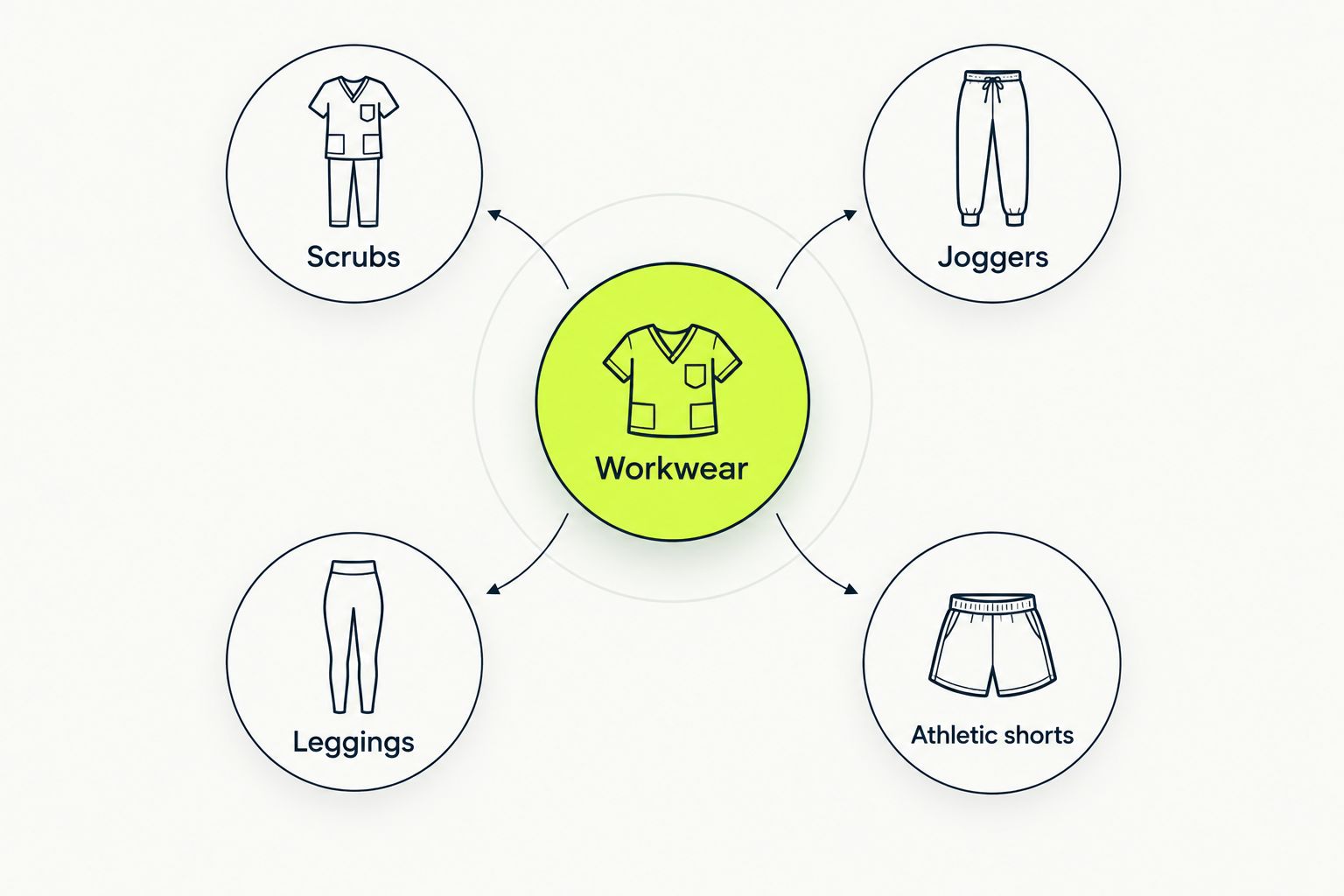
| Option | Best for | Main advantage | Key limitation |
|---|---|---|---|
| Required scrubs or employer uniform | Therapists working under a specified uniform policy | Meets the required clothing category when selected correctly | You still need to assess sizing and freedom of movement |
| Joggers with a full-length top | Clinics allowing a less body-contouring athletic outfit | Offers an alternative to close-fitting leggings | Waistbands, pockets, and cuffs need individual testing |
| Leggings with an approved top | Clinics explicitly permitting fitted athletic bottoms | Close-fitting legs avoid excess fabric around the knees | Coverage and waistband stability require careful checking |
| Athletic shorts with an approved top | Settings that explicitly permit shorts | Leaves less fabric around the knees | Coverage changes while sitting, kneeling, and bending |
| TLF Apparel activewear | Therapists also shopping for training and everyday use | Includes training and lifestyle clothing categories | It does not establish clinical suitability or workplace approval |
The table is a decision aid, not a dress-code shortcut. Choose the permitted clothing category first, then compare individual garments within it.
Common mistakes physical therapists make
Buying for demonstrations but ignoring patient care
An outfit can suit your own exercise session and still fail during hands-on work. Test leaning, sitting, and kneeling as well as exercise movements, and check clothing against every task you expect to perform.
Treating stretch as proof of suitability
Stretch does not confirm coverage, comfortable seams, or secure pockets. Assess the whole garment, including its neckline, waistband, hem, and behavior with your usual underlayers.
Choosing gym styling before checking policy
A fitted set, cropped layer, or oversized top is a style choice, not evidence of professional suitability. Keep pieces that fail your clinic's rules for personal training rather than trying to make them work during patient care.
Carrying too much in athletic pockets
A phone, keys, and other personal items change how pants feel when you sit or kneel. Test a realistic pocket load, then remove anything that interferes with the tasks your work requires.
Assuming a familiar outfit still fits correctly
Do not rely on how a garment fitted when you first bought it. Recheck coverage and movement after laundering or whenever you notice slipping, pulling, worn seams, or fabric changes.
FAQ
What's the best activewear for physical therapists?
The best activewear for physical therapists meets workplace rules and stays comfortable and covered during their actual duties. Start with the approved clothing category, then test fit through squatting, kneeling, sitting, bending, and reaching.
Can physical therapists wear leggings to work?
Physical therapists can wear leggings only where their workplace permits them. Check coverage while bending, waistband comfort while sitting, and whether your top meets the clinic's dress requirements.
Are joggers better than leggings for a physical therapy clinic?
Joggers are the better starting point when you want a less body-contouring silhouette and your workplace permits athletic pants. Leggings remain an option where approved, but neither category guarantees suitable fit or coverage.
Is TLF Apparel suitable for physical therapists?
TLF Apparel offers training and lifestyle clothing that physical therapists can assess for workplaces permitting athletic attire. Individual garments still need workplace approval and personal fit checks; they do not replace required uniforms or protective equipment.
Can I wear a sports bra as my clinic top?
Wear a sports bra as a standalone clinic top only if your workplace explicitly allows it. Otherwise, use it as an underlayer beneath an approved shirt and check coverage during reaching and bending.
How many work outfits should a physical therapist own?
Choose your work-outfit count around your schedule, laundry routine, and workplace replacement requirements. A primary outfit, an alternative, and a spare provide a practical planning framework rather than a fixed requirement.
Can I wear the same clothes at the clinic and the gym?
Do not assume clinic clothing is appropriate for reuse at the gym without changing. Follow your workplace's hygiene and laundering requirements, and plan separate clean clothing when those requirements call for it.
Do physical therapists need compression activewear?
Compression activewear is not a default requirement for a physical therapist's work outfit. Choose clothing for permitted style, comfortable movement, and coverage rather than assuming a tighter garment is better for clinical duties.
One last thing
Test the outfit with loaded pockets, not empty ones. The same pants can feel different once you add the items you carry, and a standing mirror check will not show what happens when you sit or kneel.
Before your next 2026 wardrobe purchase, test one complete outfit from your own closet. Write down the specific failure—slipping waistband, short hem, restrictive shoulder, or awkward pocket—then shop to fix that problem rather than buying another outfit with the same limitation.


