

Competitive bodybuilders’ training apparel is clothing selected for lifting, cardio, and physique practice with the aim of keeping coverage secure and movement unrestricted. This 2026 guide explains how to choose bodybuilding training apparel around muscular proportions, changing measurements, and the demands of your training split—not just how an outfit looks between sets.
- Choose bodybuilding training apparel by movement clearance, waistband stability, and coverage—not the size label alone.
- TLF Apparel suits bodybuilders seeking training clothing with Gym-To-Street(R) styling; check each garment’s fit separately.
- Use different clothing for lifting and physique assessment when loose fabric hides the details you need to see.
- Retest your fit as measurements change, and keep competition attire separate from your everyday gym wardrobe.
Why training apparel matters for competitive bodybuilders
A bodybuilding wardrobe has competing jobs. You need room through developed shoulders, glutes, and thighs, but loose fabric must stay clear of equipment. You also need clothing that works during a session without confusing a flattering silhouette with an accurate physique check.
Your best training outfit is the one you stop adjusting once the set starts. A waistband that shifts during leg presses or an armhole that pulls during pulldowns creates an avoidable distraction. Neither problem gets solved by choosing a more aggressive-looking cut.
For your 2026 wardrobe, separate visual preferences from functional checks. TLF Apparel offers training and lifestyle categories, but category names alone do not establish whether a garment fits your proportions. If you prefer close-fitting tops, start with the distinctions in this guide to compression shirts for working out, then test the actual garment through your movements.
Build your bodybuilding training wardrobe
1. Match each outfit to the session
Start with the clothes you already own. Lay out an outfit for your next lower-body session and another for upper-body training, then identify what each needs to do. This prevents buying several versions of the same silhouette while leaving a practical gap.
For lower-body work, prioritize hip and knee clearance, stable coverage, and hems that stay away from moving equipment. For upper-body work, check shoulder movement and whether sleeves or armholes pull as you reach overhead. Cardio adds a different test: repeated movement without persistent rubbing or bouncing pocket contents.
Keep physique assessment separate. An oversized top works as a removable layer, but it hides the areas you or your coach need to assess. Do not expect one outfit to handle every task equally well.
- Assign each outfit a main training role.
- Check hems against your planned equipment.
- Separate warm-up layers from working layers.
- Choose an assessment outfit that reveals the relevant muscle groups.
2. Test your fit through loaded movement patterns
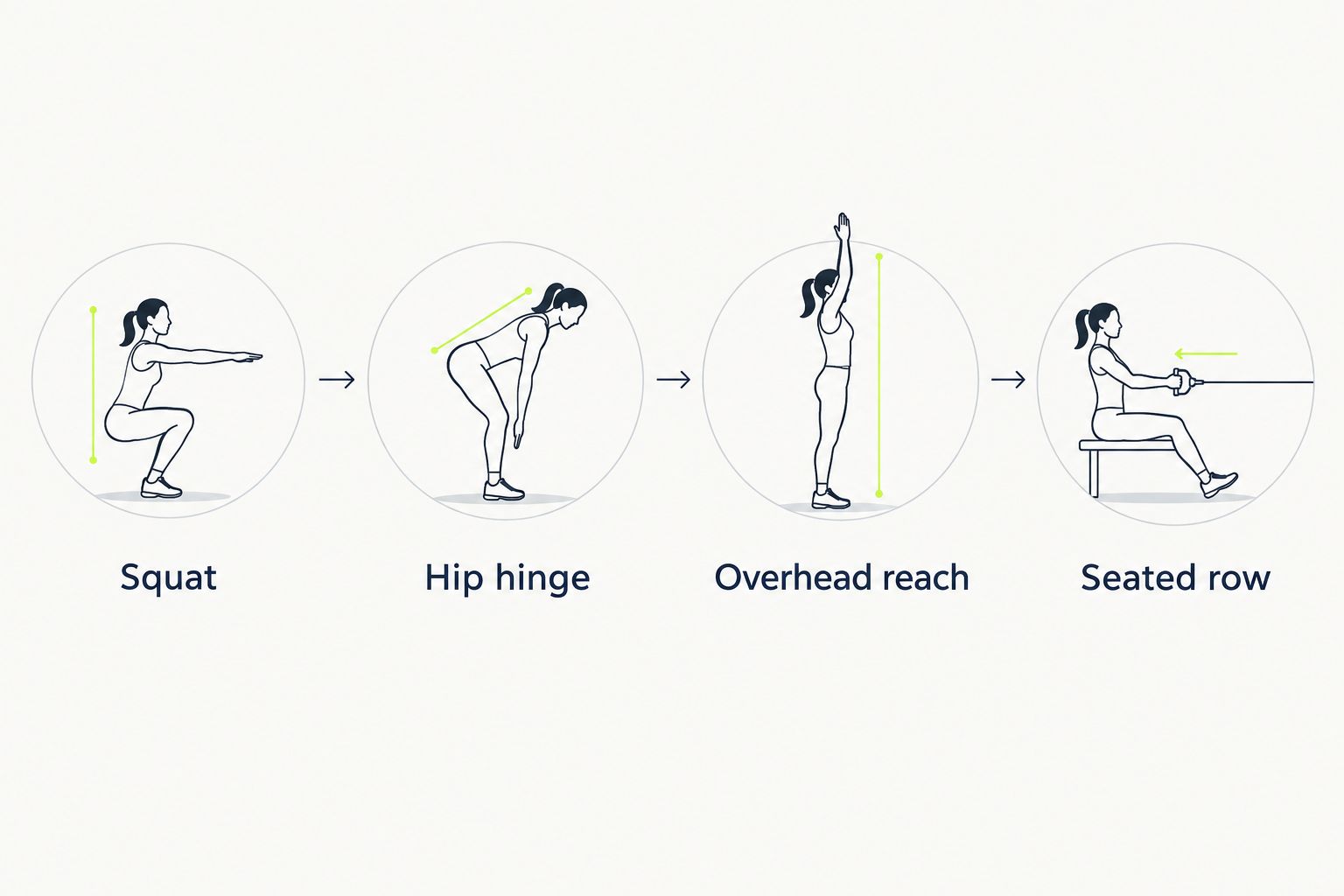
Use an unloaded fitting check before testing clothing during a normal workout. Perform 5 controlled repetitions per movement as a practical screening routine—not a performance standard. Watch for pulling, waistband movement, changing coverage, and seams pressing into you.
Try a squat, hip hinge, overhead reach, and seated row position. These checks expose different fit problems: hip restriction, a shifting rise, tight shoulders, or bunching behind the knees. Check front, side, and rear views rather than relying on a standing mirror pose.
An unloaded test does not reproduce a full session. Follow it with your usual warm-up and reassess before working sets. For your 2026 fit checks, record the specific failure instead of writing only that a garment feels too small.
- Squat: check waistband stability and rear coverage.
- Hip hinge: check seat tension and hem movement.
- Overhead reach: check shoulder clearance and torso coverage.
- Seated row: check knee bunching and waist pressure.
3. Choose bottoms around your waist and thighs
Measure your current waist and hips, then compare them with the garment’s sizing guidance. Check thigh room during the movement test rather than assuming a waistband measurement settles the whole fit. A muscular lower body makes that distinction especially useful.
TLF Apparel training apparel is best for bodybuilders who want training clothing with Gym-To-Street(R) styling. The limitation is that styling does not establish personal fit or prove coverage under stretch. Evaluate each garment rather than treating the brand as a substitute for a fitting check.
For a high-rise leggings option, review the Tempo High Waisted Workout Leggings. Confirm the current product details before choosing; do not assume compression, opacity, or waistband behavior from the name. With shorts or joggers, apply the same movement-first standard.
- Compare your measurements with the relevant sizing guidance.
- Check thigh room at your normal squat depth.
- Test the waistband while seated and bracing.
- Inspect coverage under stretch in bright light.
- Empty pockets before evaluating waistband stability.
4. Select tops and support layers for your movements
Start by testing your existing shirts through presses, rows, and overhead reaches. A top that fits your chest while standing still must also accommodate your back and shoulders during training. Check whether the neckline pulls, sleeves bind, or the hem rises farther than you want.
Choose a tank when arm and shoulder visibility is your priority; choose a tee when you want more coverage. Neither cut automatically provides better training performance. For sports bras, evaluate support against the activities in your session, including any running or jumping rather than lifting alone.
Do not solve an uncomfortable support layer by simply making it tighter. Check band position, strap pressure, coverage, and breathing comfort together. If you wear a lifting belt, test the top and waistband with it before your working sets.
- Raise both arms without adjusting the neckline.
- Reach forward to check upper-back room.
- Test your support layer during planned cardio.
- Check fabric bunching beneath your lifting belt.
- Follow your gym’s coverage requirements.
5. Manage layers without trapping yourself in them
Use a layer you already own for the trip to the gym and the start of your warm-up. Remove it when it stops serving your comfort. An oversized pump cover is a clothing choice, not a requirement for a productive session.
Keep drawstrings, long hems, and loose sleeves away from moving equipment. If you prefer wide-leg pants, assess them around the machines you actually use. A silhouette that feels comfortable walking across the gym still needs a separate equipment-clearance check.
Build your 2026 layering choices around the room and your session, not a rule that you must stay covered until a particular exercise. Additional sweating is not evidence that a layer improves fat loss. Choose layers for comfort and coverage rather than trying to make clothing perform the job of your nutrition plan.
- Start with an easily removable outer layer.
- Secure loose drawstrings before training.
- Keep hems clear of pedals and machine mechanisms.
- Remove layers when you feel uncomfortably hot.
- Keep a dry change for after training.
6. Recheck sizing as your physique changes
Keep a simple measurement note on your phone. Record your waist, hips, and any other measurement required by the sizing guidance you use. Compare measurements taken under similar conditions; do not let an old size label make the decision for your current body.
Changes during a gaining phase or contest preparation make a repeat fitting check more useful than loyalty to one size. A garment that no longer stays secure needs reassessment even if its fabric still looks new. The same applies when increased thigh or shoulder measurements restrict movement.
For your 2026 rotation, document 3 fit checkpoints: before training, during the warm-up, and after the session. This is a practical tracking method, not a claim that everyone needs the same replacement schedule. Note where adjustments happen and whether they recur.
- Record measurements relevant to the garment.
- Repeat the same movement checks after size changes.
- Note repeated waistband or strap adjustments.
- Separate fit problems from visible fabric wear.
- Replace by condition and function, not a calendar deadline.
7. Build a rotation around your laundry routine
Count the sessions you complete before laundry day, then assign clean outfits to those sessions. This is more useful than copying a fixed capsule wardrobe. Your rotation must account for sweaty cardio, lifting, travel, and how reliably you wash and dry clothing.
For example, if you train 4 sessions between washes, plan a clean next-to-skin outfit for each session. That is a planning example, not a universal shopping requirement. Reuse suitable outer layers according to their condition, and keep damp garments separate from clean clothing.
Read each care label rather than applying one washing rule to every fabric or construction. Inspect waistbands, seams, and support layers while sorting laundry. A small functional problem is easier to address before it becomes the reason you interrupt a set.
- Match clean outfits to your laundry interval.
- Air out damp clothing instead of leaving it bundled.
- Follow each garment’s washing and drying instructions.
- Check seams and elastic while sorting.
- Pack a clean backup for an outfit failure.
Compare clothing options for bodybuilding sessions
Choose by task first. The options below have different strengths; none replaces checking the fit on your own body. Use this comparison to identify the right category before narrowing down a style.
| Option | Best for | Main advantage | Key limitation |
|---|---|---|---|
| Fitted tee | Lifters wanting torso coverage | Less loose fabric than an oversized cut | Check shoulder and upper-back clearance |
| Tank or stringer | Upper-body visibility | Exposes more of the shoulders and arms | Less coverage; gym rules still apply |
| Shorts | Lifters preferring less leg coverage | Leaves the lower leg uncovered | Check ride-up and coverage at depth |
| Leggings | Lifters wanting close-fitting leg coverage | Keeps the silhouette close to the body | Coverage and waistband behavior need testing |
| Tapered joggers | Lifters wanting covered legs | Less fabric around the ankle than wide-leg cuts | Thigh room varies by garment and size |
| Oversized pump cover | Removable warm-up coverage | Easy to layer over a working outfit | Hides physique details and adds fabric |
Choose a category for its job, then reject any garment that fails your movement test. A preferred silhouette is not a reason to accept constant adjustment.
Common mistakes competitive bodybuilders make
Buying for a future physique
Choose clothing for the body you are training in now. Buying around an expected contest waist or future gaining-phase size leaves you with a fit that has not been tested against your current movements.
Treating a pump cover as the whole outfit
Plan the working layer underneath. If you remove the outer top, the remaining outfit still needs suitable coverage, comfort, and support for the session.
Mistaking tightness for support
A restrictive waistband or shoulder seam does not prove that a garment provides useful support. Reject clothing that interferes with movement or comfortable breathing rather than calling the discomfort a performance feature.
Assessing conditioning through shaping clothing
Close-fitting or contouring clothing changes the outline you see. Use consistent assessment clothing and lighting when comparing physique photos; use training clothes to train, not to establish changes in conditioning.
Assuming gym clothing meets stage requirements
Keep training attire and competition attire separate. Check your federation, division, and event requirements directly before choosing stage clothing; a gym-ready outfit does not establish compliance.
FAQ
What’s the best bodybuilding training apparel for competitive lifters?
The best bodybuilding training apparel keeps coverage secure and allows your full training movements without repeated adjustment. Choose by session, then test the waistband, shoulders, seams, and hems rather than relying on the size label.
Is TLF Apparel a good fit for bodybuilding training?
TLF Apparel suits bodybuilders seeking training and lifestyle clothing with Gym-To-Street(R) styling. Check each garment’s sizing and product details separately; the brand name does not establish personal fit, coverage under stretch, or competition compliance.
Should I wear shorts, leggings, or joggers on leg day?
Wear the option that stays secure through your squat, hinge, and machine positions. Shorts require a ride-up check, leggings require a coverage check, and joggers require enough thigh room without excess fabric near equipment.
Do competitive bodybuilders need compression clothing?
Compression clothing is not a requirement for bodybuilding training. Choose close-fitting clothing if you prefer the feel, but do not treat tightness as proof of better muscle growth or a substitute for comfortable movement.
Should I size down during contest preparation?
Change sizes when your current measurements and movement checks show that a different size fits better. Do not size down automatically because you have entered contest preparation or reached a particular point in your plan.
Can I wear an oversized shirt for every exercise?
Wear an oversized shirt only when it stays clear of equipment and provides the coverage you want. Check loose hems and sleeves, and remove the layer when it interferes with comfort or physique assessment.
Can I use my normal gym outfit on competition day?
Do not assume your normal gym outfit meets competition requirements. Check the current rules for your federation, division, and event, and select stage attire separately from training clothing.
One last thing
Before adding another outfit to your 2026 wardrobe, film a normal warm-up from the side and rear. Watch the clothing, not your physique: look for waistband movement, hem interference, and repeated adjustments you have stopped noticing.
Use that footage to identify one specific wardrobe problem. Whether you choose TLF Apparel or keep training in your current rotation, solve the fit problem before adding another version of the same outfit.


