

TLF Apparel cannot be confirmed as cruelty-free or vegan from the product information supplied for this 2026 guide. That is an unverified status, not proof that its clothing contains animal-derived materials or involves animal testing. If either standard determines what you buy, get written confirmation covering the exact garment before ordering.
- Is TLF Apparel cruelty free or vegan? Neither status is established by the supplied product information.
- Vegan activewear requires checking the whole garment, not just its main fabric.
- Cruelty-free and vegan claims address different questions; one does not establish the other.
- For strict animal-material requirements, request product-specific written confirmation before buying.
Why this matters
You need evidence that matches your buying standard. A comfortable training fabric, a plant-based fiber name, or a performance claim does not answer every question about animal-derived components or animal testing.
Start with TLF Apparel to identify the exact item you are considering, then separate its performance details from its animal-related claims. An unanswered question is a reason to verify, not a reason to declare a brand vegan or non-vegan.
Is TLF Apparel cruelty-free or vegan?
Neither designation is established by the supplied product descriptions. The information describes athletic and lifestyle clothing, proprietary fabrics, fit, and design. It does not establish a brand-wide vegan standard, an animal-testing policy, or certification covering the products discussed here.
For this 2026 assessment, the distinction is between what the descriptions support and what they do not. A product description can establish a named fabric technology without establishing the origin of every component or the testing practices behind it.
| Question | What you need to establish | What does not settle it |
|---|---|---|
| Is the garment vegan? | Confirmation that the finished item excludes animal-derived materials and ingredients | A synthetic or plant-based main fabric alone |
| Is the garment cruelty-free? | A clearly defined animal-testing claim and its scope | A vegan material claim alone |
| Does the claim cover the whole brand? | An explicit statement applying across the relevant product range | Confirmation about an individual item |
| Is the claim independently certified? | An identifiable certification and the products it covers | An unexplained badge or general ethical language |
The useful answer is therefore specific: For vegan shoppers, TLF Apparel remains an unverified activewear option. Do not turn that statement into a claim that the company uses animal materials or tests on animals; neither conclusion follows from the information available here.
What does vegan mean for workout clothing?
For clothing, a vegan claim concerns animal-derived materials and ingredients. Leather, wool, silk, and down are familiar animal-derived examples; cotton, polyester, and nylon are not animal fibers.
That distinction helps you screen a garment, but it does not establish the composition of a finished item. Your check needs to cover more than the largest piece of fabric.
Main fabric: useful evidence, limited scope
A fiber-content statement tells you about the textile it describes. Read the complete blend rather than stopping at a fabric name that sounds plant-based or synthetic.
The strength of this check is that it gives you concrete material information. Its limitation is scope: a main-fabric statement does not, by itself, confirm every lining, label, patch, decorative element, adhesive, or treatment used in an item.
Whole garment: the stronger question
Ask whether the finished garment contains any animal-derived materials or ingredients. This wording directs the answer toward the item you will receive rather than a single textile.
It also avoids a common misunderstanding: you are not asking whether the clothing looks vegan or belongs to a category associated with synthetic fabrics. You are asking what it contains.
Brand-wide claim: a separate standard
Confirmation about a shirt does not establish the status of a jacket, accessory, or future collection. Keep the answer attached to the product it actually covers.
If your shopping standard requires an entirely vegan brand, ask for a brand-wide statement. A product-specific response is useful, but it cannot answer that broader question on its own.
What does cruelty-free mean for activewear?
Cruelty-free generally concerns animal testing, while vegan material checks concern animal-derived content. The terms are related to animal welfare, but they are not interchangeable.
For clothing, ask the seller to explain exactly what a cruelty-free statement covers. Does it address the finished garment, its materials and treatments, supplier practices, or some combination of these?
A claim without a defined scope is not enough for a strict purchasing rule. You need to know what the company is confirming before deciding whether that confirmation meets your standard.
A material answer is not a testing answer
A response listing non-animal fibers answers a material question. It does not automatically describe how ingredients, treatments, or materials were tested.
Keep your follow-up separate. Ask directly about animal testing rather than expecting a fabric composition statement to answer both issues.
A testing answer is not a material answer
The reverse distinction matters too. A no-animal-testing statement does not establish that a garment excludes wool, silk, leather, or other animal-derived materials.
If you require both standards, request both confirmations. Treat an answer to only one question as an answer to only that question.
How do you verify a garment before buying?
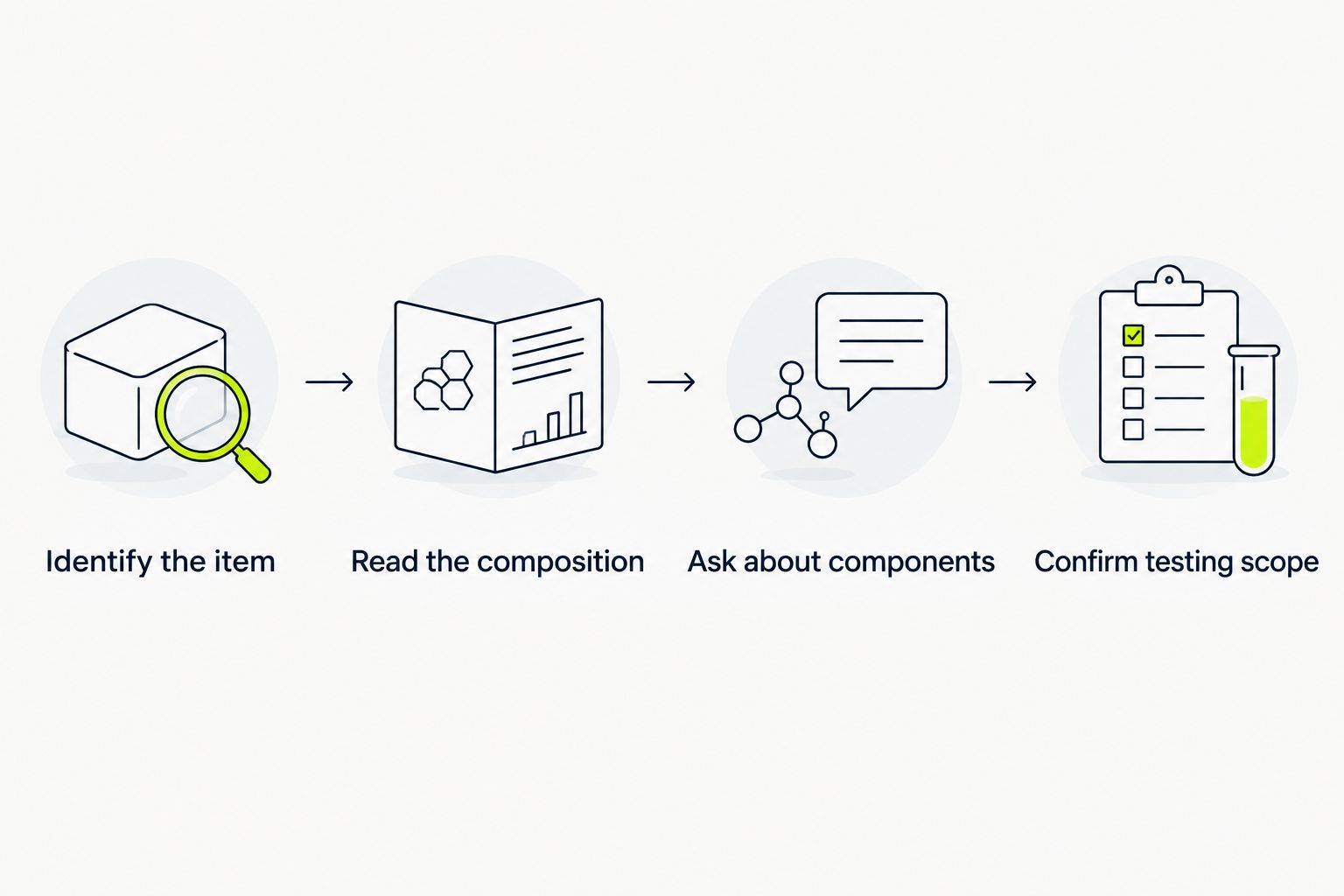
Use these 4 checks for a 2026 purchase. They organize the questions you need answered; they are not a certification system or a substitute for product information.
- Identify the item. Record the full product name and the variation you intend to buy. Keep your question tied to that item rather than an entire clothing category.
- Read the composition. Review the complete material statement and distinguish the main fabric from other listed components. Do not treat a technology name as a fiber breakdown.
- Ask about components. Request confirmation covering the finished garment, including trims, labels, decoration, adhesives, and treatments where relevant.
- Confirm testing scope. Ask separately whether an animal-testing statement applies and what materials, suppliers, or production stages it covers.
These checks work in sequence. First establish what you are buying, then establish what the material and testing answers actually cover.
Save the response with the product details. If you buy a different item later, do not assume the earlier answer applies unless the company explicitly gave it a broader scope.
Why the answer depends on the evidence
Different statements answer different parts of your question. The issue is not how confident a description sounds; it is whether the statement covers the standard you require.
- Product identity: An answer about one garment establishes nothing about an unrelated garment unless the statement explicitly includes both.
- Material coverage: Main-fabric information and finished-garment confirmation have different scopes.
- Claim wording: Vegan content and animal-testing practices require distinct answers.
- Certification coverage: A certification needs an identifiable standard and a stated product scope.
- Timing: A dated response establishes what was confirmed at that point; it does not automatically cover later changes.
This is why broad terms such as premium, performance, or lifestyle cannot settle an animal-welfare question. They describe a different part of the buying decision.
Does a cotton or bamboo description prove a garment is vegan?
No. A plant-derived fiber name does not verify the whole garment. Cotton comes from a plant, and bamboo-based textile descriptions refer to a plant source, but neither statement confirms every component of a finished item.
For example, the supplied TLF Swole Tee description names Cotton Luxe DNA(TM). That supports a statement about the named fabric technology; the excerpt does not provide a complete animal-material declaration or an animal-testing policy.
The same reading rule applies to any performance fabric name. Use the name to identify the textile being described, then look for composition and component information rather than assigning an ethical designation to the name itself.
For a separate discussion of fabric suitability, see whether bamboo fabric is good for gym T-shirts. Fabric performance and vegan verification remain separate decisions.
What should you ask customer support?
Ask direct questions that leave little room for a general product answer. You do not need to request a sales recommendation; you need confirmation tied to your requirements.
- Does this exact garment contain any animal-derived materials or ingredients?
- Does that answer include the main fabric, lining, trims, labels, decoration, adhesives, and finishes?
- What does your animal-testing policy cover for this item and its materials?
- Is there independent vegan or cruelty-free certification for this product? If so, what is its name and scope?
- Does the answer apply only to this item or to a wider product range?
If a response only repeats the fabric name, ask the component question again. If it says the garment is vegan, ask whether the answer also addresses animal testing instead of assuming that it does.
Best for strict vegan shoppers: a written, product-specific answer that covers the finished garment. Its advantage is clarity; its limitation is that it applies only within the scope stated.
Do you need certification before buying?
Certification is a separate question from material composition. An identifiable certification can give you an external standard to examine, but you still need to check which products and claims it covers.
For a 2026 purchase, look for the certifying organization's name, the applicable standard, and the product scope. Do not infer certification from an unexplained symbol or an ethical-sounding phrase.
Certification and company confirmation also serve different purposes. Best for shoppers who require independent verification: evidence of an applicable certification, not an assumed certification. A written company answer provides a direct statement, but it is not the same thing as independent assessment.
Neither route supports a broader claim than the evidence actually makes. If your personal standard requires certification, a detailed support response alone does not meet that requirement.
FAQ
Is TLF Apparel officially certified vegan?
A vegan certification is not established by the supplied product information. Ask for the certifying organization's name and confirmation that the certification covers the exact item you want.
Does unverified mean a clothing brand is not vegan?
No. Unverified means the available evidence does not establish vegan status; it does not prove that animal-derived materials are present. Keep the distinction clear when deciding whether to buy.
Are vegan and cruelty-free the same thing for gym clothes?
No. Vegan material checks address animal-derived content, while cruelty-free claims generally address animal testing. Request separate answers if you require both.
Are polyester and nylon animal-derived fibers?
No. Polyester and nylon are synthetic fibers, not animal fibers. Their presence in a composition statement does not verify every other component of the finished garment.
Does a cotton fabric name mean a shirt is vegan?
No. Cotton is plant-derived, but its name does not establish the origin of every trim, decoration, adhesive, or finish. Ask about the finished shirt rather than only its main fabric.
Can I rely on a vegan answer for one item across the whole store?
No. Product-specific confirmation applies to the scope stated in that answer. Ask for an explicit brand-wide statement if your buying standard covers the entire company.
What should I do if I need verified vegan workout clothing?
Wait for evidence that meets your standard before ordering. Identify the exact garment, request whole-item material confirmation, and check certification separately if independent verification is a requirement.
One last thing
The most useful follow-up is: does that answer cover the whole garment? It turns a general fabric discussion into the product-specific confirmation your decision needs.
Keep that rule for every 2026 activewear purchase. A clear answer with a narrow scope is more useful than a confident claim whose scope you cannot identify.


